Eugene O'Neill Theatre
230 West 49th Street | Times Square | built 1925
Open on the map17 entries

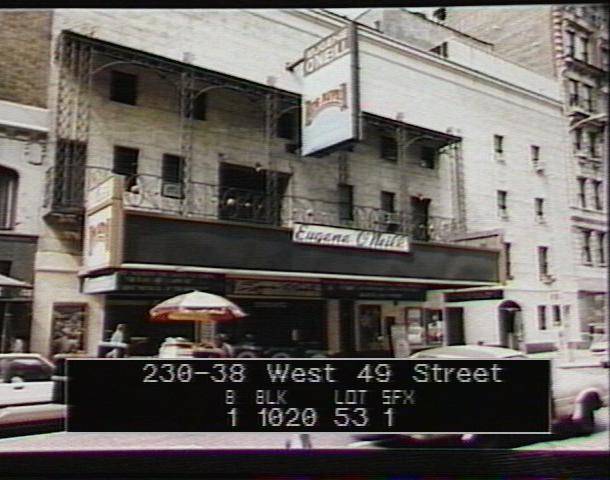
The city photographed every building for its tax records around 1940 and again in the 1980s. NYC Municipal Archives.
Written with AI from the source each entry cites, then fact-checked.
- 1925
Krapp builds the Forrest around a steel skeleton and an electric scenery system
Architect Herbert J. Krapp gave the Forrest a structural steel frame, a method that had previously been reserved for skyscrapers and large apartment buildings. He also installed a stage curtain made as a sandwich of asbestos and steel, plus a system that moved scenery by electricity. The auditorium itself was done in the Adamesque manner that Krapp used in most of his Shubert and Chanin theaters.
- 1925
The Forrest Theatre opens on West 49th Street as part of a theater and hotel complex
The Shubert brothers sold eight row houses on West 49th Street for $2 million in November 1924 to Daniel Darrow, who planned a theater and a 15-story hotel, and leased the theater back for 21 years. The Forrest Theatre opened on November 24, 1925, with the musical Mayflowers, which closed after 81 performances. Herbert Krapp designed it, and the Shuberts used it as part of a group of theaters near 48th and 49th Streets.
Source: Wikipedia
- 1927
James Cagney acts in Women Go on Forever at the Forrest
The Forrest opened in 1925 with a run of weak musicals and forgettable dramas. One of the few happy exceptions was Women Go on Forever in 1927, with Mary Boland, Osgood Perkins and James Cagney. The show played 117 performances.
“Women Go On Forever which played 117 performances in 1927 and featured exceptional performances by Mary Boland, James Cagney, and Osgood Perkins…”
- 1930
Edgar Wallace's On the Spot, with Anna May Wong, runs 167 performances at the Forrest
The English mystery drama On the Spot, starring Crane Wilbur and Anna May Wong, played 167 performances at the Forrest in 1930 and 1931. The run lasted long enough that the playhouse was briefly known as Edgar Wallace's Forrest Theater, after the author.
“Edgar Wallace's "tender English mystery drama" On The Spot with Crane Wilbur and Anna May Wong, which played 167 performances in 1930-31…”
- 1934
The Forrest and its hotel are auctioned in 1934 after a bar-door gimmick fails to save them
Through the early 1930s the Forrest stayed solvent partly because a doorway at the back of its orchestra led into the neighboring Forrest Hotel's bar, a convenience no other Broadway house offered. Variety quipped that the show was a flop but the bar was a hit. Even so, Lawyers Title and Guaranty moved to foreclose on a $960,000 mortgage on the theater and hotel in January 1933, and sold them to that company at auction in August 1934.
“…the Forrest Theatre initially remained solvent because it had a doorway at the rear of its orchestra, which led to the Forrest Hotel's bar…”
Source: Wikipedia
- 1934
Tobacco Road moves to the Forrest and becomes Broadway's longest-running production
Tobacco Road moved to the Forrest in September 1934, having opened the previous December at the Masque. It ran continuously there for five years and held the record by 1939 as the longest-running production Broadway had seen. When it closed in May 1941, it had played about 3,180 performances. The Forrest had been propped up in the early 1930s by a rear door to the Forrest Hotel bar, the only direct bar access of any Broadway theater.
Source: Wikipedia
- 1944
The unbooked Forrest becomes a radio studio for the Mutual Broadcasting Company
After Tobacco Road ended its long run, the theater was leased to the Shuberts, who struggled to book it and saw a string of flops. In 1944 the Mutual Broadcasting Company took it on a six-month lease and used it as a radio studio. Louis Lotito of City Playhouse Theaters then took over the house in 1945.
“Unfortunately they had no luck in booking the house and after a series of flops leased it to the Mutual Broadcasting Company for six months in 1944.”
- 1945
Louis Lotito renames the Forrest the Coronet to shed its jinx-house reputation
Louis Lotito, president of City Playhouse Theaters, bought the Forrest in 1945 and renamed it the Coronet, hoping to erase its long reputation as a jinx house. He spent almost as much on remodeling as the roughly $265,000 purchase price: new seats, rebuilt dressing rooms, a freon cooling system, and an auditorium repainted in light blue and gray. The facade was restyled to resemble a New Orleans house, with shutters, bright paint and an iron balcony.
- 1947
Arthur Miller's All My Sons, his first hit, comes to the Coronet
In January 1947 the Coronet staged Arthur Miller's All My Sons, with a cast led by Arthur Kennedy, Ed Begley and Karl Malden. It was Miller's first hit, a drama of war profiteering and family conflict, and it later took the New Drama Critics Circle prize for 1946-47.
“In January 1947 Arthur Kennedy, Ed Begley and Karl Malden starred in Arthur Miller's All My Sons. His first hit…”
- 1959
The Coronet is renamed for Eugene O'Neill, the first Broadway house named for a playwright
Investor Lester Osterman agreed in May 1959 to buy the theater, then called the Coronet, and planned to rename it for his favorite playwright, Eugene O'Neill. It became the first Broadway house to carry a playwright's name. O'Neill's widow, Carlotta Monterey, initially objected on the ground that her husband would not have wanted a commercial venue named for him, but she gave way. Osterman repainted the house and ordered a portrait of the playwright etched in glass.
Source: Wikipedia
- 1967
Playwright Neil Simon takes full ownership and stages his own hits at the theater
Neil Simon co-owned the theater with David Cogan and in 1967 bought Cogan's half to take full ownership. He kept the O'Neill name but put on a run of his own comedies there, among them Last of the Red Hot Lovers (1969), The Prisoner of Second Avenue (1971), The Good Doctor (1973) and California Suite (1976). His wife, Marsha Mason, helped manage the building. Jujamcyn acquired it from Simon in 1982.
Source: Wikipedia
- 1971
Neil Simon's The Prisoner of Second Avenue brings Tonys for Mike Nichols and Vincent Gardenia
Neil Simon, who owned the theater, followed The Last of the Red Hot Lovers, which ran 706 performances from 1969, with an even more popular comedy, The Prisoner of Second Avenue, in 1971. Its director Mike Nichols and its co-star Vincent Gardenia both won Tony Awards. Before Simon sold the house in 1982 he presented hits there almost every year.
“He followed this in 1971 with the even more popular The Prisoner of Second Avenue. Tony Awards were given to its director Mike Nichols and co-star Vincent Gardenia.”
- 1983
Moose Murders opens and closes on the same day, and stays notorious for decades
Jujamcyn's first year running the O'Neill brought no hits, and in February 1983 the play Moose Murders opened and closed on the same day, February 22. It stayed notorious for decades afterward. A moderate success came later in 1983, a revival of The Glass Menagerie by Tennessee Williams, and a real hit followed in Big River, which opened in 1985 and ran for 1,005 performances.
Source: Wikipedia
- 1987
The Landmarks Commission designates the theater's interior
On December 8, 1987, the Landmarks Preservation Commission designated the interior of the Eugene O'Neill Theater, covering the auditorium, stage, staircases and balcony, as a city landmark. Hearings in 1982 had drawn 83 witnesses in favor and two against, and the owner told the commission he had not formed an opinion. The designation covers the interior spaces rather than the facade.
“Eighty-three witnesses spoke in favor of designation. Two witnesses spoke in opposition to designation.”
- 1994
A $1 million interior renovation recreates the theater's plasterwork and decoration
In the 1990s Jujamcyn engaged Campagna & Russo Architects to carry out a $1 million interior renovation. Restoration architect Francesca Russo worked from historical photographs to devise plasterwork and decorations resembling the originals, and the auditorium received a purple-and-gold paint scheme. The Landmarks Preservation Commission gave the restoration an award in 1994.
“Restoration architect Francesca Russo used historical photos to design plasterwork and decorations that approximated the theater's original appearance.”
Source: Wikipedia
- 2011
The Book of Mormon opens at the Eugene O'Neill and sets the theater's box-office record
The musical The Book of Mormon opened at the Eugene O'Neill in March 2011 and recouped its production costs within nine months, outpacing the other new shows of that season. In the week ending January 4, 2015, it grossed $2,224,280 over nine performances, a record for the theater. It was still playing there when the building reopened on November 5, 2021, after the pandemic closure.
Source: Wikipedia
- 2021
The Book of Mormon reopens the theater after the pandemic shutdown
The theater went dark on March 12, 2020, because of the COVID-19 pandemic. The Book of Mormon brought it back to life on November 5, 2021. Also in 2021, operator Jujamcyn agreed, in a settlement with the Department of Justice, to upgrade accessibility for disabled visitors at its five Broadway houses, this one included.
“It reopened on November 5, 2021, with performances of The Book of Mormon.”
Source: Wikipedia
Further reading
- Eugene O'Neill TheatreWikipedia
Nearby
- Walter Kerr Theatre219 West 48th Street | 12 entries
- St. Malachy's Church, the Actors' Chapel239 West 49th Street | 9 entries
- Ambassador Theatre219 West 49th Street | 12 entries
- Longacre Theatre220 West 48th Street | 13 entries
- Engine 54, Ladder 4, Battalion 9782 8th Avenue | 2 entries
- Brill Building1619 Broadway | 14 entries