Ambassador Theatre
219 West 49th Street | also 215 West 49th Street | Times Square | built 1921
Open on the map12 entries

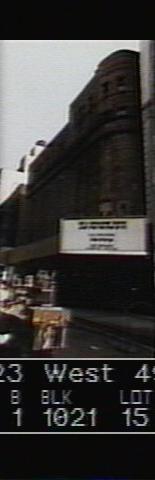
The city photographed every building for its tax records around 1940 and again in the 1980s. NYC Municipal Archives.
Written with AI from the source each entry cites, then fact-checked.
- 1921
The Shuberts open the Ambassador Theatre, built in 82 days on a diagonal plan
The Shubert brothers built the theater, designed by Herbert J. Krapp, in 82 days, then a record for theater construction. Opening night was February 11, 1921, and the show was the musical The Rose Girl. To fit the 100-by-100-foot lot, Krapp set the auditorium on a diagonal axis, which allowed about 1,300 seats where a conventional layout would have held 900. Its simple golden-brick facade has a curved entrance facing Broadway.
Source: Wikipedia
- 1921
The operetta Blossom Time becomes the Ambassador's first hit
The Ambassador's first true hit came later in 1921 with the operetta Blossom Time, which ran 516 performances. Operettas filled much of the theater's early years, including The Lady in Ermine in 1922 and Victor Herbert's The Dream Girl in 1924, but many did poorly. In 1935 Ayn Rand's Night of January 16th opened here and became another hit.
Source: Wikipedia
- 1930
The Last Mile moves in and helps send Spencer Tracy toward Hollywood
After the late 1920s the Ambassador mostly held brief engagements, revivals and shows transferred from other houses. One was The Last Mile, which arrived in 1930 and, according to the city's landmark report, sent Spencer Tracy on his way to Hollywood. Others who passed through included Claudette Colbert and Chester Morris in Fast Life, Jeanette MacDonald in Angela, and Max Reinhardt, who directed Redemption.
“…in 1930 The Last Mile sent Spencer Tracy en his way to Hollywood.”
- 1935
Ayn Rand's Night of January 16 seats twelve audience members as a nightly jury
The Ambassador's next big hit came in 1935 with Ayn Rand's courtroom melodrama Night of January 16, starring Walter Pidgeon. Twelve members of the audience were seated as the jury each night and decided the verdict. The play followed a string of short-lived runs and transfers at the Shubert-built house.
“…the mystery featured a "jury" of twelve members of the audience who nightly decided the verdict.”
- 1939
The Straw Hat Revue gives Danny Kaye his Broadway debut
In 1939 the Ambassador presented The Straw Hat Revue, which the Shubert Organization identifies as Danny Kaye's Broadway debut. The revue was one of only a few notable stage productions in a stretch when the house served mainly for radio broadcasts and film screenings, a period the Shuberts date from 1936 through 1945.
Source: shubert.nyc
- 1942
A burlesque revue costs the Ambassador its license as a legitimate theater
A burlesque revue called Wine, Women and Song began its run at the Ambassador in September 1942. About three months later it was shut down for violating rules against indecency, and under the La Guardia administration the theater lost its license for legitimate stage shows. The license was restored in August 1943, just before a final revival of Blossom Time that ran only 47 performances.
Source: Wikipedia
- 1950
DuMont Television Network turns the Ambassador into a broadcast studio
The theater spent part of the 1940s as a CBS radio studio, a movie house and a foreign-film venue. In August 1950 the DuMont Television Network signed a five-year lease and began converting it. Workers coated the wooden stage with a smooth magnesium chloride finish and built a partitioned control room. DuMont began telecasting from the Ambassador that September, and the Shuberts did not restore live theater until 1956.
Source: Wikipedia
- 1957
The Pulitzer-winning Diary of Anne Frank transfers to the Ambassador from the Cort
In February 1957 The Diary of Anne Frank moved to the Ambassador from the Cort Theater. The drama had taken the Pulitzer Prize, the Drama Critics Circle award and the Tony for best play of 1956. The transfer came months after the house returned to legitimate theater with The Loud Red Patrick, ending eleven years as a radio and television studio.
- 1985
The Landmarks Preservation Commission designates the Ambassador's interior
In August 1985 the city landmarks commission protected the exteriors of three theaters, the Ambassador, Neil Simon and Virginia, plus the interiors of the first two, over their owners' objections. When the Board of Estimate voted that December, it ratified the Ambassador's interior. It refused to ratify the facade, which had been designated only for cultural reasons, an unusual reversal.
Source: Wikipedia
- 1996
Bring in 'da Noise, Bring in 'da Funk moves to the Ambassador for nearly three years
After opening at the Public Theater in November 1995, the musical Bring in 'da Noise, Bring in 'da Funk, directed by George C. Wolfe and featuring Savion Glover, transferred to the Ambassador, opening there on April 25, 1996. It closed on January 10, 1999, after 1,135 performances. Glover had left the cast but returned for the final 40 performances, starting December 8, 1998.
Source: Wikipedia
- 2002
Suzan-Lori Parks's Topdog/Underdog opens at the Ambassador and wins the Pulitzer
Suzan-Lori Parks's play about two brothers named Lincoln and Booth opened at the Ambassador on April 7, 2002, after a run at the Public Theater in summer 2001. George C. Wolfe directed, and Mos Def replaced Don Cheadle in the Broadway cast. The play closed on August 11, 2002, and Parks received the 2002 Pulitzer Prize for Drama.
“The play opened on Broadway at the Ambassador Theatre on April 7, 2002, and closed on August 11, 2002.”
Source: Wikipedia
- 2003
The musical Chicago moves in and becomes Broadway's second-longest-running show
Chicago, already running for several years, transferred to the Ambassador in January 2003, following the play Topdog/Underdog. It has remained there ever since. In 2014 it became the second-longest-running production in Broadway history. The theater closed on March 12, 2020, because of the pandemic and reopened with Chicago on September 14, 2021.
Source: Wikipedia
Further reading
- Ambassador Theatre (Broadway)Wikipedia
Nearby
- Brill Building1619 Broadway | 14 entries
- The Theater Center1627 Broadway | 6 entries
- St. Malachy's Church, the Actors' Chapel239 West 49th Street | 9 entries
- Eugene O'Neill Theatre230 West 49th Street | 17 entries
- Walter Kerr Theatre219 West 48th Street | 12 entries
- Paramount Plaza1633 Broadway | 15 entries