Eastern Dispensary (Good Samaritan Dispensary)
232 Broome Street | also 75B Essex Street, 75A Essex Street, 75 Essex Street | Lower East Side | built 1920
Open on the map6 entries

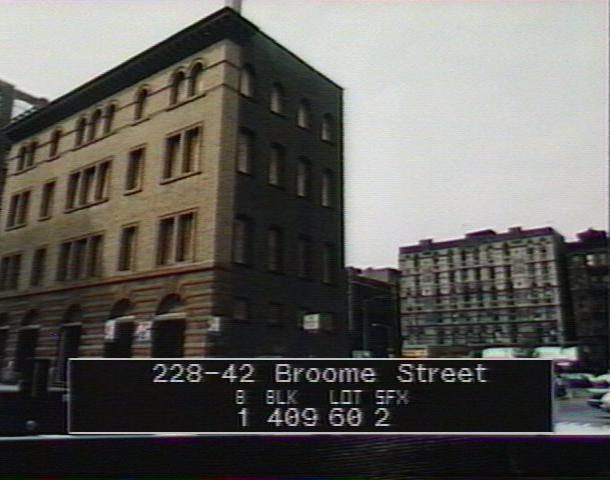
The city photographed every building for its tax records around 1940 and again in the 1980s. NYC Municipal Archives.
Written with AI from the source each entry cites, then fact-checked.
- 1891
The Eastern Dispensary opens its new Italian palazzo at Broome and Essex Streets
Rose & Stone designed a brick and brownstone Italian Renaissance building for the dispensary, with a rusticated base of alternating brick and stone and large arched openings. The cornerstone was laid on January 29, 1890, with 30 police officers holding back a crowd. It cost $133,000 and opened for public inspection on June 16, 1891, a refined presence among the surrounding tenements.
Source: Daytonian in Manhattan
- 1891
Dr. Henry Koplik sets aside a room for sterilized milk for poor children
Right after the Eastern Dispensary merged with the better-funded Good Samaritan Dispensary and took its name, Dr. Henry Koplik gave over a room to preparing sterilized milk for children of the poor neighborhood. Daytonian in Manhattan adds that he developed an early method of diagnosing measles here, now known as Koplik's spots.
Source: Daytonian in Manhattan
- 1892
Good Samaritan Dispensary reports 90,856 new patients, nearly half Russian-born
The dispensary's first annual report showed new patients up 24 percent, to 90,856, and prescriptions up 21 percent. Some 40,609 of the patients were born in Russia, while Austria-Hungary, Germany and Romania sent thousands more. Everyone but the very poorest paid ten cents, a fee the staff learned from the Eastern Dispensary so patients kept their independence.
Source: Daytonian in Manhattan
- 1915
A teenager holds up two clerks at the dispensary for a bit of morphine
Thomas Green, 17, walked into the Good Samaritan Dispensary early on April 28, 1915 and, with a revolver, held two clerks at bay. He made off with 1.5 ounces of morphine worth $5, which he then sold for $15. The New-York Tribune listed the holdup amid a rise in drug arrests, though such offenses at the dispensary were rare.
Source: Daytonian in Manhattan
- 1955
Good Samaritan Dispensary closes after its patient numbers collapse
A stronger economy during World War II and wider health insurance pulled patients away: new patients fell from 22,607 in 1940 to 4,326 in 1954. The New York Times reported on September 18, 1955 that the dispensary had outlived much of its usefulness, and it closed on September 30. Four years later the building became offices over ground-floor retail.
Source: Daytonian in Manhattan
- 2014
Landmarks Preservation Commission declines to protect the former dispensary
When the surrounding block was cleared in 2013 for the Essex Crossing development, preservationists tried to save the dispensary building. On March 27, 2014 the Landmarks Preservation Commission replied that the property lacked the significance to be considered and did not meet the criteria for designation. The owner then emptied the building and listed it for $30 million.
Source: Daytonian in Manhattan
Further reading
- The 1892 Eastern Dispensary -- No. 75 Essex StreetDaytonian in Manhattan
Nearby
- International Center of Photography82 Ludlow Street | 8 entries
- Essex Market125 Delancey Street | 4 entries
- Former Engine Company 17 firehouse91 Ludlow Street | 5 entries
- Beth Hamedrash Hagodol60 Norfolk Street | 12 entries
- Sun-Ray Yarn Building349 Grand Street | 5 entries
- Tenement Museum (97 Orchard Street)97 Orchard Street | 12 entries