Museum of Sex
233 5th Avenue | NoMad | built 1850
Open on the map9 entries

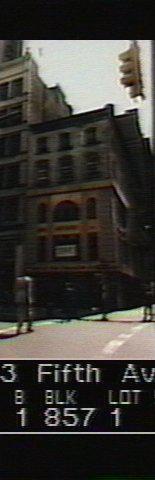
The city photographed every building for its tax records around 1940 and again in the 1980s. NYC Municipal Archives.
Written with AI from the source each entry cites, then fact-checked.
- 1861
Benjamin Halliday, a mail-stage magnate, lives in the Italianate mansion at this corner
By 1861 the house at 233 Fifth Avenue belonged to Benjamin Halliday, who had risen from stagecoach driver to a principal in a firm that carried mail to the West Coast. The four-story Italianate house stood at the corner of 27th Street, with a two-story brick stable behind. That January Halliday bought six Pacific Mail steamships, and he also kept a 755-acre country estate near Purchase, New York.
Source: Daytonian in Manhattan
- 1867
Benjamin Halliday returns to his Fifth Avenue mansion to find $2,000 in valuables missing
When the Halliday family left for their country estate, Ophir Farm, in the summer of 1867, mail-stage millionaire Benjamin Halliday left two servants, Thomas Stewart and Henry Wood, in charge of 233 Fifth Avenue. On his return in August he discovered that silverware, gold coin, greenbacks and jewelry worth about $2,000 were gone. He swore an oath that he suspected the two men, as the New York Times reported.
Source: Daytonian in Manhattan
- 1876
Halliday goes bankrupt and Amos Eno buys the house
Failed mining investments and lawsuits left Halliday bankrupt by 1876, and he lost the mansion that year. The buyer was Amos R. Eno, a real estate developer who had built the Fifth Avenue Hotel four blocks south in 1859. Eno's later years were hard. In 1884 his son, president of the Second National Bank, was found to have embezzled its funds and lost them in speculation, and Eno spent between three and four million dollars to pay depositors in full.
Source: Daytonian in Manhattan
- 1890
The Reform Club buys the house for $240,000 and converts it to a clubhouse
The Reform Club, incorporated in 1875 to promote economic and political reforms, bought the house from Eno in April 1890. The club added a cafe, a basement grill room and billiard hall, a reading room above Fifth Avenue, and a rear extension with a lecture hall and library. It hired Delmonico's chief chef to run its evening dinners. Membership was about 800 in the city and 650 outside it.
Source: Daytonian in Manhattan
- 1903
The Reform Club sells the building and it turns to business use
In February 1903 the club received two offers of $400,000 and accepted the one from the Coe estate, owner of the neighboring property. New owners remodeled the old mansion for commerce, adding show windows on Fifth Avenue and 27th Street. Tenants included an architect, a lawyer and a picture-frame maker, and after World War I apparel firms such as a children's dress maker and a corset dealer moved in.
Source: Daytonian in Manhattan
- 1986
The owner of Ely's Antiques is arrested after a warehouse theft
By the 1980s the building held Ely's Antiques, run by Nedjatollah Sakhai. On the night of January 5, 1986, Sakhai and two other men were arrested after they broke into a Queens warehouse and took Middle Eastern antiquities valued at more than $18 million. A Sotheby's antiquities director said the shop was a known name in the trade.
Source: Daytonian in Manhattan
- 2002
The Catholic League condemns the Museum of Sex before it opens
Before the museum opened, the Catholic League for Religious and Civil Rights labeled some of its contributors pornographers. The group argued that an honest exhibition would add a chamber for the deaths and diseases it blamed on promiscuity. A later account judged the attack premature, because the opening show turned out to be largely scholarly.
Source: Daytonian in Manhattan
- 2002
The Museum of Sex opens after five years of planning by Daniel Gluck
Investor Daniel Gluck first imagined the museum in 1997. The state's Board of Regents refused to accept the name for a nonprofit, so he registered it as a for-profit business and set admission at $17 for visitors 18 and over. The Catholic League objected before the opening. The first show covered the 1836 murder of Helen Jewett, Margaret Sanger and Christine Jorgensen, and more than 15,000 people came in the first six weeks.
Source: Daytonian in Manhattan
- 2009
The museum moves its entrance from East 27th Street to Fifth Avenue and adds a floor
In 2009 the Museum of Sex began an expansion that moved its main entrance from East 27th Street to Fifth Avenue. The project doubled the store's floor area and added one floor and another gallery. A cafe themed on aphrodisiacs and more gallery space followed.
Source: Wikipedia
Further reading
- Museum of SexWikipedia
- From Mansion to Sex Museum--233 Fifth AvenueDaytonian in Manhattan
Nearby
- The Grand Madison225 5th Avenue | 3 entries
- The Madison Parq66 Madison Avenue | 1 entry
- The NoMad (Johnston Building)1170 Broadway | 7 entries
- Hotel Seville22 East 29th Street | 15 entries
- Porcelanosa Building202 5th Avenue | 7 entries
- Church of the Transfiguration (Little Church Around the Corner)1 East 29th Street | 12 entries