ASPCA Brooklyn Office, Shelter, and Garage
233 Butler Street | Gowanus | built 1931
Open on the map9 entries

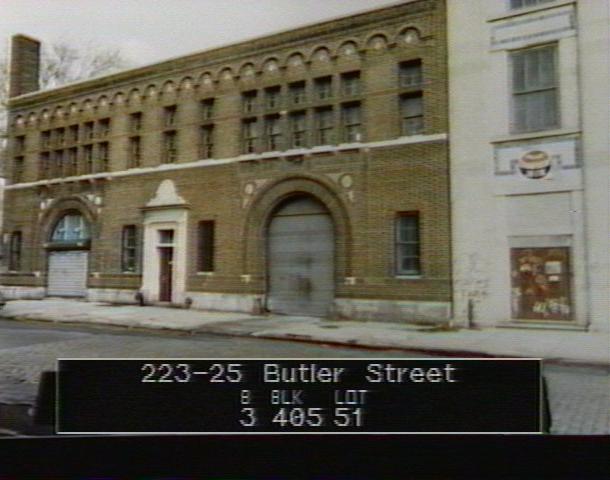
The city photographed every building for its tax records around 1940 and again in the 1980s. NYC Municipal Archives.
Written with AI from the source each entry cites, then fact-checked.
- 1913
The ASPCA opens a new Brooklyn dog and cat shelter on Butler Street, which it calls the largest in the country
Replacing the ASPCA's Malbone Street shelter, the new fireproof building rose across from the head of the Gowanus Canal, designed by Renwick, Aspinwall & Tucker. It was a single story and 38 feet wide, with a full kitchen and rooms for attendants who staffed it around the clock. The ASPCA called it the most modern establishment of its kind and the biggest animal shelter in the country, larger even than its Manhattan one.
“…considered its new Brooklyn shelter to be "the most modern establishment of its kind in existence" and the largest animal shelter in the country…”
- 1913
A granite drinking trough, the gift of Edith G. Bowdoin, goes into the sidewalk in front of the new shelter
When the shelter opened, benefactor Edith G. Bowdoin gave an animal drinking trough that was set into the Butler Street sidewalk. Horses filled the city's streets, and public drinking water was scarce, especially in summer. The trough follows a plain design the city's Art Commission approved in 1909 after a campaign led by Bowdoin. It is now the only animal fountain left in front of a historic ASPCA facility.
“The only animal drinking fountain remaining in front of a historic ASPCA facility, this trough and the building behind it constitute a unique monument…”
- 1922
The ASPCA expands the building to two stories to hold its Brooklyn offices, shelter and ambulance garage
Renwick, Aspinwall & Tucker designed an expansion that stretched the building east to a full 80 feet and up to two stories. The shelter stayed in the western end, while a new arched opening on the east served as the ambulance entrance. A classical entrance topped by a relief of the Society's seal led to the second floor, where the Brooklyn office kept its offices, its complaint bureau and a dog-license counter. The Brooklyn Citizen called the result the most up-to-date structure of its kind.
- 1932
A man who lost his dog visits the Butler Street shelter every day for six months until they are reunited
Among the happier moments at the shelter, a local man whose dog had gone missing came by every day for six months in 1932. At last the dog, barking wildly, recognized him at the shelter and the two were reunited. Two years earlier, in 1930, the staff had traced a dog wearing a California license back to its owner on the West Coast.
“…in 1932, a local man who had lost his dog visited every day for six months until "master and dog were reunited at the shelter…”
- 1932
Brooklyn children coax their parents into adopting 500 dogs from the shelter in a single Christmas month
During the Depression the holiday season was the shelter's happiest, with holly wreaths decorating the dog cages. Many parents took home a pet for only the two-dollar license fee. The Brooklyn Citizen reported in December 1932 that children were pleading to visit so they would have a dog by Christmas, and that 500 dogs had been adopted that month already.
“…explaining that 500 dogs had already been adopted that month…”
- 1935
Shelter staff rappel down the Gowanus Canal's slick timbers to rescue a dog that fell from a barge
In 1935 the Brooklyn Eagle visited district manager William H. Groome in his office overlooking the canal, where coal mountains and elevators lined both banks. He described a recent rescue of a dog that had tumbled from a barge in view of the building. The dog could swim but not climb the greasy timbers, so the staff rappelled down the canal's side to bring it out.
- 1947
The Brooklyn office honors a cat and a dog that saved 28 Flatbush residents from a gas leak
The Brooklyn office gave bravery medals to humans and animals alike over the years. Among the honorees were Mickey and Sparky, a cat-and-dog team credited with rescuing 28 apartment dwellers in Flatbush from a gas leak in 1947. Another medal went to Micky the dog, who alerted his family to a house fire in 1939.
- 1981
Organ builder Lawrence Trupiano and a partner buy the building and build and restore pipe organs there
The ASPCA had left by 1981, when it sold the property to two partners, one of them master organ builder Lawrence Trupiano. He and his staff built organs at the building, including one for Brooklyn Heights' First Unitarian Church. They also took on restorations of the Appleton Organ at the Metropolitan Museum of Art, the huge organ of Wanamaker's store in Philadelphia, and the organ of St. Paul's Chapel after it filled with debris on September 11.
- 1983
RetroFret, a dealer in historic guitars, moves in, and the building serves as a performance art space in the mid-1980s
RetroFret, which sold historic guitars and other instruments, made the building its home from 1983 to 2018. For a period in the mid-1980s the building also served as a performance art space. In 2017 Steven Uhrick, the owner of RetroFret, and organ builder Lawrence Trupiano sold the building and its entire lot to two limited-liability companies, and the report notes that it then housed Public Records, a cafe, bar and live music venue.
“From 1983 to 2018, it was also the home of RetroFret, a seller of historic guitars and other musical instruments.”
Nearby
- Gowanus Canal Flushing Tunnel Pumping Station201 Douglass Street | 1 entry
- Gowanus Canal Flushing Tunnel Pumping Station9 entries
- 360 Pacific Street4 entries
- Brooklyn High School of the Arts345 Dean Street | 1 entry
- Mile End Delicatessen348 Atlantic Avenue | 1 entry
- Public Bath No. 7227 4th Avenue | 8 entries