Gowanus Canal Flushing Tunnel Pumping Station
Open on the map9 entries

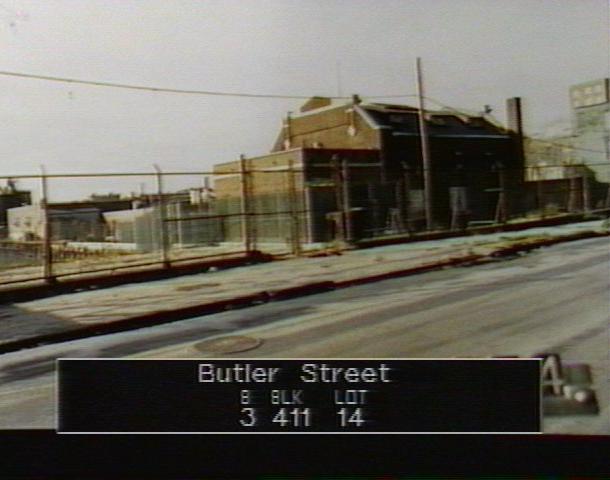
The city photographed every building for its tax records around 1940 and again in the 1980s. NYC Municipal Archives.
Written with AI from the source each entry cites, then fact-checked.
- 1890
Brooklyn buys the plot at the head of the Gowanus Canal that later holds the pumping station
The City of Brooklyn purchases a large piece of land at the head of the Gowanus Canal, running southwest from the corner of Butler and Nevins streets. A storm sewer from Greene Avenue empties there, and the pumping station and gate house are later built on the plot. The purchase comes a year after a commission studying the canal's pollution suggested filling it in altogether.
“In 1890, the City of Brooklyn purchased a large plot of land at the head of the canal, extending southwesterly from the corner of Butler and Nevins streets…”
- 1905
Sewer engineer Edwin J. Fort draws on a Milwaukee river-flushing design for a Gowanus tunnel
Edwin J. Fort of Brooklyn's Bureau of Sewers studies pumping systems in Chicago and Milwaukee and appears especially influenced by the scheme Edwin Reynolds devised in 1887 for the Milwaukee River. He adopts its 12-foot tunnel diameter and its engine-driven four-bladed propeller. Plans for a 6,280-foot tunnel from the canal head to Buttermilk Channel are announced in early 1905.
- 1906
Gowanus flushing tunnel construction begins, then stalls until the contractor changes method
Construction of the 12-foot-diameter flushing tunnel begins in April 1906, but the first year brings little progress because the design did not fit the building method picked. The contractor, John Pierce Co. of Manhattan, then adopts the pneumatic shield method frequently used for tunneling under water, and work moves forward. The tunnel is finished by 1909.
“…construction of the 12-foot diameter tunnel began in April 1906 but little progress was made in the first year…”
- 1907
Edwin J. Fort becomes chief engineer of Brooklyn's Bureau of Sewers
Born in Illinois in 1868, Fort worked as a draftsman in Washington and as an engineer at Niagara Falls before settling in Brooklyn. He became assistant engineer in 1904, Engineer of Design in 1906 and Chief Engineer in 1907, succeeding Harry Asserson. He left in 1918 to be Niagara Falls city manager, and he helped found the Brooklyn Engineers' Club, serving once as its president.
“…in 1906 he was appointed Engineer of Design and in 1907 succeeded Asserson as Chief Engineer.”
- 1909
Architect Arthur L. L. Martin files plans for a pumping station and a gate house at the canal head
In July 1909 Martin, architect for the Bureau of Sewers, submits new-building applications for two structures: a 67-by-53-foot brick and limestone pumping station, 43.5 feet tall, and a nearly square gate house of about 25 feet on a side. Bids had been opened in 1910; the contractors, Fox, Hennessey & Co., have both structures enclosed by February 1911 and begin installing machinery.
- 1911
South Brooklyn celebrates the flushing tunnel with a barge parade and Miss Gowanus tosses lilies
The pumping station opens on June 21, 1911, with speeches, ceremonies and a parade of barges moving down the canal. Jennie Haviland, Miss Gowanus, throws lilies into the water as a sign of the cleanliness residents hope will return. After some adjustment, including running only on the ebb tide at first, the pump goes into nearly full-time operation.
- 1999
A $10 million rebuild revives the pumping station after decades of silence
The flushing system stopped working in the 1960s when the propeller's drive shaft broke, and repairs were delayed in part by the city's fiscal troubles. City officials began the first of two renovations in 1994; it finished in 1999. The $10 million job dredged 2,000 tons of polluted material from the canal head and added a new 600-horsepower motor, propeller and sluice gates.
“Completed in 1999 the $10 million project included dredging 2,000 tons of polluted material from the head of the canal and installing a new electric motor, propeller, and sluice gates.”
- 2014
The Department of Environmental Protection finishes a five-year overhaul, swapping in three pumps
Beginning in 2009, the city's Department of Environmental Protection rebuilds the tunnel and pumping system, finishing in 2014. The single pump gives way to three vertical turbine pumps, and the tunnel is drained so it can be inspected and repaired. After Hurricane Sandy, crews also add measures to shield the equipment from future flooding.
“The single pump was replaced by three vertical turbine pumps, the tunnel itself was drained for inspection and repair…”
- 2019
The Landmarks Preservation Commission hears only support for landmarking the pumping station and gate house
Speakers at the September 24, 2019 public hearing on designating the pumping station and gate house are unanimous: fourteen people back it, among them the Department of Environmental Protection, which owns the property, and groups such as the Gowanus Landmarking Coalition and the Historic Districts Council. Nobody speaks in opposition, and the commission also receives 33 e-mails in support. Its designation report is dated October 29, 2019.
Nearby
- Gowanus Canal Flushing Tunnel Pumping Station201 Douglass Street | 1 entry
- ASPCA Brooklyn Office, Shelter, and Garage233 Butler Street | 9 entries
- 360 Pacific Street4 entries
- Brooklyn High School of the Arts345 Dean Street | 1 entry
- Mile End Delicatessen348 Atlantic Avenue | 1 entry
- Public Bath No. 7227 4th Avenue | 8 entries