Paramount Hotel
235 West 46th Street | Times Square | built 1928
Open on the map16 entries

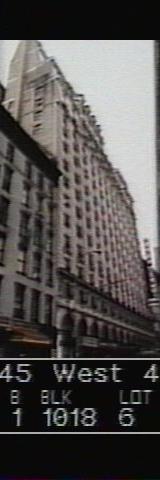
The city photographed every building for its tax records around 1940 and again in the 1980s. NYC Municipal Archives.
Written with AI from the source each entry cites, then fact-checked.
- 1926
Isidore Zimmer, Samuel Resnick and Frank Locker plan a hotel for a block of tenements and small houses
Before the hotel, the lots on West 46th Street held a tenement and small houses, which the Spear Construction Company combined in 1925 and sold in 1926. The developers Isidore Zimmer, Samuel Resnick and Frank Locker then announced a $3.5 million hotel of 18 stories and 612 rooms, with the theater architect Thomas Lamb as designer. They also planned a grill room cooled by refrigerated air and nine stores along 46th Street.
“Shortly thereafter an announcement appeared in The New York Times that Isidore Zimmer, Samuel Resnick and Frank Locker would build on this combined lot…”
- 1928
The Hotel Paramount formally opens with a banquet for hundreds of guests
A. Lincoln Scott, the first manager, took over when the hotel informally opened on June 5, 1928. The formal opening on June 12 was a dinner attended by 600 to 800 guests, and the Garment Salesmen's Association opened a clubhouse on the 19th floor that August. The Eighth Avenue Association gave a plaque honoring the hotel's contribution to the district's prestige. The building cost about $5 million.
“The Paramount Hotel formally opened on June 12, 1928, with a dinner banquet attended by 600 to 800 guests.”
Source: Wikipedia
- 1928
Thomas Lamb gives the hotel a theatrical French Renaissance front of arches, terra cotta and copper
Lamb, a prolific theater architect, put the building's ornament where passers-by and distant viewers would see it. A double-height arcade of arches fronts 46th Street, with large windows that let people see into the hotel's lounge. The two floors above carry terra-cotta moldings, keystones, volutes and swags, and the building steps back to a central pavilion under a tall copper mansard roof with oversized urns and ornate dormers.
“The lower floors of the Paramount Hotel provide a wealth of decoration that enlivens the street.”
- 1930
Prosecutors bring a padlock suit against the Paramount grill room over liquor
The grill room was modeled on a Spanish patio and offered dancing and live entertainment. In July 1930 an assistant United States attorney brought a padlock suit against it on liquor charges, which nearly closed it. The grill survived and went on to feature jazz for years, even as the Depression pushed the hotel into foreclosure by 1935.
Source: Daytonian in Manhattan
- 1938
Billy Rose opens the Diamond Horseshoe nightclub in the hotel basement
By the late 1930s the lower level held Billy Rose's Diamond Horseshoe, a nightclub known for inexpensive fare and a chorus line of lightly dressed dancers. Dick Haymes and W. C. Handy were among the performers who headlined there. The club kept the name until it closed in 1951.
Source: Daytonian in Manhattan
- 1940
Female impersonator Julian Eltinge joins the cast of the Diamond Horseshoe's Nights of Gladness
Billy Rose's Diamond Horseshoe staged its second revue, Nights of Gladness, in 1940 and 1941, a look at the decade after 1905. The cast included Julian Eltinge, a major draw on Broadway and in vaudeville who is often ranked among the leading female impersonators in history. Raoul Pene Du Bois designed the sets and costumes.
Source: NYC LGBT Historic Sites Project
- 1945
The Diamond Horseshoe inspires a Betty Grable movie musical
The basement club inspired a 1945 film musical, Diamond Horseshoe, starring Betty Grable. Rose's chorus girls, billed as his Long-Stemmed Beauties, were the draw, and the club kept entertaining tourists and New Yorkers until 1951.
Source: Daytonian in Manhattan
- 1951
Skater Sonja Henie tries to run an ice rink in the closed nightclub
When the Diamond Horseshoe closed in 1951, the figure skater Sonja Henie tried running an ice rink in the basement. Room prices began to fall afterward, and room service was cut. In 1953 the federal government agreed to lease the hotel for Internal Revenue Service offices, but that conversion never happened.
“…figure skater Sonja Henie then attempted to operate an ice rink in the basement…”
Source: Wikipedia
- 1961
The hotel basement becomes the 299-seat Mayfair off-Broadway theater
In December 1960 the hotel's operators leased the basement to Irving Maidman and Norman Twain. Russell Patterson renovated the space into the Mayfair Theatre, a 299-seat off-Broadway house that opened in March 1961. Maidman turned it into a cabaret after two years as an off-Broadway house.
Source: Wikipedia
- 1964
Future Hair writers James Rado and Gerome Ragni act in Hang Down Your Head and Die in the basement theater
The hotel's basement theater staged Hang Down Your Head and Die, a revue about capital punishment, in 1964. The cast included Remak Ramsay, James Rado and Gerome Ragni, and Rado and Ragni went on to write the musical Hair, which opened in 1967.
Source: NYC LGBT Historic Sites Project
- 1974
Casey Donovan stars in Tubstrip, a comedy set in a gay bathhouse, at the basement theater
In 1974 the basement theater presented Tubstrip, a comedy set in a gay bathhouse. It starred Calvin Culver, better known as Casey Donovan of the pioneering gay films Boys in the Sand and The Back Row, alongside Michael Kearns, Gerald Grant and Eddie Rambeau. The show ran five weeks at the Mayfair, according to the LGBT Historic Sites Project.
Source: NYC LGBT Historic Sites Project
- 1986
Ian Schrager fires the whole staff and interviews 4,000 people for jobs
After Philip Pilevsky and Arthur Cohen bought the Century-Paramount in 1986, they handed operations to Ian Schrager and Steve Rubell, who had run Studio 54. Schrager dismissed all 130 employees and interviewed 4,000 applicants, advertising in Playbill and Variety. He wanted workers with quirky beauty and elegance. Occupancy climbed from 38 percent in 1986 to 82 percent two years later.
“Schrager fired all of the hotel's 130 workers, interviewing 4,000 people to fill the positions…”
Source: Wikipedia
- 1990
Philippe Starck's remodeled lobby reopens the hotel under the name Paramount
After closing for a renovation of about a year and a half, Schrager reopened the hotel in 1990 with Philippe Starck redesigning the common areas. Thomas Lamb's period interiors gave way to sleek lines and bold colors, which New York magazine later called a time capsule of late-twentieth-century chic. Starck did another $7 million update in 1998.
Source: Daytonian in Manhattan
- 2009
The Landmarks Commission designates the Paramount as one of Thomas Lamb's few non-theater buildings
On November 17, 2009 the Commission designated the Paramount Hotel. Its report said Lamb, a prolific theater architect, used flamboyant French Renaissance details to give the building drama on a busy side street. Two speakers favored designation, one representing the owner, and none opposed.
“One of a very few hotels designed by noted theater architect Thomas Lamb, this building's design reflects the theatrical nature of the neighborhood.”
- 2013
Queen of the Night opens in the revived Diamond Horseshoe on New Year's Eve
The long-closed basement space reopened as the Diamond Horseshoe at the end of 2013 with Queen of the Night, an immersive theater piece directed by Christine Jones. Creative director Giovanna Battaglia likened the redesigned room to a mix of church, opera house and bordello. The show ran exactly two years, closing on December 31, 2015.
“Queen of the Night opened December 31, 2013, directed by Christine Jones; closed December 31, 2015…”
Source: Wikipedia
- 2022
A plan to turn the Paramount into housing and a shelter collapses over a union buyout demand
In early 2022 Breaking Ground proposed turning the Paramount into a 136-unit shelter for homeless adults plus 510 housing units. The plan needed the backing of the Hotel and Gaming Trades Council, which asked Breaking Ground to buy out the workers' contract for $50 million, more than the nonprofit could pay. The conversion was canceled and the hotel reopened in late 2022 under the management firm Generator.
“…the conversion plan was ultimately canceled after HTC requested that Breaking Ground buy out the workers' contract for $50 million…”
Source: Wikipedia
Further reading
- Paramount HotelWikipedia
Nearby
- Lena Horne Theatre256 West 47th Street | 13 entries
- Hotel Edison221 West 46th Street | 7 entries
- Imperial Theatre249 West 45th Street | 13 entries
- Richard Rodgers Theatre226 West 46th Street | 14 entries
- Samuel J. Friedman Theatre261 West 47th Street | 14 entries
- Music Box Theatre239 West 45th Street | 14 entries