Imperial Theatre
249 West 45th Street | also 248 West 46th Street | Times Square | built 1923
Open on the map13 entries

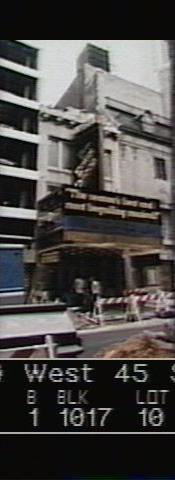
The city photographed every building for its tax records around 1940 and again in the 1980s. NYC Municipal Archives.
Written with AI from the source each entry cites, then fact-checked.
- 1923
The Shuberts open the Imperial to replace their aging Lyric Theatre
Since 1903 the Shubert brothers had staged their musicals at the Lyric Theatre, which by the 1920s was getting old. They hired Herbert Krapp in January 1923 to design the Imperial, which opened on Christmas Day 1923 with the hit Mary Jane McKane and ran 151 performances. Producer Arthur Hammerstein had asked Lee Shubert to name the theater for his late father, Oscar Hammerstein I, but Shubert refused.
Source: Wikipedia
- 1924
Rose-Marie gives the Imperial its first big hit and sends "Indian Love Call" through 581 performances
The Imperial's first big hit came the season after it opened: Rose-Marie, an operetta by Rudolf Friml and Oscar Hammerstein II. Its stars, Mary Ellis and Dennis King, performed the "Indian Love Call" for 581 performances. The Landmarks Preservation Commission's 1987 report treats it as the theater's first major success.
“The following season brought the Imperial's first big hit, Oscar Hammerstein and Rudolf Friml's operetta Rose-Marie, whose stars Mary Ellis and Dennis King sang their "Indian Love Call" through 581 performances.”
- 1935
Cole Porter's Jubilee opens and closes early so its star can honor a Hollywood contract
Jubilee, Moss Hart's fantasy about royalty on holiday, opened at the Imperial in October 1935 with a Cole Porter score featuring "Begin the Beguine" and "Just One of Those Things." It had to close after 169 performances because its star, Mary Boland, was bound to a Hollywood contract. It was succeeded by Rodgers and Hart's On Your Toes, with choreography by George Balanchine.
“Forced to close after 169 performances so that star Mary Boland could honor a Hollywood contract, it found a worthy successor in Rodgers & Hart's On Your Toes.”
- 1938
Mary Martin rises to stardom with "My Heart Belongs to Daddy" in Leave It to Me!
In 1938 Cole Porter's musical Leave It to Me! made Mary Martin a star at the Imperial, thanks to her performance of "My Heart Belongs to Daddy." It was Porter's second score for the house, three years after Jubilee had brought "Begin the Beguine" to the stage. The theater went on to host a string of hit musicals through the 1940s.
- 1946
A warped beam suspends the run of Annie Get Your Gun
In 1946 the run of Annie Get Your Gun was halted for a time when the weight of the show's scenery caused one of the Imperial's beams to warp. The musical, starring Ethel Merman, resumed afterward at the theater.
“The run of Annie Get Your Gun was suspended temporarily in 1946 after the weight of the musical's set caused one of the theater's beams to warp.”
Source: Wikipedia
- 1946
Annie Get Your Gun, starring Ethel Merman, opens at the Imperial and runs 1,147 performances
Irving Berlin's Annie Get Your Gun, with Ethel Merman in the lead, opened at the Imperial in 1946 and played 1,147 performances. The run was briefly suspended that year after the weight of the show's scenery warped one of the theater's beams. Merman returned to the Imperial in 1950 for Berlin's Call Me Madam, which ran 644 performances.
Source: Wikipedia
- 1952
Wish You Were Here puts a working swimming pool on the Imperial's stage
The scenery for the musical Wish You Were Here, which premiered at the Imperial in 1952, held a functioning swimming pool on the stage. The show ran for 598 performances. In 1953 the theater hosted John Murray Anderson's Almanac, among the last of Broadway's large revues.
“Wish You Were Here premiered in 1952, running 598 performances, with a set that included a fully functional swimming pool on the Imperial's stage.”
Source: Wikipedia
- 1964
Fiddler on the Roof opens at the Imperial with Zero Mostel
Fiddler on the Roof, with Zero Mostel and a score by Jerry Bock and Sheldon Harnick, opened at the Imperial in 1964 and stayed nearly three years before transferring. It followed Lionel Bart's Oliver!, a West End import that had its Broadway premiere at the theater in 1963, and it was succeeded in 1967 by Cabaret, which moved over from the Broadhurst.
Source: Wikipedia
- 1972
Pippin opens with Bob Fosse's choreography and Ben Vereen's dancing
In 1972 the Stephen Schwartz musical Pippin opened at the Imperial and became its greatest success up to that point, in the words of the Landmarks Preservation Commission's 1987 report. The show stood out for the inventive choreography of Bob Fosse and the extraordinary dancing of Ben Vereen. Five years later Liv Ullmann's Anna Christie took the house into drama, before Neil Simon's Chapter Two and They're Playing Our Song.
“In 1972, the Imperial had its greatest success to date with the Stephen Schwartz musical Pippin which was notable both for Bob Fosse's inventive choreography and Ben Vereen's extraordinary dancing.”
- 1981
Michael Bennett's Dreamgirls, with Jennifer Holliday, opens at the Imperial at the end of 1981
Michael Bennett's musical Dreamgirls, with Jennifer Holliday in a starring role and music credited to Henry Krieger and Tom Eyen, opened at the Imperial at the end of 1981. It stayed four years and played 1,522 performances. During its run, the Imperial also hosted the 1982 Tony Awards ceremony, after hosting the 1973 ceremony during the long run of Pippin.
Source: Wikipedia
- 1987
The Landmarks Commission designates the Imperial's interior, but not its exterior
Although the Landmarks Preservation Commission considered both the exterior and interior of the Imperial, on November 17, 1987, it designated only the interior. This was part of the commission's 1987 effort to protect Broadway theaters. The Shuberts, the Nederlanders and Jujamcyn sued in 1988 to overturn the landmark status of 22 theaters, and the designations were upheld in 1992.
Source: Wikipedia
- 1990
Les Misérables moves to the Imperial and plays there until 2003
Late in 1990 Les Misérables came to the Imperial and stayed for about a decade. When it closed in 2003, it was the second-longest-running production in Broadway history, and its end was partly blamed on a drop in ticket sales after the September 11 attacks. The musical returned to the Imperial in a 2014 revival.
Source: Wikipedia
- 2021
The Shuberts sell the air rights above the Imperial for $51 million
In 2021 the Shuberts sold the Imperial's air rights to Extell Development Company for $51 million, which was then the highest price paid for air rights in the area. The theater, closed since March 12, 2020 by the pandemic, reopened on October 16, 2021 with performances of the musical Ain't Too Proud.
“In 2021, the Shuberts sold the air rights above the Imperial to Extell Development Company for $51 million, at the time a record high price for air rights in the area.”
Source: Wikipedia
Further reading
- Imperial TheatreWikipedia
Nearby
- Music Box Theatre239 West 45th Street | 14 entries
- Richard Rodgers Theatre226 West 46th Street | 14 entries
- Gerald Schoenfeld Theatre (Plymouth Theatre)236 West 45th Street | 14 entries
- Paramount Hotel235 West 46th Street | 16 entries
- Bernard B. Jacobs Theatre242 West 45th Street | 14 entries
- John Golden Theatre252 West 45th Street | 14 entries