Gustave A. Mayer House
24 St Stephens Place | also 2475 Richmond Road | Lighthouse Hill | built 1856
Open on the map5 entries

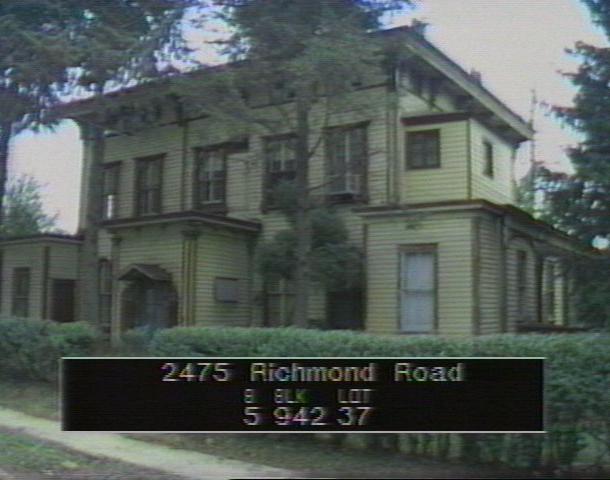
The city photographed every building for its tax records around 1940 and again in the 1980s. NYC Municipal Archives.
Written with AI from the source each entry cites, then fact-checked.
- 1776
British General William Howe gets a copy of the Declaration of Independence at the Rose and Crown
An inn called the Rose and Crown once stood on this property, at a crossroads where routes to New York, Richmond and Philadelphia met. During the Revolutionary War, General William Howe based himself at the inn, and it was there, around July 9, 1776, that a copy of the Declaration of Independence reached him. The tavern was torn down in 1855 to make way for the present house.
“General William Howe established his headquarters at the Rose and Crown. It was there that on or about July 9, 1776 he received a copy of the Declaration…”
- 1856
Militia captain David R. Ryers replaces the old tavern with a hilltop Italianate villa
Ryers bought the Rose and Crown property in 1855, demolished the inn and by 1856 had built this house higher up the slope. The two-and-a-half-story frame villa has a porch wrapping three sides and a square belvedere on its low hipped roof. The Landmarks Preservation Commission called it among the first rural Italianate residences on Staten Island and a rare, nearly intact survivor of its kind in the city.
“In 1855 he demolished "The Rose and Crown" and by 1856 had replaced it, at a higher elevation on the site, with the large Italianate residence…”
- 1889
Confectioner Gustave A. Mayer, credited with the Nabisco sugar wafer, buys the villa
Mayer, born near Ulm, Germany, in 1845, came to New York in 1864 and later ran a bakery in Stapleton, where he made printed wafers from molds he designed and patented. The Nabisco sugar wafer was credited to him, and his customers included Delmonico's and Sherry's. In July 1889 he bought the house from the Catholic Church, which had bought land in the area for St. Stephen's Home for boys.
“He was known as the originator of the "Nabisco sugar wafer.”
- 1898
Gustave Mayer turns the villa's basement into a workshop for his inventions
Mayer moved his family here between 1896 and 1898 and brought his business after 1898, enlarging the basement for it. There he worked on small manufacturing experiments, including Sparkling Brilliant Reflectors meant for electric lights but mostly used as holiday decorations, nickel-plated wire candy baskets, glass-enclosed sign letters, birch beer and a patented room humidifier. He also tended the gardens himself; he died in 1918.
“Mayer enlarged the basement for business purposes, and there later conducted his small manufacturing experiments…”
- 1989
The Mayer House becomes a city landmark over the objection of the property's trustee
At the April 1988 hearing seven witnesses spoke for designation and none against. The trustee of the property later said he opposed any designation, but the Commission received many supportive letters, including one from a Mayer family member living in the house, along with a petition bearing 152 signatures. The Landmarks Preservation Commission designated the house on March 21, 1989.
Nearby
- Church of Our Lady Queen of Peace62 Cloister Place | 3 entries
- New Dorp Light25 Boyle Street | 5 entries
- Nathaniel J. and Ann C. Wyeth House190 Meisner Avenue | 5 entries
- McCall's Demonstration House1929 Richmond Road | 3 entries
- Church of St. Charles220 Penn Avenue | 1 entry
- Frederick Douglass Memorial Park3201 Amboy Road | 3 entries