Nathaniel J. and Ann C. Wyeth House
190 Meisner Avenue | Lighthouse Hill | built 1925
Open on the map5 entries

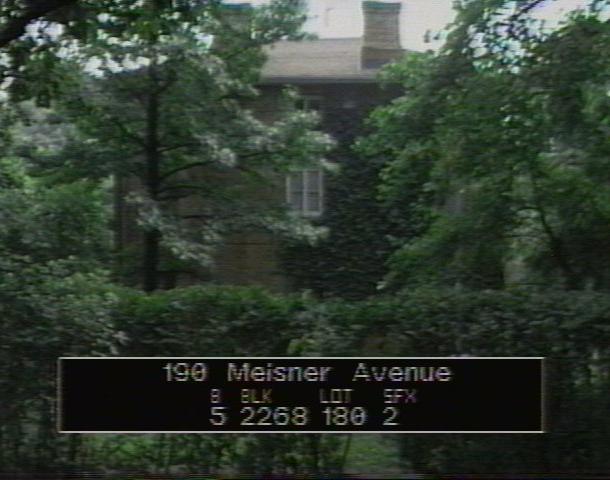
The city photographed every building for its tax records around 1940 and again in the 1980s. NYC Municipal Archives.
Written with AI from the source each entry cites, then fact-checked.
- 1856
Lawyer Nathaniel J. Wyeth builds a brick Italianate villa with an octagonal belvedere on Lighthouse Hill
Wyeth bought his first 1.1 acres here from Carl August Meissner in 1854 and an extra acre in 1856, when he put up this house. It was a brick and sandstone villa at a time when most Staten Island houses were wood. Its square plan, hipped roof, paired chimneys and belvedere follow the Southern Mansion design in Samuel Sloan's 1852 pattern book The Model Architect, and the octagonal belvedere lights an oval stairwell.
“The design of the Wyeth House relates to one of Sloan's more elaborate versions of this building type, his Southern Mansion…”
- 1870
Assemblyman Nathaniel Wyeth, who practiced law from this house, pushes a bridge bill for Staten Island
Wyeth kept an office in the house for his Staten Island practice, which included acting as chief counsel for the Staten Island Railroad. He sat in the State Assembly for Richmond County from 1867 to 1872, and in 1870 he wrote and passed a bill for a bridge running from Ellis Island to Robbins Reef and on to New Brighton. The plan was dropped for lack of capital.
- 1916
Nathaniel Wyeth dies at 86 in "Florence Home," the house he named for a daughter lost at nine
Wyeth called the house Florence Home after his eldest child, Annie Florence, born in 1855, who died at age nine. Friends and clients came to visit, and his home office held books and portraits of Emerson, Lincoln, Grant and other statesmen. His wife Ann died at 85 in 1914, and Wyeth died in the house at 86 in March 1916, after which it stood empty for some years.
- 1925
Opera baritone Graham Marr buys the house and remakes it as "Marr Lodge"
Marr, a Columbia Records artist who had sung with the Century, Chicago and Boston operas, bought the villa in 1925 as his career wound down. With landscape painter Norman Robert Morrison he added electricity, telephone service and modern plumbing and rebuilt the captain's walk around the belvedere. They turned the old dining room into a drawing room and amateur theater with murals of Staten Island scenes, and renamed the place Marr Lodge.
- 1968
Painter Norman Morrison dies and leaves the house to neighbors who promised to look after his pets
Morrison lived on in the house and spent much of his time in the gardens, planting 12,000 bulbs in the spring of 1955. He died in 1968 at 76 after a period of failing health, willing the house and land to two neighbors who had helped care for him and had agreed to take in his many pets. After a long dispute, the estate's executor, Vito Lettieri, took title in 1970.
“…he left the house and land to two neighbors who had assisted with his care and who had promised to care for his numerous pets…”
Nearby
- Jacques Marchais Museum of Tibetan Art338 Lighthouse Avenue | 6 entries
- Staten Island Lighthouse418 Edinboro Road | 5 entries
- Moore-McMillen House3531 Richmond Road | 4 entries
- The Crimson Beech (Cass House)48 Manor Court | 7 entries
- Stephens-Prier House3672 Richmond Road | 5 entries
- St. Patrick's Church256 Center Street | 3 entries