Our Lady of Pompeii Church
240 Bleecker Street | also 25 Carmine Street | West Village | built 1928
Open on the map9 entries

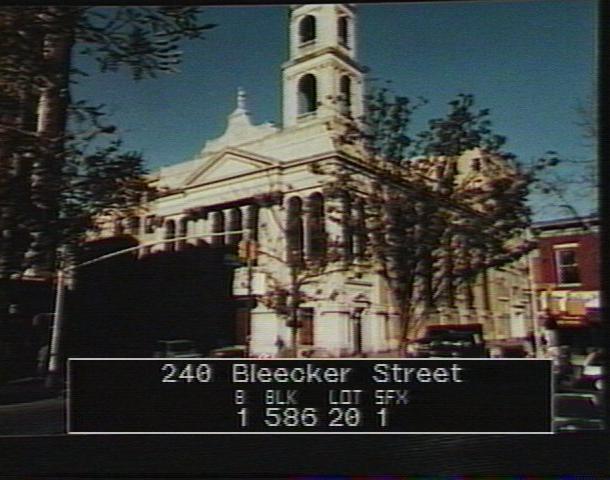
The city photographed every building for its tax records around 1940 and again in the 1980s. NYC Municipal Archives.
Written with AI from the source each entry cites, then fact-checked.
- 1892
Father Pietro Bandini founds an Italian parish that becomes Our Lady of Pompeii
Pietro Bandini, an Italian Jesuit, opened a chapel for Italian immigrants in a Waverly Place storefront, where the first Mass was said in 1892. The parish moved to Sullivan Street in 1895 and to Bleecker Street in 1898. It only reached its permanent home at Carmine and Bleecker Streets in 1928.
Source: Wikipedia
- 1895
Annie Leary gives the parish the Pompeii painting that now hangs above the church's altar
The marble reredos holds an exact replica of a painting in the Shrine of Our Lady in Pompei, given to the parish in 1895 by Annie Leary. It shows the Virgin Mary holding the child Jesus, who hands a rosary to St. Dominic, while his mother gives one to St. Catherine of Siena. The painting first hung in the old Bleecker Street church and was cut and moved when the present church was built.
“It was given to the church in 1895 as a gift by Annie Leary.”
Source: Wikipedia
- 1926
The parish buys and clears the 17-25 Carmine Street lots for a new church
In 1923 the city told Father Antonio Demo that Sixth Avenue was to be extended through the parish's Bleecker Street church, and the buildings in its path were condemned. Demo organized parish committees, bought the properties at 17 to 25 Carmine Street on the Bleecker Street corner, and had them cleared. Ground was broken in 1926 for a church designed by Matthew W. Del Gaudio, the architect Demo chose himself.
Source: Daytonian in Manhattan
- 1928
A Kilgen pipe organ with some older pipes is installed in the new church
The original organ in the present church came in 1928 from Geo. Kilgen & Son of St. Louis, its Opus 4247, a three-manual instrument installed in two sections on either side of the gallery windows. It includes many old pipes, quite possibly kept from the 1918 organ of the previous church. An Echo division was added later using pipes from a Kilgen organ of about 1928 at Immaculate Conception Church in Trenton, New Jersey.
Source: nycago.org
- 1928
A falling scaffolding beam kills a three-year-old girl during construction
On New Year's Day 1928, a 10-foot beam fell from the belfry scaffolding at the building site and killed three-year-old Zita Triglia. The church rising at Carmine and Bleecker Streets was designed by Matthew W. Del Gaudio in the Romanesque Revival style. It cost more than $1 million to build.
Source: Wikipedia
- 1928
Cardinal Hayes dedicates the new Our Lady of Pompeii church
Cardinal Patrick Hayes led a solemn mass to dedicate the church on the feast day of Our Lady of the Rosary, with more than 2,000 worshippers present. The parish had used three earlier locations since 1892, including the Waverly Place chapel. This building became its permanent home and, in time, the American counterpart of a shrine to Our Lady of Pompei in Italy.
Source: Wikipedia
- 1930
The parish school opens, staffed by the Missionary Zelatrices of the Sacred Heart
Beside the new church, the parish built a rectory that opened in 1928 and a parish school that opened in 1930 with teaching sisters of the Missionary Zelatrices of the Sacred Heart of Jesus. A convent followed in the 1950s. The school today is staffed by the Apostles of the Sacred Heart of Jesus.
“…a parochial school that opened in 1930 staffed by the Missionary Zelatrices of the Sacred Heart of Jesus…”
Source: Wikipedia
- 1937
A mural of Our Lady of the Rosary, with the Battle of Lepanto in one corner, is painted above the altar
The largest painting in the church is the 1937 mural in the semi-dome above the altar, showing the Virgin Mary and the child Jesus with St. Dominic and St. Catherine of Siena. In one corner a galleon sails in the 1571 Battle of Lepanto. The mural was removed in the 1970s and replaced with plainer imagery; it was later recreated by Anthony D'Ambrosio from his father's drawings.
“The largest painted accent in the interior is the mural in the semi-dome above the altar, which was created in 1937…”
Source: Wikipedia
- 1941
The plot left by the Sixth Avenue extension is named Father Demo Square for the parish's late pastor
Father Antonio Demo served his mostly Italian congregation until 1935 and died a year later. He had steered the parish through its move from Bleecker Street to the Carmine Street church. Five years after his death, in 1941, the empty triangular plot that Sixth Avenue's extension left behind was named Father Demo Square in his honor.
Source: Daytonian in Manhattan
Further reading
- Our Lady of Pompeii Church (Manhattan)Wikipedia
- Buying produce from Bleecker Street pushcartsEphemeral New York
Nearby
- Society of St. Charles Borromeo Community House27 Carmine Street | 2 entries
- 12 Leroy Street3 entries
- 14 Leroy Street2 entries
- 233 Bleecker Street5 entries
- 31 Carmine Street2 entries
- 16 Leroy Street2 entries