233 Bleecker Street
also 237 Bleecker Street, 235 Bleecker Street, 15 Carmine Street | West Village | built 1822
Open on the map5 entries

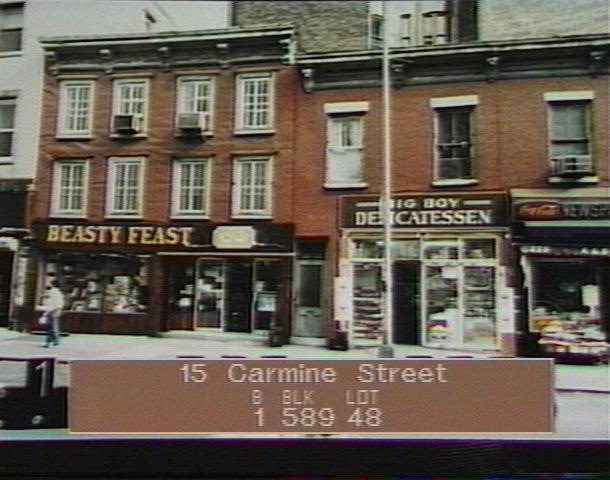
The city photographed every building for its tax records around 1940 and again in the 1980s. NYC Municipal Archives.
Written with AI from the source each entry cites, then fact-checked.
- 1822
A carpenter builds a frame house at Bleecker and Carmine, and a stagecoach house follows behind it
Hixon Wilson, a carpenter, put up a two-story wood house on this corner in 1822. In 1832 he sold the lot to dry goods merchant Samuel Harris, who opened a store in the Carmine Street part. Harris also built a wooden stagecoach house on the rear lot, now 237 Bleecker Street, around 1835. It was perhaps meant for a stage line running between Bowling Green and Bleecker Street.
- 1837
Bookseller Abraham Maze opens a shop at 237 Bleecker Street that lasts for decades
By 1837 the former coach house was listed as the shop of Abraham Maze, a bookseller who also sold stationery and bound books to order. On New Year's Eve 1842 the New-York Tribune named his small Greenwich Village store among the great Broadway booksellers. He kept it going for about four decades, and a stationers' directory still listed a Maze bookstore here in 1896.
Source: Daytonian in Manhattan
- 1841
Maze's bookshop also sells patent cures as good as a family doctor
On July 20, 1841 Abraham Maze advertised Dr. Plumleight's Indian Botanic Plaister in the New-York Tribune as a cure for sore legs, rheumatism and many other ailments. A year later he offered a black salve and pills claimed to treat everything from fever sores to rattlesnake bites. His ad claimed the pills were as good as a family physician kept at hand.
Source: Daytonian in Manhattan
- 1875
Bookseller Maze dies, and Orange County sues his estate over the wife who left him
Abraham Maze died in 1875 leaving about $2,000. Soon afterward the Superintendent of the Poor of Orange County sued the estate to recover the cost of supporting Maze's wife, who had left him about a year after their wedding and was later declared insane. The Supreme Court ruled against the county, holding that a husband who had no notice of the proceedings owed no support.
Source: Daytonian in Manhattan
- 1969
The Sunshine Fruit and Vegetable Market owner says she is closing after about 40 years, blaming rising rents
Josephine Majiotta's family had run the Sunshine Fruit and Vegetable Market in the old wooden building since the early Depression. On October 5, 1969, she told The New York Times she was getting out the next month because the landlord was raising the rent, and that everyone on the street planned to sell. Italian cheese, meat and bread shops in the area were being replaced by clothing and antiques stores. A pet-food store later took the space.
Source: Daytonian in Manhattan
Further reading
- Abraham Maze's Bookstore -- No. 237 Bleecker StreetDaytonian in Manhattan
Nearby
- 13 Carmine Street1 entry
- 11 Carmine Street1 entry
- 239 Bleecker Street3 entries
- Joe's Pizza7 Carmine Street | 6 entries
- 241 Bleecker Street2 entries
- 243 Bleecker Street3 entries