Rockefeller Guest House
242 East 52nd Street | Turtle Bay | built 1951
Open on the map12 entries

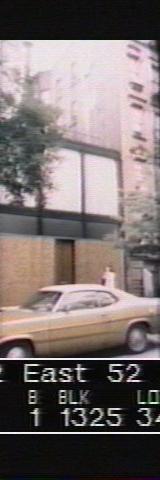
The city photographed every building for its tax records around 1940 and again in the 1980s. NYC Municipal Archives.
Written with AI from the source each entry cites, then fact-checked.
- 1866
A modern high-stoop house on the lot is advertised for sale, decades before Philip Johnson's guest house
An advertisement in the New York Herald dated February 18, 1866, listed a house at 242 East 52nd Street for sale, calling it a modern high-stoop house, with a mirror-image, two-bay Italianate house beside it. By the Depression years the house had lost its stoop and been converted to furnished rooms, and as early as 1940 it was abandoned. This entry concerns the earlier house on the site, before Johnson's building.
Source: Daytonian in Manhattan
- 1949
The Rockefellers call their nearly finished town house an 'adjunct' rather than a guest house
On September 2, 1949, the New York Times reported that a town house for John D. Rockefeller 3d and his wife Blanchette was nearing completion in the Beekman Place section, calling it an outstanding example of modern architecture. The couple planned to keep living in their apartment around the corner, and a Rockefeller spokesman said they would rather call the new building an adjunct than a guest house. The Times added that the furnishings were being made to suit its unusual character.
Source: Daytonian in Manhattan
- 1950
Blanchette Rockefeller commissions Philip Johnson's only NYC house
Blanchette Ferry Hooker Rockefeller, wife of John D. Rockefeller III, hired architect Philip Johnson in 1948 to build a freestanding townhouse for displaying her modern art collection and hosting guests near the couple's Beekman Place home. Built mostly within two gutted 19th-century townhouse shells, it was completed in 1950 as Johnson's only private residence in New York City.
Source: Wikipedia
- 1951
The house opens to the public for a garden show
The Rockefellers opened the guest house in May 1951 for the City Garden Club's annual garden show, letting the public see its modernist courtyard and reflecting pool. The Museum of Modern Art also used the house for trustee luncheons and fundraising events until 1964.
Source: Daytonian in Manhattan
- 1954
MoMA's Junior Council stages a benefit exhibition in the house, curated by Alfred Barr and others
In 1954 the house hosted an exhibition to benefit MoMA's Junior Council. Alfred Barr, Dorothy C. Miller and William Lieberman curated it, drawing on paintings, sculptures and prints owned by council members. New York Times critic Aline Saarinen was disappointed by how cautious the choices were, but the show gave the public a rare look inside the minimal interior. In those years a butler named Charles also ran luncheons there for trustees and donors.
- 1955
Blanchette Rockefeller donates the house to the Museum of Modern Art
Rockefeller gave the guest house to MoMA in 1955. The museum later sold it, and it passed through later owners including the Leonhardt family, Philip Johnson himself as a tenant, antiquities dealer Robin Symes, and buyers at a 1989 Sotheby's auction.
Source: Daytonian in Manhattan
- 1964
MoMA sells its guest house to the Leonhardt family for $100,000
The Museum of Modern Art had used the guest house for events until its own East Wing, a Philip Johnson design as well, opened in 1964. On February 7 of that year the New York Times reported the sale of the house to Mrs. Robert C. Leonhardt, whose husband was a Manhattan business consultant who also owned a Johnson house on Long Island. The price was $100,000, and the Times called the house one of Johnson's most striking designs.
Source: Daytonian in Manhattan
- 1971
Philip Johnson and David Whitney move in, and Andy Warhol calls the house a prototype of loft living
After Robert Leonhardt died in 1971, his widow, Lee Sherrod, invited Philip Johnson and his partner, former art dealer David C. Whitney, to lease the house. Johnson, who called their previous home a ratty old two-room walk-up, repainted the interiors white and hung works by Roy Lichtenstein, John Chamberlain and Frank Stella. Andy Warhol, an occasional visitor, described the open plan as a prototype of loft living in New York.
“Andy Warhol, who occasionally visited Johnson, admired the openness of the plan, calling it a prototype of loft living in New York.”
- 1979
London dealer Robin Symes buys the house and fills it with Art Deco furniture
Robin Symes, a London antiques dealer, bought the guest house in 1979 and filled it with Art Deco furniture. The New York Times described his collection of designs by Pierre Legrain and Eileen Gray as the largest private holding of their work. His partner, Christo Michailidis, told the Times they needed a New York house like a hole in the head, but fell in love with this one as an art work.
Source: Daytonian in Manhattan
- 1989
Sotheby's sells the house, its first real estate auction, and one bidder is stuck in the Holland Tunnel
In 1989 Robin Symes put the house up at Sotheby's, which had never before sold a house at an art auction; it was also the first house sold at an art auction in New York. Nine bidders took part, and one who was crossing the Holland Tunnel while bidding found it already sold by the time he emerged. It brought $3.5 million from a buyer later revealed to be MoMA trustee Ronald Lauder, while the contents sold for $4.3 million.
Source: Wikipedia
- 2000
Christie's auctions the house and six bidders push the price to $11.16 million
Anthony d'Offay, a London gallery owner who specialized in modern art, had bought the guest house in the mid-1990s. Christie's auctioned it in May 2000, and six bidders pushed the final price to $11.16 million. The Landmarks Preservation Commission designated the house a city landmark that December 5.
- 2000
The city landmarks the modernist guest house
The New York City Landmarks Preservation Commission designated the Rockefeller Guest House an official city landmark on December 5, 2000, protecting its symmetrical brick-and-glass facade over a courtyard garden.
Source: Wikipedia
Further reading
- Rockefeller Guest HouseWikipedia
- The 1950 Rockefeller Guest House - 242 East 52nd StreetDaytonian in Manhattan
Nearby
- Sutton Place Synagogue225 East 51st Street | 3 entries
- 980 2nd Avenue1 entry
- Halcyon305 East 51st Street | 7 entries
- Norwegian Seamen's Church317 East 52nd Street | 2 entries
- Lipstick Building885 3rd Avenue | 9 entries
- Gluck-Zimbalist House225 East 49th Street | 4 entries