242 Lafayette Street
also 244 Lafayette Street | SoHo | built 1882
Open on the map5 entries

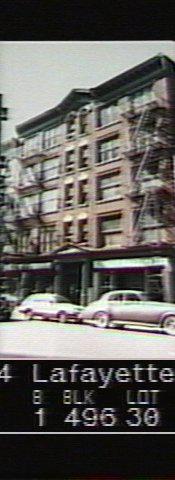
The city photographed every building for its tax records around 1940 and again in the 1980s. NYC Municipal Archives.
Written with AI from the source each entry cites, then fact-checked.
- 1882
John Sexton builds a five-story brick factory for Thomas Wetherbed on Lafayette Street, doubled in size in 1897
Developer Thomas Wetherbed hired architect John Sexton in 1881 to design a loft building at 244 Lafayette Street, and the five-story brick factory was finished in 1882. In 1897 Wetherbed brought Sexton back to double it with a matching extension at 242. Sexton joined the two halves with a Queen Anne-style two-bay center, topped by a peaked cornice, and an entrance portico with a sunburst pediment.
Source: Daytonian in Manhattan
- 1906
Neighborhood boys burn blasting caps on the sidewalk at 242-244 Lafayette Street and the explosion injures five
About a dozen boys from the Italian quarter found a pile of blasting caps left by construction workers on Centre Street. Hoping to sell the copper wire, they burned off its insulation in a fire on the sidewalk in front of the building. The blast sent copper shrapnel into five boys, and ten-year-old Alfonso Capola was gravely hurt in the eye. The Sun reported that about 5,000 people crowded outside the Mulberry Street police station and anxious mothers briefly scuffled their way in.
Source: Daytonian in Manhattan
- 1906
A neckwear maker at 242 Lafayette Street refuses a union fine and triggers a strike of East Side manufacturers
The neckwear union ordered a strike of East Side manufacturers after employee Fanny Tepper accused her boss, Meyer Berse of 242 Lafayette Street, of slapping her and tearing her blouse. Berse's brother told The Sun that she had been insolent and that the blouse tore only when Meyer's sweaty hand slipped as he tried to escort her out. Berse would not pay the union's $25 fine, saying only courts could levy fines, and the dispute turned violent, with several neckwear makers arrested.
Source: Daytonian in Manhattan
- 1947
Police raid Gri-O Press at 242 Lafayette Street in a massive crackdown on an illegal lottery ring
Plainclothes officers seized plates, books and records from the Gri-O Press, which police said was owned by Anthony Grio. The New York Times noted the irony: the shop stood in the shadow of Police Headquarters, and Grio lived near Commissioner Arthur Wallander. The ring was said to take in about $5 million a week and had been run by Lucky Luciano before the war, then by a new syndicate after his deportation.
Source: Daytonian in Manhattan
- 1993
Former neckwear and bookbinding lofts at 242-244 Lafayette Street become live-work spaces for certified artists
As SoHo was reborn as an artists' district, Architectural Sculpture took one ground-floor store around 1982 and Bicycle Habitat the other in 1984. In 1993 the upper floors, long home to neckwear makers and bookbinders, were converted to residences with two joint living-working quarters per floor. The Department of Buildings required occupants to be certified by the Department of Cultural Affairs.
Source: Daytonian in Manhattan
Further reading
- John Sexton's Nos. 242-244 Lafayette StreetDaytonian in Manhattan
Nearby
- 240 Lafayette Street2 entries
- 87 Crosby Street2 entries
- Crosby Street Hotel79 Crosby Street | 2 entries
- 238 Lafayette Street1 entry
- 69 Spring Street5 entries
- 250 Lafayette Street4 entries