69 Spring Street
also 67 Spring Street, 71 Spring Street | SoHo | built 1890
Open on the map5 entries

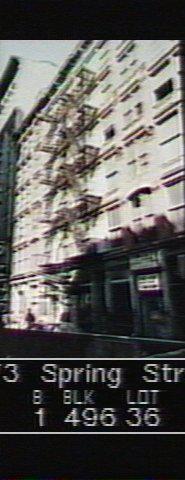
The city photographed every building for its tax records around 1940 and again in the 1980s. NYC Municipal Archives.
Written with AI from the source each entry cites, then fact-checked.
- 1888
Builder Philip Goerlitz buys four lots on Spring Street at auction and has Schneider & Herter design two factory stores
Court-ordered auctioneers sold the four lots at 67 to 73 Spring Street on May 3, 1888, and developer Philip Goerlitz won with a bid of $74,500. He hired Schneider & Herter for two six-story brick and iron stores, 50 feet wide each, costing $80,000. They share a Queen Anne facade, with cast iron storefronts and terra cotta ornaments carrying faces on the brick piers.
Source: Daytonian in Manhattan
- 1892
A brass dealer's clerk caught selling $500 of metal for $8 blames a partner's brother and is acquitted
Emile Beck worked for the brass merchants J. W. Carroll Company and was arrested in May 1892 for selling a pawnbroker stolen brass valued at $500 for just $8. At his trial on June 15 he reversed an earlier confession, claiming a Carroll relative had told him to sell it. Despite the unlikely story, the jury acquitted him after only 30 minutes, to the visible disgust of the judge.
Source: Daytonian in Manhattan
- 1895
An assembly investigator calls a Spring Street button factory a sweatshop, and the Times runs a headline on it
In June 1895 Edward Thimmie, on a committee investigating child and female labor in factories, visited the E. D. St. George button and ornament-card factory here. He listed it among the East Side sweatshops and described its workers as all immigrants, saying most of them lived on bologna and dry bread. Owner Edward St. George counted 21 men and 42 girls earning $5.50 to $7 a week.
Source: Daytonian in Manhattan
- 1906
A tailor shoots a coworker dead in Heller & Company's workroom, wounding her fiance before the shop's workers beat him
On November 26, 1906, Giuseppe Figlia, a 20-year-old Sicilian tailor hired three weeks earlier, shot Antoinetta Macciocia, a machine operator, dead at Heller & Company, saying she had mocked him. Her fiance Vincenzo Tanora struck Figlia with an iron bar and was shot in the jaw and shoulder. Policemen rescued Figlia from the workers, and he pleaded guilty in April 1907.
Source: Daytonian in Manhattan
- 1928
A stenographer plunges to her death in the elevator shaft during a failed payroll robbery
On December 10, 1928, stenographer Shirley Bergman, 20, returned from the bank with deposit checks, not payroll. Taxi driver Martin Baylos, who assumed she carried cash, attacked her in the elevator and she jumped into the shaft and died. Baylos pleaded guilty to manslaughter and went to Sing Sing, where he later played a judge in the prison's annual revue.
Source: Daytonian in Manhattan
Further reading
- "Working Their Lives Away" -- The 1890 Nos. 67-73 Spring StreetDaytonian in Manhattan
Nearby
- 65 Spring Street2 entries
- 71 Spring Street2 entries
- 238 Lafayette Street1 entry
- 63 Spring Street3 entries
- 240 Lafayette Street2 entries
- 75 Spring Street2 entries