Gabriel Winter House
242 West 14th Street | West Village | built 1910
Open on the map6 entries

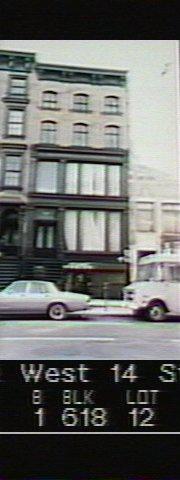
The city photographed every building for its tax records around 1940 and again in the 1980s. NYC Municipal Archives.
Written with AI from the source each entry cites, then fact-checked.
- 1853
Lawyer Gabriel Winter completes an Italianate brownstone to replace an older house on the lot
Winter, a wealthy lawyer and developer, bought the house and lease on the lot in early 1848 for $6,500 and replaced the old structure with a 25-foot-wide, four-story Italianate brownstone house over an English basement, completed in 1853. He lived here with his wife, his son and his daughter's family, the Livingstons. An 1860 guide to the city's wealthy men put his fortune at $1 million. The house was then numbered 120 West 14th Street; renumbering later made it No. 242.
Source: Daytonian in Manhattan
- 1879
William Winter wins a decade-long suit to undo a trust that put his brother-in-law in control of the house
After Gabriel Winter died in 1862 without a findable will, his son-in-law John Livingston tried to have the heir, William, declared insane; after 35 hearings William was found sane. A friendly lawyer then talked William into a trust deed that gave Livingston a hand in managing the property. In 1879 a court found the deed was obtained by false representations and undue influence. In 1881 Livingston produced Gabriel's long-missing will from a law book, but the judge dismissed his claim.
Source: Daytonian in Manhattan
- 1888
The Arlington League opens its new clubhouse here and, for one night, admits ladies
The Arlington League, a social club of men interested in the theater, leased the house from its owner, Mary Hungerford. At the opening on May 11, 1888, women were admitted for once, and the Evening World listed their gowns and jewels one by one. Guests tried the billiard table on the second floor, and an orchestra played for dancing. The club had left by 1890 and the house reverted to boarders.
Source: Daytonian in Manhattan
- 1891
Abolitionist and journalist James Redpath's funeral fills a parlor with about 300 mourners
The funeral of James Redpath took place on February 12, 1891, on the parlor floor, which resident Frederick Weaverson had been given use of. Redpath was an abolitionist, journalist and author who had been struck by a Fourth Avenue streetcar a week earlier. About 300 people viewed his casket in the drawing room, according to the Times. The mourners included many Black New Yorkers, supporters of the Irish cause, newspapermen and members of reform movements.
Source: Daytonian in Manhattan
- 1900
Painter Jerome Myers rents a $7-a-month skylit studio on the top floor
In 1900 Jerome Myers, later linked to the Ashcan School for his sympathetic scenes of city life, rented a skylit top-floor studio for $7 a month, the first of a series of artists to live upstairs. A neighbor, painter Edward Adam Kramer, sent a visiting art dealer to see his work. William Macbeth bought two paintings and invited him to bring more to his gallery. The lower floors had been renovated in 1897 by architect Frank Bayliss, who added a cast-iron storefront.
Source: Daytonian in Manhattan
- 1958
Abstract Expressionist Franz Kline moves into a second-floor loft
Kline, who worked alongside Jackson Pollock and Willem de Kooning, took a room on the second floor in 1958. A receipt shown in a 2011 Morgan Library exhibition records him buying more than $274 of wine, Scotch, cognac and champagne from a Village liquor store on December 31, 1960, delivered to his loft at 242 West Fourteenth Street. The building had earlier housed the Depression-era painters Moses Soyer and Gaston Longchamp.
Source: Daytonian in Manhattan
Further reading
- The Gabriel Winter House - 242 West 14th StreetDaytonian in Manhattan
Nearby
- 240 West 14th Street5 entries
- New York Public Library Jackson Square Branch251 West 13th Street | 5 entries
- 245 West 13th Street5 entries
- Pierre Ouvrier House247 West 13th Street | 5 entries
- 254 West 14th Street4 entries
- 241 West 13th Street3 entries