245 West 13th Street
West Village | built 1854
Open on the map5 entries

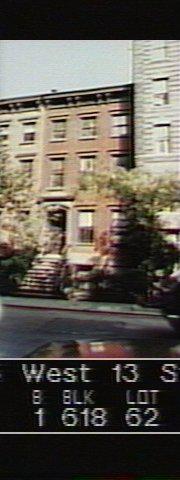
The city photographed every building for its tax records around 1940 and again in the 1980s. NYC Municipal Archives.
Written with AI from the source each entry cites, then fact-checked.
- 1854
Mary Ann C. Rogers builds six Italianate houses on West 13th Street, including No. 245
Mary Ann C. Rogers worked in a real estate development field that was then almost entirely male, and in 1854 she built a row of six Italianate houses, each 21 feet wide. No. 245 has three bays and three stories over a rusticated brownstone basement, reached by a high stoop to a double-doored entrance with a segmental arch. Its cornice, topped by plain blocks, avoids the carved pediments and brackets that were popular in the style.
Source: Daytonian in Manhattan
- 1882
The Mulry family, Irish Catholic builders, settle into No. 245 with a large family
William Mulry, a builder and member of the Real Estate Exchange, bought the house in January 1882 for $9,740, but his brother Thomas Maurice Mulry's family moved in. The brothers had come from Ireland in the 1840s and started as construction laborers known as cellar-diggers. Thomas and his wife Parthenia had 14 children, four of whom became priests and two nuns, and her funeral was held in the house in 1902.
Source: Daytonian in Manhattan
- 1913
The Florence Crittenton Mission buys No. 245 as a home for women in need
The New York Press reported on May 14, 1913 that the Florence Crittenton Mission, founded in 1883, had bought the house after selling its Bleecker Street property, where it had been for about 35 years. Residents, who included unwed mothers and women the mission hoped to steer away from prostitution, shared the housework, and gospel services were held here. The Evening Telegram reported that its first Thanksgiving in the house fed 300 people.
Source: Daytonian in Manhattan
- 1935
Tenant Stanley Wescott, a payroll robber, is caught while plotting a Pennsylvania coal payroll job
By 1935 the house was a rooming house, and one tenant was Stanley Wescott, 25, who with 20-year-old Joseph Fletcher had stolen the $7,500 Swift & Co. payroll in August 1934. The pair then scouted a coal-mining payroll in Cambria County, Pennsylvania, checking the post office daily. Their flashy clothes made the postmistress suspicious, weapons were found in their hotel room, and the New York Post ran the story on September 16.
Source: Daytonian in Manhattan
- 2014
Artist Angel Oliveros turns the house back into a single-family home with salvaged Plaza Hotel banisters
The house had been converted in 1946 to a duplex on the lower floors with one apartment on each upper floor. In 2014 the artist Angel "Vlady" Oliveros reconverted it to a single-family house. To replace lost interior features he recycled pieces such as banisters from the Plaza Hotel and an earthenware soaking tub from the 1920s.
Source: Daytonian in Manhattan
Further reading
- The Thomas M. Mulry, Sr. House - 245 West 13th StreetDaytonian in Manhattan
- Then & Now photos: 245 West 13th StreetVillage Preservation: Greenwich Village Then & Now
Nearby
- Pierre Ouvrier House247 West 13th Street | 5 entries
- 241 West 13th Street3 entries
- New York Public Library Jackson Square Branch251 West 13th Street | 5 entries
- 240 West 14th Street5 entries
- Gabriel Winter House242 West 14th Street | 6 entries
- Panhard & Levassor Building230 West 13th Street | 5 entries