Bernard B. Jacobs Theatre
242 West 45th Street | Times Square | built 1927
Open on the map14 entries

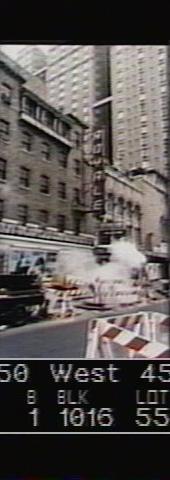
The city photographed every building for its tax records around 1940 and again in the 1980s. NYC Municipal Archives.
Written with AI from the source each entry cites, then fact-checked.
- 1927
The Royale Theatre opens as the first of the Chanin brothers' three theaters on the block
Irwin and Henry Chanin razed the brownstones on the block to build the Lincoln Hotel and three theaters on the block, all designed by Herbert Krapp: the large Majestic, the mid-sized Royale and the small Masque. The Royale opened first, on January 11, 1927, with the comedy Piggy, which had a weak script but was carried by comedian Sam Bernard for 79 performances. The Chanins meant the 1,200-seat house for musical comedies.
Source: Wikipedia
- 1928
Mae West's Diamond Lil gives the Royale its first major hit
The Royale's first straight play, Sh! The Octopus, came in 1928. Later that year the theater scored its first major success with Diamond Lil, the play by Mae West. West returned in 1931 with The Constant Sinner and again in 1944 in Catherine Was Great, both at the Royale. The Shubert brothers had by then bought out the Chanins' half-interest in the three theaters in 1929.
Source: Wikipedia
- 1930
Ethel Waters and Buck and Bubbles star in Lew Leslie's Blackbirds of 1930
Lew Leslie's Blackbirds of 1930 plays the Royale, starring Ethel Waters and the duo Buck and Bubbles, with a score by Eubie Blake that features Memories of You. A string of unsuccessful productions then follows, until John Golden's production of the comedy When Ladies Meet opens in 1932.
“Ethel Waters and Buck and Bubbles starred in Lew Leslie's Blackbirds of 1930, with songs by Eubie Blake that included "Memories of You.”
- 1933
Both Your Houses wins the Pulitzer Prize despite lukewarm reviews
The Theatre Guild stages Maxwell Anderson's Both Your Houses, a satire aimed at the United States Congress, at the Royale in 1933. Reviews are lukewarm, yet the play takes the Pulitzer Prize that year. The Guild's other production there, John Wexley's They Shall Not Die, draws on the Scottsboro case and stars Claude Rains and Ruth Gordon.
“Both Your Houses, a satire about the United States Congress, which won the Pulitzer Prize in 1933, despite lukewarm reviews…”
- 1934
John Golden renames the Royale for himself
The producer and playwright John Golden had been awarded management of the Royale by the courts in 1932, as a co-receiver during the Shuberts' Depression troubles, leaving his own theater on West 58th Street to take it on. When his lease is renewed in 1934, he renames the house the John Golden Theatre.
- 1937
CBS turns the Royale into Radio Theatre No. 1 after the Depression auction
After the Majestic, Masque and Royale were auctioned in November 1936 to cover a $2 million mortgage, the Shuberts leased the Royale to CBS Radio. CBS began using it in January 1937 as a broadcast studio called CBS Radio Theatre No. 1, one of several Times Square theaters it converted. The studio closed in May 1940 for lack of programming, and the Royale assumed its old name and reopened on October 21, 1940, with the musical Du Barry Was a Lady.
Source: Wikipedia
- 1950
Richard Burton makes his Broadway debut in The Lady's Not for Burning
Richard Burton makes his Broadway debut at the Royale in 1950, appearing with John Gielgud in The Lady's Not for Burning, a verse play by Christopher Fry. The same year Maurice Evans stars in a revival of Shaw's The Devil's Disciple, and in 1951 Claude Rains wins a Tony Award for Darkness at Noon, which transfers in from the Alvin.
“Richard Burton made his Broadway debut in Christopher Fry's verse play The Lady's Not for Burning with John Gielgud.”
- 1954
A single performance of The Starcross Story becomes the Royale's shortest run
In 1954 The Starcross Story plays one lone performance at the Royale, the shortest production the theater has on record. The same year the house hosts The Immoralist and The Boy Friend, a musical that carries Julie Andrews's Broadway debut.
Source: Wikipedia
- 1958
MGM books the Royale for two days to premiere the film Gigi
After Laurence Olivier's run in John Osborne's The Entertainer, in which he played a seedy vaudevillian, ends in 1958, MGM contracts the Royale for two days to hold the opening premiere of its new film Gigi. The theater then returns straight to stage shows, including the revue La Plume de Ma Tante, which plays 835 performances starting in 1959.
“MGM contracted for two days at the Royale to hold the opening premiere of the new film Gigi.”
- 1965
Cactus Flower opens with Lauren Bacall and runs 1,234 performances
In 1965 Lauren Bacall and Barry Nelson open in Cactus Flower, which runs 1,234 performances. The same year The Subject Was Roses, at the Royale, collects the Pulitzer Prize and the Drama Critics' Circle Award, and Jack Albertson wins a Tony Award for his performance in it.
“That same year Lauren Bacall and Barry Nelson opened in The Cactus Flower, which ran for 1,234 performances.”
- 1972
Grease opens at the Royale and runs until 1980, becoming the longest-running show on Broadway
From 1972 to 1980 the Royale was home to the musical Grease, which went on to become the longest-running show in Broadway history at that time. By the time it left, the set was peeling. The theater had earlier hosted the comedy Cactus Flower, which opened in 1965 and played 1,234 performances, and in 1954 the musical The Boy Friend, which gave Julie Andrews her Broadway debut.
Source: Wikipedia
- 1980
Mary Tyler Moore takes a lead role rewritten for a woman in Whose Life Is It Anyway?
In 1980 Whose Life Is It Anyway? returns to Broadway at the Royale in a rewritten version that lets a woman, Mary Tyler Moore, play the leading role. The commission's list of notable productions also names Joseph and the Amazing Technicolor Dreamcoat in 1982 and Andrew Lloyd Webber's Song and Dance with Bernadette Peters in 1985.
- 1987
The Landmarks Commission designates the Royale's facade and interior
In December 1987 the Landmarks Preservation Commission designated the Royale's facade and interior as part of its campaign to protect Broadway theaters. The Shuberts, the Nederlanders and Jujamcyn sued in June 1988 to overturn the designations of 22 theaters, arguing that the status limited how the buildings could be modified. The designations were ultimately upheld in 1992, after the case went up to the U.S. Supreme Court.
Source: Wikipedia
- 2005
The Royale is renamed for Shubert Organization president Bernard B. Jacobs
In September 2004 the Shubert Organization's board voted to rename the Royale for Bernard B. Jacobs, who lived from 1916 to 1996 and had long served as the company's president, and to rename the neighboring Plymouth for then-president Gerald Schoenfeld. A marquee-replacement ceremony made the change official on May 9, 2005. Jacobs's family welcomed the honor, but some producers and theater fans objected, even though naming houses after producers was an old Broadway custom.
Source: Wikipedia
Further reading
- Bernard B. Jacobs TheatreWikipedia
Nearby
- John Golden Theatre252 West 45th Street | 14 entries
- Majestic Theatre245 West 44th Street | 16 entries
- Gerald Schoenfeld Theatre (Plymouth Theatre)236 West 45th Street | 14 entries
- Row NYC Hotel (Hotel Lincoln, Milford Plaza)700 8th Avenue | 9 entries
- Broadhurst Theatre235 West 44th Street | 12 entries
- Music Box Theatre239 West 45th Street | 14 entries