Gerald Schoenfeld Theatre (Plymouth Theatre)
236 West 45th Street | also 234 West 45th Street | Times Square | built 1918
Open on the map14 entries

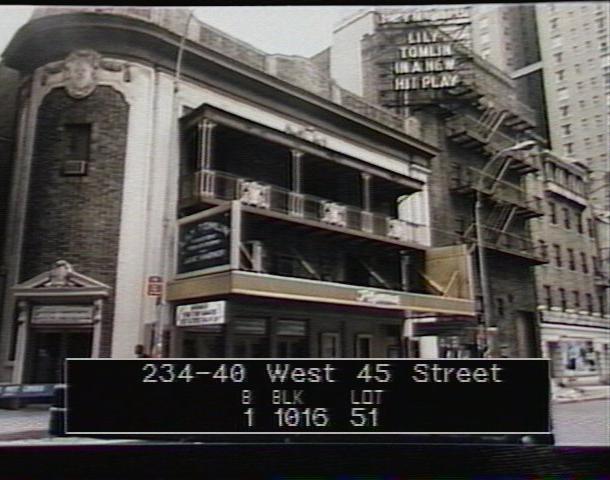
The city photographed every building for its tax records around 1940 and again in the 1980s. NYC Municipal Archives.
Written with AI from the source each entry cites, then fact-checked.
- 1917
The Plymouth Theatre opens with A Successful Calamity, built by the Shuberts for producer Arthur Hopkins
Architect Herbert J. Krapp filed plans for a theater at 234 West 45th Street in December 1916, and the Shubert brothers leased it to producer Arthur Hopkins in July 1917. Hopkins could choose the name, so it became the Plymouth, though the Shuberts' names had to appear on programs and on the building. Its first show, on October 10, 1917, was the comedy A Successful Calamity, a transfer from the neighboring Booth Theatre.
“The Plymouth opened on October 10, 1917, with the comedy A Successful Calamity, which had transferred from the Booth Theatre.”
Source: Wikipedia
- 1917
Arthur Hopkins, called the Sphinx of 45th Street, makes the Plymouth his base from opening day until his death in 1950
The city's landmark report calls Arthur Hopkins one of the most unusual producers Broadway has had. He brought Ibsen to the stage early, produced Eugene O'Neill's first financial success, Anna Christie, and was friend and producer to the Barrymores, including John Barrymore's best-known appearance, in Hamlet. Nicknamed the Sphinx of Forty-fifth Street, Hopkins and the Plymouth were so closely linked that the report treats each as the other's identity.
- 1919
John and Lionel Barrymore star together in The Jest, which runs 179 performances
Producer Arthur Hopkins brought Sem Benelli's drama The Jest to the Plymouth in 1919 with the brothers John and Lionel Barrymore in the leading roles. It ran for 179 performances. John Barrymore had already appeared at the theater the year before in Hopkins's production of Tolstoy's Redemption, and he returned in 1920 for Richard III. A 1926 revival without the Barrymores lasted only 78 performances.
Source: Wikipedia
- 1924
Hopkins directs and produces What Price Glory? at the Plymouth
In September 1924 Arthur Hopkins directs and produces What Price Glory? at the Plymouth. The play is a portrait of army buddies in wartime France, with William Boyd and Louis Wolheim in the leading roles. The Landmarks Preservation Commission says it set a new standard for realism in American drama and ran 435 performances in 1924-25.
“One of the most important plays of the decade, What Price Glory? debuted at the Plymouth in September 1924.”
- 1927
Burlesque makes Barbara Stanwyck a star
The hit Burlesque of 1927 establishes Barbara Stanwyck as a star, according to the landmark report. It follows Winthrop Ames's Gilbert and Sullivan revivals of 1926, which brought long runs to the house, and precedes Philip Barry's comedy Holiday, written for the socialite actress Hope Williams, which is both a popular and critical success in 1928.
“Barbara Stanwyck was established as a star in the hugely successful Burlesque (1927)…”
- 1928
Machinal, Sophie Treadwell's play inspired by Ruth Snyder, opens with Zita Johann and a young Clark Gable
Arthur Hopkins staged Sophie Treadwell's Machinal at the Plymouth, where it opened on September 7, 1928, and closed on November 24 after 91 performances. Zita Johann played the central role of the Young Woman, and Clark Gable made his Broadway debut in the cast. The play was inspired by the case of Ruth Snyder, a convicted murderer, and was noted for its expressionistic style.
Source: playbill.com
- 1938
Two Pulitzer Prize winners run at the Plymouth, Abe Lincoln in Illinois in 1938 and The Skin of Our Teeth in 1942
Robert E. Sherwood's Pulitzer-winning Abe Lincoln in Illinois opened here in 1938 with Raymond Massey and ran for a year. The Shubert Organization's history of the house also lists Thornton Wilder's Pulitzer-winning The Skin of Our Teeth, which starred Tallulah Bankhead in 1942. It adds Barbara Stanwyck in Burlesque, which had played the theater back in 1927.
Source: shubert.nyc
- 1952
Boyer, Laughton, Hardwicke and Moorehead perform Shaw's Don Juan in Hell
The Landmarks Preservation Commission's history of the house records that Charles Boyer, Charles Laughton, Cedric Hardwicke and Agnes Moorehead took part in Don Juan in Hell in March 1952, a piece excerpted from Shaw's Man and Superman and called critically acclaimed. Later that year the thriller Dial M for Murder, with Maurice Evans, opens and holds audiences for 552 performances.
“In March 1952 Charles Boyer, Charles Laughton, Cedric Hardwicke and Agnes Moorehead appeared in the critically acclaimed Don Juan in Hell…”
- 1965
Neil Simon's The Odd Couple premieres with Walter Matthau and Art Carney, followed by Plaza Suite
Neil Simon's comedy The Odd Couple opened at the Plymouth in 1965 with Walter Matthau and Art Carney and stayed more than a year before transferring. Simon's The Star-Spangled Girl followed in late 1966. His Plaza Suite arrived in 1968 with Maureen Stapleton and George C. Scott and played 1,097 performances over the next two years, and The Gingerbread Lady, again with Stapleton, opened in 1970.
“Plaza Suite, which opened in 1968 with Maureen Stapleton and George C. Scott; it had 1,097 performances over the next two years.”
Source: Wikipedia
- 1974
Equus, with Anthony Hopkins, wins Tonys for best play and best director
In 1974 Peter Shaffer's Equus, with Anthony Hopkins, takes the best play and best director Tonys while playing the Plymouth. British work was a thread of the decade at the house: Peter Cook and Dudley Moore starred in Good Evening in 1973, and Simon Gray's Otherwise Engaged played 309 performances in 1977.
“Peter Shaffer's Equus with Anthony Hopkins won Tony Awards for best play and best director in 1974…”
- 1981
Catwalks are built inside the theater for the eight-hour Nicholas Nickleby
To fit the Royal Shakespeare Company's The Life and Adventures of Nicholas Nickleby, catwalks are installed inside the Plymouth in 1981. The production is unusual for its $100 ticket price and for lasting eight hours per performance. It stays at the theater for three months.
“…catwalks were installed within the theater to accommodate the Royal Shakespeare Company's production of The Life and Adventures of Nicholas Nickleby…”
Source: Wikipedia
- 1987
The Landmarks Preservation Commission designates the Plymouth after hearing 81 speakers in favor
The commission held hearings on the Plymouth in June and October 1982, and its designation report is dated December 8, 1987. Eighty-one witnesses spoke or had statements read in support and one opposed, while the owner said he had not formed an opinion. The report describes it as one of a pair with the Broadhurst, built by the Shubert Organization to designs by Herbert J. Krapp.
“Eighty-one witnesses spoke or had statements read into the record in favor of designation. One witness spoke in opposition to designation.”
- 1988
Broadway's big landlords sue to overturn landmark status for 22 theaters, the Plymouth included
In June 1988, six months after the Plymouth's designation, the Shuberts, the Nederlanders and Jujamcyn jointly sue the Landmarks Preservation Commission to overturn the landmark status of 22 theaters, including this one, arguing that it sharply limits how the buildings can be altered. The case climbs to the New York Supreme Court and the United States Supreme Court, and the designations are finally upheld in 1992.
Source: Wikipedia
- 2017
Come From Away sets the theater's box-office record at $1.83 million in a week
Come From Away opens at the Schoenfeld in March 2017 and, for the week ending December 31, 2017, grosses $1,834,218 over nine performances, the theater's box-office record. It plays until the theater closes on March 12, 2020, returns when the house reopens on September 21, 2021, and closes in October 2022, the longest run the theater has had.
“The current record for the Gerald Schoenfeld Theatre was set by the 2017 musical Come From Away. The production grossed $1,834,218 over nine performances…”
Source: Wikipedia
Further reading
- Gerald Schoenfeld TheatreWikipedia
Nearby
- Booth Theatre222 West 45th Street | 14 entries
- Bernard B. Jacobs Theatre242 West 45th Street | 14 entries
- Broadhurst Theatre235 West 44th Street | 12 entries
- Music Box Theatre239 West 45th Street | 14 entries
- Shubert Theatre225 West 44th Street | 14 entries
- John Golden Theatre252 West 45th Street | 14 entries