Cunard Building
25 Broadway | also 25B Broadway, 25 Greenwich Street, 25A Broadway | Financial District | built 1921
Open on the map12 entries

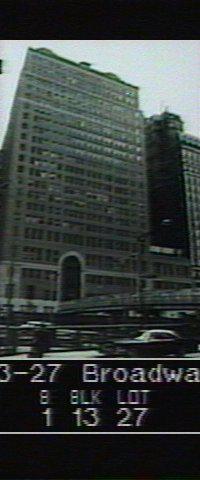
The city photographed every building for its tax records around 1940 and again in the 1980s. NYC Municipal Archives.
Written with AI from the source each entry cites, then fact-checked.
- 1846
The Delmonico brothers open a restaurant and hotel on the site of the future Cunard Building
Long before the Cunard headquarters, the site at the foot of Broadway held Dutch colonial houses, one belonging to a skipper named Lucas Andries as early as 1660. The Swiss-born restaurateurs Joseph and Lorenzo Delmonico started a restaurant and hotel there in 1846. It reopened in 1856 as the Stevens House, a name that survived into the twentieth century.
“In 1846, Swiss-born restaurateurs Joseph and Lorenzo Delmonico ... opened a restaurant and hotel on the site. Reopened as the Stevens House hotel in 1856…”
- 1856
The Stevens House draws shipbuilders, inventors and Civil War figures
After reopening as the Stevens House in 1856, the hotel became known among people in shipping and trade. A 1919 Times article, cited in the landmark report, names guests including George Steers, who built the yacht America; the Monitor's inventor John Ericsson; Commodore Vanderbilt; and the Civil War figures Robert E. Lee and Stonewall Jackson. By the early 1900s the name applied to two five-story buildings at the northeast corner of the block.
“Stevens House clients: George Steers, builder of the famous yacht "America"; John Ericsson, inventor of the "Monitor"; ... Robert E. Lee, Stonewall Jackson…”
- 1918
Irons & Todd assemble the Broadway site for $5 million
In February 1918 the real estate firm Irons & Todd acquired the separate lots for $5 million and set up a building company, Todd, Irons & Robertson, to erect an office tower. They planned to hand it to a Cunard-linked company, the Twenty-Five Broadway Corporation, headed by the Cunard official Thomas Ashley Sparks. The assembled property was the largest single holding in lower Manhattan at that time, and the biggest real estate deal since the preparations for the Equitable Building.
“In February 1918 ... Irons & Todd acquired the individual lots for $5 million and formed the construction concern of Todd, Irons & Robertson, Inc.”
- 1920
A blast at the Cunard excavation hurts six subway riders
In February 1920, while the Cunard Building's site was being excavated, a blast sent rocks into a B.R.T. subway train near Whitehall. The New York Times reported on February 19 that six passengers were hurt. The headline tied the rocks to the excavation for the Cunard Building.
Source: Internet Archive
- 1921
The Cunard Line opens its new Broadway headquarters
Benjamin Wistar Morris designed the building, with Carrere & Hastings as consultants, for the British steamship operator Cunard Line. Its foundation had to be built around a subway line crossing the site diagonally. It opened in May 1921 at a cost of $15 million and was almost fully leased, with tenants including Atlas Portland Cement and Anaconda Copper.
Source: Wikipedia
- 1921
Ezra Winter paints maritime frescoes on the Great Hall ceiling
The Great Hall, where Cunard sold tickets, was described when completed as the largest room of its kind in the United States and was compared to railroad waiting rooms. Its central dome is 65 feet tall, and Ezra Winter painted its ceiling with maritime frescoes. Barry Faulkner added murals of maps showing the routes the Cunard Line operated.
Source: Wikipedia
- 1953
Two penthouse apartments are meant for Cunard's resident director and its night cable receiver
In a letter dated September 25, 1953, the Twenty-five Broadway Corporation told the city's Superintendent of Buildings what two penthouse apartments atop the Cunard Building were for. One was meant as a home for the Cunard resident director. The other was for the employee who received the company's cablegrams overnight.
“…one was intended as a residence for the Cunard resident director, the other as an apartment for the Cunard night cablegram receiver.”
- 1968
Cunard moves out and the Great Hall is later leased to the Postal Service
The Cunard Line operated its ticket hall at 25 Broadway until 1968, when it moved to 555 Fifth Avenue. The United States Postal Service leased the Great Hall in 1974 and occupied it until 2000. By 1977 Standard & Poor's had signed a lease for space in the tower, and the building became known as the Standard & Poor's Building in the 1970s.
Source: Wikipedia
- 1995
The city designates the Cunard Building a landmark after a hearing with no opposition
The Landmarks Preservation Commission designated the Cunard Building on September 19, 1995, after a May 16 hearing. Eleven witnesses spoke in favor, among them Councilwoman Kathryn Freed and speakers for the American Institute of Architects' New York chapter, the Municipal Art Society and the New York Landmarks Conservancy. No one spoke against it, and the owner's representative took no position.
“Eleven witnesses spoke in favor of designation ... No one spoke in opposition…”
- 2002
Deloitte moves into three floors after losing its World Trade Center offices
Deloitte leased three floors of the Cunard Building in 2002, after the September 11 attacks destroyed its offices at the World Trade Center. The landmark built for a steamship line thus became home to a firm displaced by the attacks. Its upper floors held a mix of tenants that later included schools and colleges.
“In 2002, Deloitte leased three floors of the Cunard Building after its previous offices at the World Trade Center were destroyed in the September 11 attacks.”
Source: Wikipedia
- 2014
Cipriani leases the Great Hall for an event venue
In 2014 the Great Hall was leased to Cipriani S.A., which runs it as an event venue. Upper floors have also found new uses, with Leman Manhattan Preparatory School occupying the top four floors since 2010. WeWork also operated a coworking space in the building from 2013 to 2021.
Source: Wikipedia
- 2024
The Cunard Building's owners default on a $250 million loan with 30 percent of the building empty
By April 2024 the owners had failed to repay a $250 million loan packaged into a commercial mortgage-backed security, and about 30 percent of the building stood vacant. Lenders agreed to postpone foreclosure after Wolfson paid $7 million toward the debt. One of the largest tenants, the Léman Manhattan school, had stopped paying rent in a rent strike that continued until May 2025.
Source: Wikipedia
Further reading
- Cunard Building (New York City)Wikipedia
Nearby
- Bowling Green Offices Building11 Broadway | 10 entries
- Harriman Building39 Broadway | 3 entries
- 1 Broadway14 entries
- Standard Oil Building26 Broadway | 11 entries
- Downtown Athletic Club20 West Street | 10 entries
- Seamens Church Institute50 Broadway | 4 entries