Bowling Green Offices Building
11 Broadway | also 11 Greenwich Street, 9 Broadway, 7 Broadway | Financial District | built 1898
Open on the map10 entries

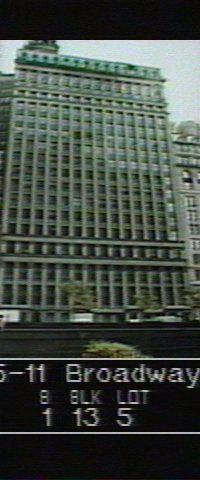
The city photographed every building for its tax records around 1940 and again in the 1980s. NYC Municipal Archives.
Written with AI from the source each entry cites, then fact-checked.
- 1895
Stacy Richmond buys a lot once home to the Atlantic Garden and a railroad freight depot
In June 1895 Stacy C. Richmond bought the lot facing Bowling Green from the attorney Joseph F. Stier, and the Broadway Realty Company submitted its building application the following month. Dutch colonists had occupied the ground by the 1650s. For many years in the 1800s it was home to the Atlantic Garden, a popular amusement resort, and later to the New York Central & Harlem River Railroad's freight depot. These earlier uses belong to the site, not to the present building.
“…it was the location of the Atlantic Garden, a popular place of amusement, and, subsequently, a freight depot…”
- 1895
Financier Spencer Trask, the largest stakeholder, keeps a top-floor suite while profits fund Yaddo
The Broadway Realty Company, which submitted its plans in July 1895, had a board that included the philanthropist Spencer Trask, the largest stakeholder in the building. He kept a suite on the top floor for several years. Profits from the building went toward Yaddo, the artists' community near Saratoga Springs that Trask had founded.
“Spencer Trask, who, being the largest stakeholder in the building, would maintain a suite on the top floor for several years…”
Source: Wikipedia
- 1897
The Audsley brothers, the building's architects, keep their own office in it for five years
George and William Audsley, brothers who had opened an architectural office in New York in 1892, ran their firm from inside the Bowling Green Offices Building from 1897 to 1902. Their two most prominent American works were this building and the Layton Art Gallery in Milwaukee. George had earlier moved to London to write, and the brothers published more than twenty-five books on craftsmanship and decorative art.
- 1898
W. and G. Audsley complete the Bowling Green Offices Building
Architects W. and G. Audsley complete the Bowling Green Offices Building in November 1898, after construction began in 1895. Philanthropist Spencer Trask, a director of the developer Broadway Realty Company and the building's largest stakeholder, keeps a suite on the top floor for several years. The white-granite-based building has an estimated hundred-plus anthemia on its facade and used over 5,000 tons of steel in its frame.
Source: Wikipedia
- 1899
The Red Star Line advertises transatlantic crossings from its Broadway office
The Red Star Line, a shipping company distinct from the ill-fated White Star Line, runs its New York office from 9 Broadway, offering passenger service between Belgium and American ports from 1871 into the 1930s. A 1899 promotional poster by artist Henri Cassiers depicts the line's 16,000-ton steamship Westernland making the crossing.
Source: Ephemeral New York
- 1903
Spencer Trask offers the entire building as bail for his arrested driver
The New-York Tribune reported in 1903 that, after Trask's automobile driver was arrested, the financier offered the Bowling Green Offices Building to cover the man's bail. The building was valued at $1 million, while the bail was $500.
“Trask had offered the $1 million Bowling Green Offices Building to cover his driver's $500 bail amount…”
Source: Wikipedia
- 1912
Crowds gather outside the White Star Line's office awaiting Titanic survivors' names
As word spreads that the Titanic has sunk, anxious New Yorkers gather outside the White Star Line's headquarters at 9 Broadway, the crowd spilling across the sidewalk and Bowling Green. A company spokesman initially assures the crowd the ship is safe, but incoming wireless reports gradually reveal the disaster's scale; on the evening of April 18, the rescue ship Carpathia finally docks with survivors.
Source: Ephemeral New York
- 1915
Seven elevators drop down their shafts with 30 people aboard, and nobody is hurt
In 1915 seven of the building's elevator cars fell down their shafts carrying 30 people between them. Safety systems slowed each cab near the bottom, so no one was hurt. The next year four cabs dropped at once and a man was injured. The building had opened with 16 elevators, eight of them clustered in the northern lobby.
“In 1915, seven elevators dropped down their shafts with a combined 30 people in the cabs, though no one was hurt…”
Source: Wikipedia
- 1920
Five stories are added, raising the tower to 21 floors
Architects Ludlow and Peabody add five stories to the Bowling Green Offices Building in 1920 and 1921, expanding it from 16 to 21 floors. The enlarged tower keeps its white-granite colonnaded base and terra-cotta ornament, and later receives city landmark status in 1995 before joining the Wall Street Historic District in 2007.
Source: Wikipedia
- 1995
The Landmarks Preservation Commission designates the building after eleven witnesses speak in favor
At a hearing on May 16, 1995, eleven witnesses backed designation, among them Councilwoman Kathryn Freed and representatives of the Municipal Art Society, the New York Landmarks Conservancy and the local AIA chapter. No one spoke against it, and the owners' representative took no position. The commission designated the building a landmark on September 19, 1995.
Further reading
- Bowling Green Offices BuildingWikipedia
- Waiting for word about the Titanic survivorsEphemeral New York
- Crossing the Atlantic on the Red Star LineEphemeral New York
- Old phone exchange: Digby 4-8260Ephemeral New York
Nearby
- 1 Broadway14 entries
- Cunard Building25 Broadway | 12 entries
- Standard Oil Building26 Broadway | 11 entries
- Battery Park Control House10 Battery Park | 5 entries
- Alexander Hamilton U.S. Custom House1 Bowling Grn | 12 entries
- Whitehall Building17 Battery Place | 6 entries