25 Cleveland Place
Nolita | built 1900
Open on the map4 entries

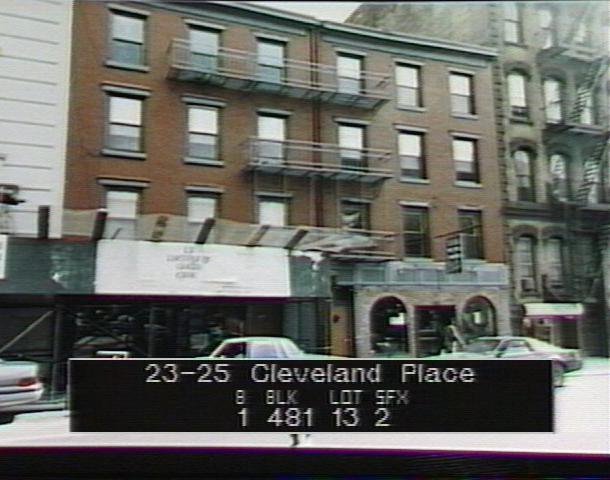
The city photographed every building for its tax records around 1940 and again in the 1980s. NYC Municipal Archives.
Written with AI from the source each entry cites, then fact-checked.
- 1851
Immigrant families crowd a Greek Revival house and its rear building on Marion Street
By 1851 this 25-foot-wide Greek Revival brick house, then on Marion Street, held several immigrant families, and a second building in the rear yard housed poorer tenants still. Classified ads placed from the address that decade show residents seeking work as a nurse and seamstress, a cook and washer, and a coachman and gardener. By the Civil War's end the surrounding blocks were known as the Italian District.
Source: Daytonian in Manhattan
- 1908
Marion Street is renamed Cleveland Place after Grover Cleveland's death
Marion Street was renamed Cleveland Place in honor of Grover Cleveland, who had served as president and as governor of New York, after his death in 1908. During Prohibition the streets around this address, a block from Police Headquarters, were nicknamed the "whiskey curb market" for the bootlegging done there.
Source: Daytonian in Manhattan
- 1939
Barber Salvatore Di Sapio is arrested for trying to influence a juror in the Hines trial
By the 1930s the ground floor held Salvatore Di Sapio's barbershop, which also served as a polling place, and Tammany Hall leader Albert Marinelli voted there in November 1937. Officials from District Attorney Thomas E. Dewey's office arrested Di Sapio on March 1, 1939 for trying to influence a juror in the trial of Tammany figure James J. Hines. He was sentenced to an indeterminate term that could run from six months to three years.
Source: Daytonian in Manhattan
- 2007
A stop-work order halts the renovation of Nos. 23 and 25 Cleveland Place
La Locanda Di Giotto took over the old barbershop space in 1986 and Caffe Giardino followed in 1991. In 2006 the buyer of Nos. 23 and 25 hired an architect to rebuild the pair as a condominium, but the permits excluded roof removal. Contractors tore off the roof of No. 23 anyway, and the city issued a stop-work order in 2007. By 2016 No. 23 was still partly demolished.
Source: Daytonian in Manhattan
Further reading
- Battered and Endangered -- No. 25 Cleveland Pl.Daytonian in Manhattan
Nearby
- Storefront for Art and Architecture87 Kenmare Street | 3 entries
- Former Con Edison substation214 Lafayette Street | 4 entries
- 63 Spring Street3 entries
- 210 Lafayette Street1 entry
- 65 Spring Street2 entries
- A.I.R. Gallery building63 Crosby Street | 3 entries