63 Spring Street
also 234 Lafayette Street, 236 Lafayette Street | SoHo | built 1897
Open on the map3 entries

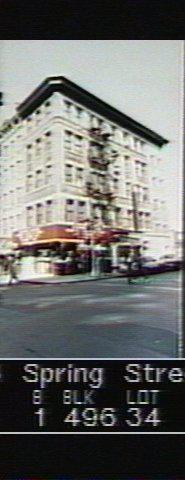
The city photographed every building for its tax records around 1940 and again in the 1980s. NYC Municipal Archives.
Written with AI from the source each entry cites, then fact-checked.
- 1897
Lafayette Street's widening forces a new facade and factory use at 63 Spring Street
Architect Julius Kastner redesigned this former dwelling in 1897, while the city was widening Lafayette Street, and the building was converted from residence to manufacturing. The result is a five-story Renaissance Revival store and factory building, with terra-cotta spandrel panels and a bracketed metal cornice, whose upper floors later became residential.
- 1930
63 Spring Street holds the United Cigar Co. in the 1920s and the Lafayette Smoke Shop from 1967
Over the twentieth century this corner building held a succession of tenants. The United Cigar Co. was listed there from 1920 to 1930, the Dallek Office Equipment Co. in 1930, and the Lafayette Smoke Shop from 1967 to 1999. The Landmarks Preservation Commission cites New York Times notices from 1930, 1967, 1992 and 1999 among its references.
“United Cigar Co. (1920-30); the Dallek Office Equipment Co. (1930); and the Lafayette Smoke Shop (1967-1999)…”
- 1965
The upper floors of 63 Spring Street become artists' live/work lofts, and designer Ken Brown later lives there
In the 1960s the upper floors were turned into artists' live/work space, part of SoHo's rise as an art center in the later twentieth century. The Landmarks Preservation Commission names the designer and illustrator Ken Brown as one of its later occupants. The upper stories are still residential today.
“…upper floors were converted to artists’ live/work space in the 1960s, and the designer and illustrator Ken Brown was one its later occupants…”
Nearby
- 65 Spring Street2 entries
- 238 Lafayette Street1 entry
- 69 Spring Street5 entries
- 240 Lafayette Street2 entries
- 71 Spring Street2 entries
- 242 Lafayette Street5 entries