258 West 4th Street
West Village | built 1866
Open on the map3 entries

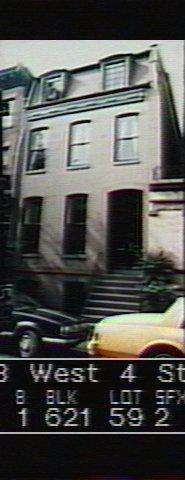
The city photographed every building for its tax records around 1940 and again in the 1980s. NYC Municipal Archives.
Written with AI from the source each entry cites, then fact-checked.
- 1866
Carriage dealer William H. Gray commissions William Naugle to build a Second Empire house
In 1866 William H. Gray, who ran a carriage business on Wooster Street, hired architect William Naugle to design a new family home on West 4th Street. Naugle brought the French Second Empire look, then in fashion, to the block. The brownstone front was a little wider than its neighbors, with a mansard roof above a deep English basement.
Source: Daytonian in Manhattan
- 1889
Gray advertises nearly 700 reconditioned second-hand carriages from his Wooster Street warehouse
The Sun reported on November 4, 1889 that William H. Gray, of 20-22 Wooster Street, had many English-style surreys and landaus for sale. He also held nearly 700 used carriages that he had bought cheaply in small lots and refurbished until they looked new, the paper said. A trade journal later described his firm as one of the largest of its kind in the city.
Source: Daytonian in Manhattan
- 1893
William H. Gray dies, after filling his West 4th Street house with paintings
Gray began work in the hardware business at 13 and rose to head one of the city's largest carriage firms. He was a School Commissioner for decades and also served on the board of trustees of the College of the City of New York. A trade journal noted that he collected paintings and loved his home. The family had moved to West 72nd Street by his death in 1893, and his son drove the firm into bankruptcy in 1898.
Source: Daytonian in Manhattan
Further reading
- The Wm. H. Gray House -- No. 258 W. 4th StreetDaytonian in Manhattan
- Then & Now photos: 258 West 4th StreetVillage Preservation: Greenwich Village Then & Now
Nearby
- 254 West 4th Street2 entries
- 55 Charles Street1 entry
- Congregation Darech Amuno53 Charles Street | 6 entries
- Arnet Seaman House51 Charles Street | 5 entries
- 253 West 4th Street1 entry
- 57 Charles Street1 entry