Dunbar Apartments
2594 Adam Clayton Powell Jr Boulevard | also 2588 Adam Clayton Powell Jr Boulevard, 2580 Adam Clayton Powell Jr Boulevard, 2802 Fredrick Douglass Bl | Harlem | built 1928
Open on the map12 entries

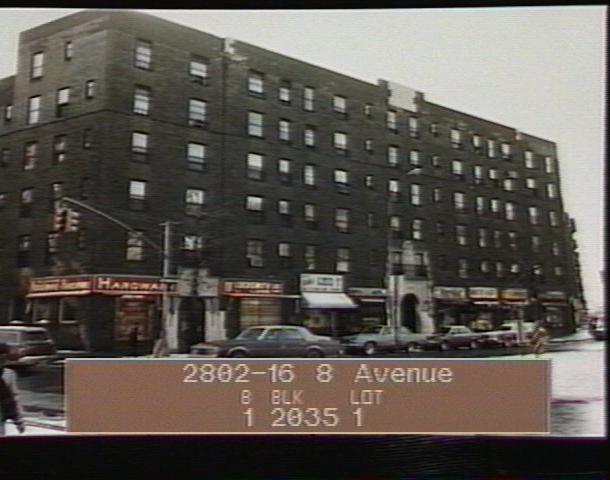
The city photographed every building for its tax records around 1940 and again in the 1980s. NYC Municipal Archives.
Written with AI from the source each entry cites, then fact-checked.
- 1926
Rockefeller buys a five-acre Harlem block from William Vincent Astor for $500,000
In 1925 the Urban League asked John D. Rockefeller Jr. to help finance second mortgages in Harlem, but his real interest was in building housing. Early in 1926 he purchased the five-acre block, paying William Vincent Astor $500,000, and brought in the architect Andrew J. Thomas, with whom he had worked before. Construction began in October 1926 and was finished by February 1928.
- 1927
The architects' institute gives the Dunbar first prize for walk-up apartments
In 1927 the New York Chapter of the American Institute of Architects awarded the Dunbar Apartments first prize for walk-up apartments. The complex was praised on all sides as a model of how housing should be planned. Andrew J. Thomas had argued since a 1919 prototype plan that covering half the land instead of 70 percent gave investors better returns and tenants more light and air.
- 1928
John D. Rockefeller Jr.'s Dunbar opens as a cooperative for Black New Yorkers
Financed by John D. Rockefeller Jr. and designed by Andrew J. Thomas, the Dunbar filled the block between West 149th and 150th Streets with six buildings holding 511 apartments around a garden courtyard. Named for poet Paul Laurence Dunbar, it opened in 1928 as a cooperative: tenants paid $50 a room down and $14.50 a room each month toward ownership. The Depression brought defaults, and Rockefeller foreclosed in 1936 and turned it into rentals.
Source: Wikipedia
- 1928
Every apartment in the Dunbar is sold within about seven months of sales opening
Sales of Dunbar apartments began on October 1, 1927, before the buildings were finished, and the rush was so great that every unit had been sold by May 12, 1928. Buyers had to become stockholders in the Paul Lawrence Dunbar Apartments Corporation, paying at least $150 down plus $50 a room, then monthly charges that averaged about $14 a room. Rockefeller held all of the corporation's preferred and voting stock.
“…all units were sold out by May 12, 1928…”
- 1928
The Dunbar National Bank opens on the complex's corner, Harlem's first bank with a Black manager
On September 15, 1928 the Dunbar National Bank opened at the corner of Eighth Avenue and 150th Street, among the stores that were part of the Dunbar development. The Landmarks Commission's report describes it as the first bank in Harlem and the first with a Black manager and staff.
“…the Dunbar National Bank opened on the corner of Eighth Avenue and 150th Street --Harlem's first bank and the first to have a Black manager and personnel…”
- 1928
Resident manager Roscoe Bruce calls the Dunbar 'an adventure in community building'
The Dunbar was completed in 1928. Roscoe C. Bruce, an educator, served as its resident manager until 1937 and described it as 'an adventure in community building'. Residents had a nursery and kindergarten, a playground, an athletic field, a clubroom for the older boys, men's and women's clubs, a forum, and a Board of Advisers chosen by the tenants. Vocational guidance, job placement and a legal aid bureau were added in its first year.
- 1936
John D. Rockefeller Jr. forecloses on the Dunbar after the Depression
Residents had bought in with $50 per room down and $14.50 a month toward ownership after 22 years, but the 1929 crash brings widespread defaults across the cooperative's six buildings. Rockefeller forecloses in 1936, and by 1937 the complex has converted from cooperative ownership to ordinary rental apartments.
Source: Wikipedia
- 1937
Rockefeller sells the Dunbar Apartments less than a year after foreclosing
On October 29, 1937, John D. Rockefeller Jr. sold the Dunbar Apartments to a private corporation, less than a year after he had foreclosed on the mortgage in December 1936. The property then changed hands twice more, to the New York City Society of the Methodist Church in 1949 and to the IES Corporation in 1963.
“On October 29, 1937 Rockefeller sold the Dunbar Apartments to a private corporation.”
- 1970
The city makes a landmark of the home of Du Bois, Robeson and Matthew Henson
The Dunbar's residents included W.E.B. Du Bois, Paul Robeson, James Weldon Johnson, Countee Cullen, Bill "Bojangles" Robinson and polar explorer Matthew Henson. The Landmarks Preservation Commission designated the complex in 1970. Henson's apartment was separately named a National Historic Landmark in 1975, and the complex joined the National Register in 1979.
Source: Wikipedia
- 1970
A tablet honoring explorer Matthew Henson is dedicated at the Seventh Avenue entrance
Matthew A. Henson, described in the Landmarks Commission's report as co-discoverer of the North Pole with Peary, was a Dunbar resident from 1928 until he died in 1955. A tablet remembering him was dedicated at the Seventh Avenue entrance on April 6, 1970.
- 1975
The federal government designates explorer Matthew Henson's apartment a landmark
Henson, who reached the North Pole with Robert Peary in 1909, lived in apartment 3F at the Dunbar from 1929 until his death in 1955. The National Park Service designates his former home a National Historic Landmark, a distinction separate from the whole complex's 1970 city landmark status.
Source: Wikipedia
- 2013
E&M Associates buys the Dunbar Apartments and plans upscale renovations
The Dunbar Apartments were sold in June 2013 to E&M Associates, a developer based in Brooklyn. The plans included renovating vacant apartments, refurbishing the interior courtyard and garden, and adding a fitness center, a playground, more security and a doorman, with the aim of making the Dunbar a leading upscale complex in Upper Manhattan.
“In June 2013, the Dunbar Apartments were sold to the Brooklyn-based developer E&M Associates.”
Source: Wikipedia
Further reading
- Dunbar ApartmentsWikipedia
Nearby
- Chapel of the Resurrection276 West 151st Street | 3 entries
- Frederick Douglass Academy2581 Adam Clayton Powell Jr Boulevard | 5 entries
- Harlem River Houses2628 Adam Clayton Powell Jr Boulevard | 11 entries
- Greater Hood Memorial AME Zion Church160 West 146th Street | 2 entries
- Bethany Baptist Church303 West 153rd Street | 2 entries
- Jackie Robinson Pool and Recreation Center89 Bradhurst Avenue | 4 entries