Harlem River Houses
2628 Adam Clayton Powell Jr Boulevard | also 2622 Adam Clayton Powell Jr Boulevard, 2626 Adam Clayton Powell Jr Boulevard, 2624 Adam Clayton Powell Jr Boulevard | Harlem | built 1936
Open on the map11 entries

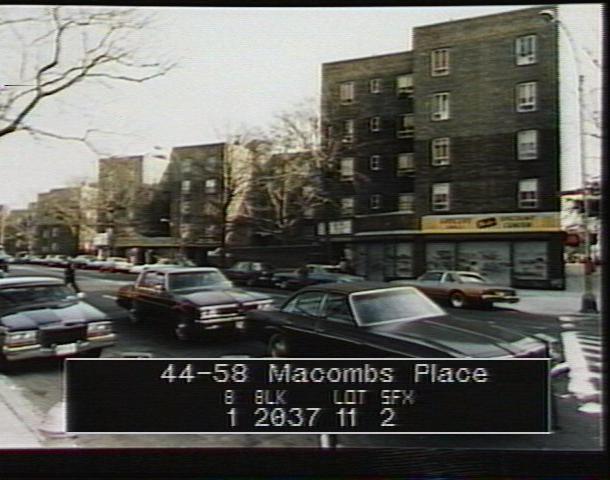
The city photographed every building for its tax records around 1940 and again in the 1980s. NYC Municipal Archives.
Written with AI from the source each entry cites, then fact-checked.
- 1935
Federal funds, condemnation and Harold Ickes's approval secure the Harlem River Houses site
A federal brochure on the project traces how the site was won. Planners narrowed Harlem sites to four, an appraiser was appointed in May 1935, and President Roosevelt allotted funds in June. The Housing Authority, acting for the Public Works Administration, began condemnation proceedings, and the condemnation was obtained in July. Administrator Harold L. Ickes approved the project on October 3, and title passed to the PWA Housing Division in November.
Source: archive.org
- 1936
A team of architects designs the complex around open plazas and lawns
Archibald Manning Brown serves as chief architect, with a team that includes John Louis Wilson Jr., among the first African American architects registered in New York State. A landscape team headed by Michael Rapuano shapes the grounds, and about two-thirds of the land remains open space with lawns, walkways, and plazas.
Source: Wikipedia
- 1937
More than 15,000 families register for the 574 apartments in the new Harlem River Houses
Before the project opened, registrations from prospective tenants flooded the project offices, according to the federal housing brochure. The total passed 15,000 families, competing for just 574 apartments, even though final rents were not yet known. The New York City Housing Authority was to pick tenants, favoring the families with the greatest need for housing.
Source: archive.org
- 1937
Federal brochure lists a nursery school for up to 60 children, a health clinic, laundries and 24 stores
The federal brochure promoting the new community listed its extras. There was to be a nursery school for as many as 60 children, a health clinic maintained by the Department of Health, four social units for adults, laundries and 24 stores. A children's wading pool was among the play features planned for the grounds.
Source: archive.org
- 1937
Tenants must come from substandard housing, take no lodgers, and pay about $5.20 a week for three rooms
Under the rules in the federal brochure, the houses were meant only for low-income families living in substandard housing, and no lodgers were allowed. A family's income could not exceed five times its gross rent. A typical three-room apartment averaged $5.20 a week including heat and hot and cold water, and rents ranged from $4.45 for the smallest units to $7.25 for the largest.
Source: archive.org
- 1937
The Harlem River Houses open as a federally funded housing project
The Public Works Administration's Housing Division builds the Harlem River Houses in 1936 and 1937 at a cost of about $4.5 million, and the complex opens in October 1937. It spans nine acres between West 151st and 153rd Streets and holds 574 apartments in four- and five-story buildings. It is one of the first two federally funded housing projects in New York City and is intended for working-class African Americans.
Source: Wikipedia
- 1941
Richmond Barthé's frieze made for the houses is installed at Brooklyn's Kingsborough Houses instead
Sculptor Richmond Barthé designed a large cast-stone frieze for the back wall of an amphitheater at the Harlem River Houses, but the amphitheater was never built. Months after the complex opened, his panels were still in storage, and in 1941 they were installed on a walk at Brooklyn's Kingsborough Houses without consulting him. It was later renamed Green Pastures: The Walls of Jericho, and Barthé was disappointed that Black residents were not the main tenants there.
Source: NYC LGBT Historic Sites Project
- 1975
The city designates the Harlem River Houses a landmark
New York City's Landmarks Preservation Commission designates the Harlem River Houses complex a city landmark on September 23, 1975. The National Register of Historic Places adds the site four years later, on December 18, 1979, and in 2014 the surrounding blocks become a Special Planned Community Preservation District.
Source: Wikipedia
- 1979
The Harlem River Houses are listed on the National Register of Historic Places
The Harlem River Houses, built in 1936-37 and opened in October 1937 as one of the first two federally funded housing projects in New York City, earned a place on the National Register of Historic Places in 1979. The listing came four years after the city designated the complex a landmark. The complex has 574 apartments on nine acres.
Source: Wikipedia
- 2014
The complex becomes a Special Planned Community Preservation District
The city gave the Harlem River Houses a Special Planned Community Preservation District designation in 2014, using a zoning tool created in 1974 to protect outstanding examples of town planning and large-scale development. The complex had been a city landmark since 1975.
Source: Wikipedia
- 2022
The complex is converted to Section 8 management in a public-private partnership under NYCHA's RAD program
Sometime in 2022, the Harlem River Houses were converted to RAD PACT Section 8 management through a partnership between NYCHA and four private firms: C&C Apartment Management, L+M Builders Group, Settlement Housing Fund and West Harlem Group Assistance. Presbyterian Senior Services was added as the social service provider for residents.
“Sometime in 2022, the development was converted into RAD PACT Section 8 Management in a Public-private partnership between NYCHA and…”
Source: Wikipedia
Further reading
- Harlem River HousesWikipedia
Nearby
- Chapel of the Resurrection276 West 151st Street | 3 entries
- Dunbar Apartments2594 Adam Clayton Powell Jr Boulevard | 12 entries
- Frederick Douglass Academy2581 Adam Clayton Powell Jr Boulevard | 5 entries
- Bethany Baptist Church303 West 153rd Street | 2 entries
- Greater Hood Memorial AME Zion Church160 West 146th Street | 2 entries
- 409 Edgecombe Avenue4 entries