26 Jones Street House
26 Jones Street | West Village | built 1844
Open on the map7 entries

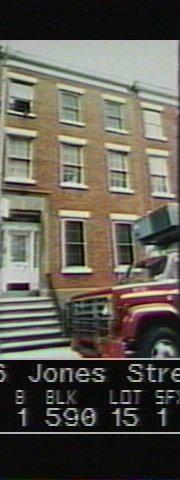
The city photographed every building for its tax records around 1940 and again in the 1980s. NYC Municipal Archives.
Written with AI from the source each entry cites, then fact-checked.
- 1844
Jane S. Paradise moves into a plain Greek Revival row house on Jones Street
Number 26 Jones Street was built in 1844 as one of a short row of nearly identical three-story Greek Revival houses, faced in brick and trimmed in brownstone. Its doorway had stone pilasters, sidelights and a transom. The house and lot cost the developer about $3,800. Jane S. Paradise moved in that year, and she may have run it as a boarding house.
Source: Daytonian in Manhattan
- 1864
Piano and billiard-table dealer Abram Bassford dies and his funeral is held in the parlor
Abram Bassford, who sold billiard tables and pianos from shops on Centre Street, Ann Street and Broadway, died suddenly on June 13, 1864, and his funeral took place in the parlor two days later. His billiard tables had been advertised as prize winners at the 1851 World's Fair. His son William K. Bassford became an organist and composer of songs and an opera.
Source: Daytonian in Manhattan
- 1902
Mary Simkhovitch opens Greenwich House, a settlement house, on Thanksgiving Day
George and Emma Schenk bought the house in March 1899 and leased it to Greenwich House, a settlement founded by Mary Kingsbury Simkhovitch. It opened on Thanksgiving Day, 1902, after a scrubbing, repainting and pest-removal job. Simkhovitch, her family and five women residents moved in, and the trustees included Jacob Riis, Carl Schurz and Felix Adler.
Source: Daytonian in Manhattan
- 1905
Greenwich House buys the building as its programs serve a block of immigrant families
On October 21, 1905, the Record & Guide reported that title had passed to the settlement's governing society. Simkhovitch told a reporter that 115 of the 296 families on Jones Street were Italian and that eight nationalities lived on the block. The house offered clubs, sewing and cooking classes, a kindergarten, and a Tenants' Manual that explained eviction law, among other topics.
Source: Daytonian in Manhattan
- 1908
An exhibit of immigrants' handicrafts shows what neighbors brought from their homelands
In May 1908 Greenwich House held an exhibit of items that neighborhood immigrants had brought with them. The New-York Tribune of May 28 described embroidered bed covers, aprons, towels and caps, and carved wood. Besides the expected pieces from Italy and Ireland, the show had Russian brasses, a Chinese bronze mirror and a Viking bowl from Norway.
Source: Daytonian in Manhattan
- 1966
The Landmarks Preservation Commission designates 26 Jones Street a landmark
After a public hearing on March 8, 1966, at which two witnesses spoke in favor, including the owner's representative, the Commission designated the house a landmark. The designation report calls it a simple late Greek Revival row house with plain splayed lintels, and notes that it and its two neighbors are virtually identical. It praised the house as a modest residence of great simplicity.
“…designates as a Landmark the 26 Jones Street House…”
- 1972
Children's author Irma Simonton Black is found dead in her third-floor apartment
By 1972 residents of the house included Irma Simonton Black and her husband James, a Wall Street lawyer. Irma was a children's-book writer and editor who joined Bank Street College in 1942 and was about to retire after 40 years. On June 18, 1972, neighbors who had noticed a broken basement window found her dead, and police believed she had surprised a burglar.
Source: Daytonian in Manhattan
Further reading
- The 1844 Abram Bassford House - 26 Jones Street Daytonian in Manhattan
Nearby
- 22 Jones Street3 entries
- 28 Jones Street House28 Jones Street | 6 entries
- 30 Jones Street House30 Jones Street | 8 entries
- 20 Jones Street6 entries
- 18 Jones Street3 entries
- Greenwich House Pottery16 Jones Street | 4 entries