30 Jones Street House
30 Jones Street | West Village | built 1844
Open on the map8 entries

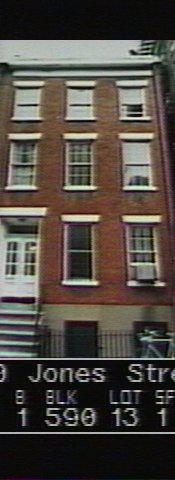
The city photographed every building for its tax records around 1940 and again in the 1980s. NYC Municipal Archives.
Written with AI from the source each entry cites, then fact-checked.
- 1844
30 Jones Street is completed in 1844 as a simple Greek Revival row house
Completed in 1844, the house rises three stories of warm red brick over a low basement, with a gently sloped stoop, splayed lintels and a recessed doorway under a three-light transom. The commission called it one of three virtually identical neighbors and cited a cost of about $3,700 with the lot. It designated the house a landmark on April 19, 1966.
“Thirty Jones Street with its lot cost about $3,700. ... one of three similar houses located together in the same block.”
- 1872
A resident of 30 Jones Street shares a drink with Edward Stokes shortly before Stokes shoots Jim Fisk
David Smith, a railroad-stock speculator who owned the house, was sitting in a restaurant that afternoon when the millionaire Edward Stokes walked up, shook hands and talked about a horse race. Stokes then went to the Grand Central Hotel and fatally shot his business partner Jim Fisk. Smith's brief chat was among the last contacts before the killing, but it gave neither prosecution nor defense useful testimony.
Source: Daytonian in Manhattan
- 1894
A storeroom fire in the yard of 30 Jones Street badly burns owner Frederick Schmidt
Smoke from the one-story storeroom behind the house, which held pictures and household goods, sent Frederick Schmidt rushing in with a blanket. His clothes ignited, and his wife and two daughters tore them off him, though he was badly burned. Julia Schmidt then went back into the burning building to save a valuable picture and had to be carried out. Firemen blamed rats gnawing matches.
Source: Daytonian in Manhattan
- 1911
Greenwich House leases 30 Jones Street and runs its settlement programs there until about 1922
The social settlement, founded in 1902 at 26 Jones Street, was renting number 30 from owners Stefano and Adelaide Rolandelli by 1911. A handbook of settlements that year described the surrounding old American quarter as one of small houses and winding streets with a note of torpor and decay. The Rolandellis converted the house to apartments around 1922.
Source: Daytonian in Manhattan
- 1923
Painter Reginald Marsh gives 30 Jones Street as his address on a marriage license
The 25-year-old artist took out a license with Elizabeth Burroughs while living in the building. Writer Sue Jenkins Brown and her husband James Light, who was linked to the Provincetown Players, had lived there for a year, and their apartment served as a hub for the Village's artists and writers. A biography of Ludwig Lewisohn describes one of her gatherings as drawing young writers such as Malcolm Cowley and Kenneth Burke, with Hart Crane and Allen Tate among possible guests.
Source: Daytonian in Manhattan
- 1924
Sue Jenkins Brown lends her 30 Jones Street apartment to Allen Tate and Caroline Gordon
The poet and essayist Allen Tate and the novelist and critic Caroline Gordon were lent Brown's apartment in 1924. According to a biography of Gordon, the pair began telling friends and relatives that they were already married, though the wedding did not take place until the next year.
Source: Daytonian in Manhattan
- 1934
The Theatre Union holds a tea at 30 Jones Street on the eve of its play Stevedore
The Theatre Union held a well-attended tea at the home of Mr. and Mrs. Gratton on a Sunday afternoon. The tea came just before the opening of the company's second production, Stevedore, and The New York Age reported on it on April 14. The apartments had been bought by their occupants as a cooperative in 1929, and many of the owners were still involved in the arts.
Source: Daytonian in Manhattan
- 1960
Teenager Maria Muldaur runs away from home to 30 Jones Street and works as a mother's helper
Before she became a leading voice of the 1960s folk revival, Maria Muldaur fled home in 1960 and headed for the building on Jones Street where she had been staying during a visit to New York. One family in the building hired her as a mother's helper, so she had a room and meals provided as she completed high school.
Source: Daytonian in Manhattan
Further reading
- The 1844 Stephen and Jane Webster House - 30 Jones StreetDaytonian in Manhattan
Nearby
- 28 Jones Street House28 Jones Street | 6 entries
- 26 Jones Street House26 Jones Street | 7 entries
- 277 Bleecker Street1 entry
- Peter Weimar Saloon Building275 Bleecker Street | 6 entries
- 22 Jones Street3 entries
- Matt Umanov Guitars273 Bleecker Street | 3 entries