260 West 11th Street
West Village | built 1830
Open on the map7 entries

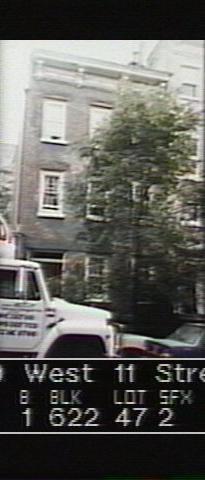
The city photographed every building for its tax records around 1940 and again in the 1980s. NYC Municipal Archives.
Written with AI from the source each entry cites, then fact-checked.
- 1830
Federal house with Gothic-motif ironwork and pineapple newels, enlarged in 1872
The Landmarks Commission's 1969 report praises No. 260's Federal ironwork, with Gothic motifs at the stoop landing and twisted ironwork supporting pineapple finials on the newels. It was built in 1830 for the wealthy tallow chandler John Mildeberger as a two-story Flemish-bond house. A third floor and Italianate cornice were added in 1872.
“It was erected in 1830 for John Mildeberger, a wealthy tallow chandler.”
- 1830
Candle and soap maker John A. Mildeberger builds No. 58 Hammond Street as an investment
John A. Mildeberger, a tallow chandler and soap boiler who also sat as a trustee of the Greenwich Savings Bank, built several investment properties during the Village building boom. No. 58 Hammond Street, later 260 West 11th, was finished in 1830. Its Federal doorway nearly matches that of the neighboring house at No. 262, built two years earlier.
Source: Daytonian in Manhattan
- 1867
Boarder Kate Norton, 19, dies after the man who deceived her has her put out of his store
Kate Norton, 19, moved into Louisa Bussing's boarding house in late May 1867 after following a man who had promised to marry her and then wed another woman. On June 6 a policeman advised her to leave his New York store, and that afternoon she was found in a deep sleep and soon died. A bottle of morphine and a farewell note were in her pocket, and the press condemned him.
Source: Daytonian in Manhattan
- 1871
Mildeberger's will ties a grandson's inheritance to leaving the priesthood
John Mildeberger, who died in 1871, left one-third of his estate to his grandson Seymour Herbert Spencer on the condition that Spencer renounce the Roman Catholic priesthood and marry. The house had passed in 1838 to his son-in-law, the future State Senator Mark Spencer, and the extended family kept it until 1915.
Source: Daytonian in Manhattan
- 1915
"The Hall corner" leaves a family's hands for the first time since 1830
In 1915 Margaret E. Hall sold the group known as the Hall corner, which the Times described as among the best-known private dwellings in old Greenwich Village. It was the first time No. 260 left the extended family that had owned it since Mildeberger built it in 1830. Five houses on West Fourth Street were in the deal.
Source: Daytonian in Manhattan
- 1920
Elizabeth Walton, chair of the New York Urban League, buys the house to remodel for herself
In July 1920 Elizabeth Walton bought No. 260 and announced she would remodel it to live in. Unmarried, she chaired the New York Urban League for Social Service Among Negroes, a post the Daytonian write-up calls remarkable for its time. She was a speaker at a December 1925 testimonial dinner for banker Algernon B. Frissell.
Source: Daytonian in Manhattan
- 1928
Anna N. Davis, a resident, serves as War Resisters League secretary pro tem
After Elizabeth Walton, Horace Andrew Davis and his wife Anna moved here from Brookline, Massachusetts. Anna N. Davis, described as interested in social work, in 1928 served as secretary pro tem of the War Resisters League, according to The New York Times. By 1930 she was living in Memphis.
Source: Daytonian in Manhattan
Further reading
- "An Abandoned Woman" No. 260 W 11th StreetDaytonian in Manhattan
- Then & Now photos: 260 West 11th StreetVillage Preservation: Greenwich Village Then & Now
Nearby
- 262 West 11th Street3 entries
- Abingdon Boarding Stable264 West 11th Street | 4 entries
- 261 West 11th Street3 entries
- 61 Perry Street5 entries
- 267 West 11th Street5 entries
- 251 West 11th Street6 entries