263 East 7th Street
East Village | built 1899
Open on the map4 entries

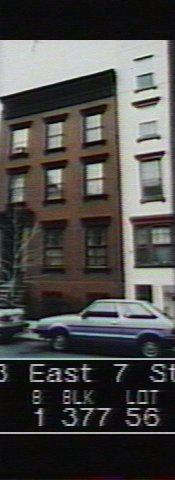
The city photographed every building for its tax records around 1940 and again in the 1980s. NYC Municipal Archives.
Written with AI from the source each entry cites, then fact-checked.
- 1843
Shipwright William Niles moves into a new row house
Shipwright William Darwin Niles, who oversees the construction of whole ships in the nearby Dry Dock District, buys 263 East 7th Street soon after the Greek Revival row is completed. He and his wife, Melinda Seeley, raise four children there. In December 1852 both of their daughters marry.
Source: Daytonian in Manhattan
- 1886
Peter and Ellen Caffrey buy the house at auction
Peter and Ellen A. Caffrey buy 263 East 7th Street at auction after the previous owner, Aaron Bamberger, loses it to foreclosure. The couple almost certainly update the house with new paneled entrance doors, cast iron lintels over the entrance and windows, and a modern cornice.
Source: Daytonian in Manhattan
- 1964
Composer Ray Green and dancer May O'Donnell move in
Musician and composer Ray Green and his wife, modern dancer May O'Donnell, move into 263 East 7th Street in 1964. A New York Times column in 1974 on the brownstone revival notes that the block was once known locally as Artist's Row and then Rabbi's Row.
Source: Daytonian in Manhattan
- 2018
The house is renovated into two luxury duplexes
263 East 7th Street is renovated into two luxury duplex apartments, more than 170 years after William Niles first lived in the new row house. Almost all of the interior detail is gone, but at least one yellow-veined black marble Greek Revival mantel survives.
Source: Daytonian in Manhattan
Further reading
- The 1843 William Niles House - 263 East 7th StreetDaytonian in Manhattan
- 263 East 7th StreetVillage Preservation: East Village Building Blocks
Nearby
- The John A. Squires House271 East 7th Street | 4 entries
- 260 East 7th Street3 entries
- 262 East 7th Street3 entries
- 368 East 8th Street1 entry
- Congregation Beth Hamedrash Hagadol Anshe Ungarn242 East 7th Street | 6 entries
- 366 East 8th Street1 entry