Henry Street Settlement (No. 263)
263 Henry Street | Lower East Side | built 1827
Open on the map4 entries

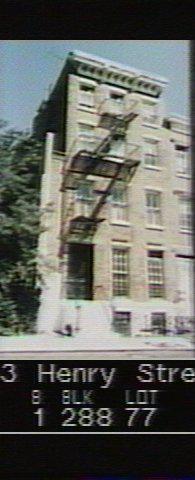
The city photographed every building for its tax records around 1940 and again in the 1980s. NYC Municipal Archives.
Written with AI from the source each entry cites, then fact-checked.
- 1880
George Graham hires Gage Inslee to raise the 1827 house to four stories
No. 263 began in 1827 as a two-and-a-half-story Federal house. After George Graham bought it in 1880, he hired architect Gage Inslee to raise it to four stories and add a four-story rear extension. Inslee gave the windows brownstone lintels carved with vines, put a Queen Anne sunburst panel over the entrance, and topped the house with a neo-Grec cornice.
Source: Daytonian in Manhattan
- 1902
Chief Rabbi Jacob Joseph dies at home, and about 50,000 people follow his funeral procession
Rabbi Jacob Joseph, whom The New York Times called the top official of Orthodox Judaism in the United States, had moved here in the 1890s to a more modest home, having never saved money from his early high salary; by 1901 he was paralyzed and nearly penniless. He died here on July 28, 1902, and about 50,000 mourners followed his coffin. Workers at the Hoe factory on Grand Street jeered and threw water and missiles at the procession, a riot followed, and police were accused of clubbing mourners. Days later 3,000 people protested at Cooper Union.
Source: Daytonian in Manhattan
- 1904
Mrs. Joseph Fine opens the Hebrew Day Nursery in the house
Mrs. Joseph Fine, a Polish-born rabbi's daughter active in many Jewish welfare groups, founded the Hebrew Day Nursery here in 1904 so that mothers could work during the day. The nursery carried on after her death in 1919. In July 1925 a fire broke out on the stairway, and teachers and nurses brought the dozen or so children outside unharmed; the damage was put at $200.
Source: Daytonian in Manhattan
- 1935
The Henry Street Settlement opens a WPA-sponsored Workers’ Education Center here
The Henry Street Settlement acquired 263 Henry Street in 1935 and opened a Workers' Education Center there, sponsored by the Works Progress Administration. According to Ellen Snyder-Grenier's history of the settlement, it served 150 students, mostly Lower East Siders such as unemployed cooks, clerks and garment workers. A renovation in 1942 turned the basement and the first and third floors into classrooms, leaving an apartment on each of the second and fourth floors.
Source: Daytonian in Manhattan
Further reading
- The 1827 Joseph Benedict House - 263 Henry StreetDaytonian in Manhattan
Nearby
- Henry Street Settlement265 Henry Street | 10 entries
- Henry Street Settlement (No. 267)267 Henry Street | 6 entries
- Henry Street Settlement265 Henry Street | 4 entries
- Engine Company 15 Firehouse269 Henry Street | 6 entries
- Isaac T. Ludlam House281 East Broadway | 5 entries
- St. Augustine's Church290 Henry Street | 5 entries