Henry Street Settlement
265 Henry Street | Lower East Side | built 1900
Open on the map10 entries

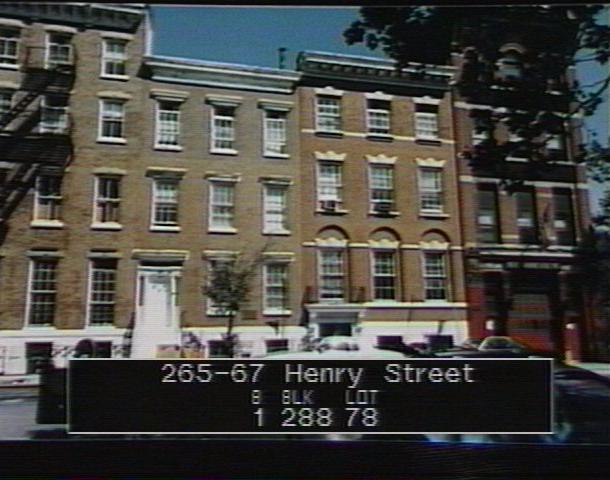
The city photographed every building for its tax records around 1940 and again in the 1980s. NYC Municipal Archives.
Written with AI from the source each entry cites, then fact-checked.
- 1827
The Federal-style rowhouse at 265 Henry Street is built
Built in 1827 during the Lower East Side's early development, 265 Henry Street is a Federal-style rowhouse with Flemish-bond brickwork over a brownstone basement. Its doorway features fluted Ionic colonnettes and ornamental iron cage newels typical of a well-off merchant family's home. Alderman Thomas W. Adams lives there before the Civil War.
Source: Daytonian in Manhattan
- 1860
Friends present Alderman Thomas Adams with a gold watch in his Henry Street house
At two in the afternoon on January 3, 1860, citizens gathered at the Henry Street home of Alderman Thomas W. Adams, who had fallen seriously ill early in his last term, which ended on December 31, 1859. William L. Ely presented him with a gold hunting-case watch, chains, a pencil-case and a key, worth $363. Adams thanked them as a private citizen and led the guests into another room for refreshments.
Source: Daytonian in Manhattan
- 1863
The Moores family opens its parlor for a Union soldier's funeral
After Charles T. Jenkins, a Union soldier from Company D of the 40th Ohio Volunteers, died in New York on April 3, 1863, the Moores family at 265 Henry Street lent their parlor for his funeral. Their son William was drafted four months later, on August 27. He survived the war and later became dean of the board at the Empire City Savings Bank.
Source: Daytonian in Manhattan
- 1895
Jacob Schiff buys 265 Henry Street for Lillian Wald's nurses
Nurse Lillian Wald began teaching home health care to immigrant women on the Lower East Side in 1892 and founded the Nurses' Settlement the next year. In 1895 banker Jacob Schiff bought this Federal-style townhouse at 265 Henry Street for the group, which became the Henry Street Settlement. Its nursing work grew into the Visiting Nurse Service, which became independent in 1944.
Source: Wikipedia
- 1902
A resident of 265 Henry Street accuses police of rough handling at a rabbi's funeral riot
After the funeral of Rabbi Jacob Joseph erupted into a riot in the summer of 1902, Jane W. Hitchcock of 265 Henry Street, who was connected with the Mercy Settlement, told the press that police had treated women with needless force. The New York Times printed her statement on August 20. Daytonian in Manhattan notes that the women of the Nurses' Settlement were used to speaking out against injustice.
Source: Daytonian in Manhattan
- 1902
Lina Rogers, a Henry Street nurse, becomes the city's first school nurse
In 1902, Lina Rogers, a nurse from the Henry Street Settlement, becomes New York City's first public school nurse. Her placement in the schools grows directly out of Lillian Wald's home-nursing program for the neighborhood's immigrant families. She works alongside a growing staff of settlement nurses providing free home visits across the Lower East Side.
Source: The Bowery Boys
- 1909
The National Negro Committee, forerunner of the NAACP, meets at the settlement
On May 31 and June 1, 1909, the National Negro Committee held its first meeting in New York at the Henry Street Settlement House. Its members included W. E. B. Du Bois, Oswald Garrison Villard and the settlement's founder, Lillian Wald. At its second conference, in May 1910, the committee formed a permanent body, the National Association for the Advancement of Colored People.
Source: Wikipedia
- 1920
The Henry Street nursing service runs a $1 million fund drive
In the week of March 15 to 22, 1920, the settlement's visiting nurse service ran a drive to raise $1 million. It was by then the largest visiting nurse service in the country, with 185 nurses. In 1919 some 43,946 patients had received care, and an advertisement in The Survey said the nurses had been present at 614 births that year.
Source: Daytonian in Manhattan
- 1944
The settlement is reorganized as its Visiting Nurse Service moves uptown
Lillian Wald died in 1940 after a long illness. Four years later the settlement was reorganized, with the Visiting Nurse Service moving uptown while the Henry Street Settlement stayed on the Lower East Side to concentrate on the needs of its immediate neighbors. Its administrative offices remain in the three Federal-style houses at 263 through 267 Henry Street.
Source: Daytonian in Manhattan
- 2022
265 and 267 Henry Street are listed on the National Register as the Lillian Wald Residence
In February 2022, after a New York State Register listing in December 2021, 265 and 267 Henry Street gained a second National Register listing under the administrative name Lillian Wald Residence. The NYC LGBTQ Historic Sites Project and the settlement worked together on the effort, which brought out the homosocial world of the settlement around Wald and the leading role lesbians played in the settlement house movement. The houses had first been listed on the National Register in 1974.
Source: NYC LGBT Historic Sites Project
Further reading
- Henry Street SettlementWikipedia
- The Henry Street Settlement House -- 265 Henry StreetDaytonian in Manhattan
- Henry Street Settlement: From the doors of old townhouses springs the compassionate heart of the Lower East SideThe Bowery Boys
Nearby
- Henry Street Settlement (No. 267)267 Henry Street | 6 entries
- Henry Street Settlement (No. 263)263 Henry Street | 4 entries
- Henry Street Settlement265 Henry Street | 4 entries
- Engine Company 15 Firehouse269 Henry Street | 6 entries
- Isaac T. Ludlam House281 East Broadway | 5 entries
- St. Augustine's Church290 Henry Street | 5 entries