St. Patrick's Chancery Office (St. Michael's Chapel)
266 Mulberry Street | also 256 Mulberry Street | Nolita | built 1900
Open on the map5 entries

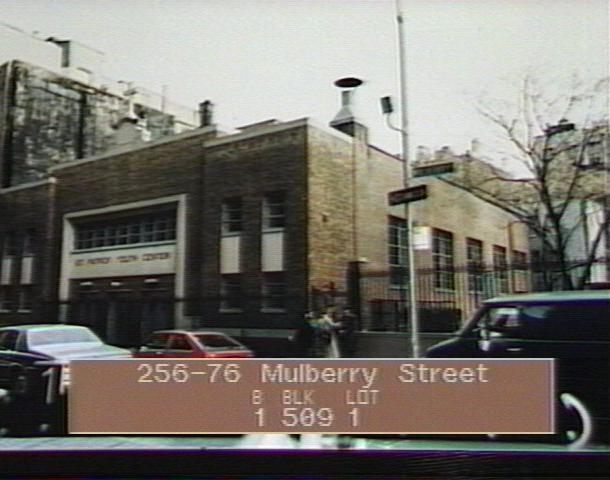
The city photographed every building for its tax records around 1940 and again in the 1980s. NYC Municipal Archives.
Written with AI from the source each entry cites, then fact-checked.
- 1859
James Renwick Jr. designs a battlemented brick Chancery Office for Archbishop Hughes
In 1858 Archbishop John Hughes, who was also planning the new cathedral on Fifth Avenue, asked James Renwick Jr. and William Rodrigue for an office building for the diocese's growing staff. It was finished within a year on the old St. Patrick's grounds. Renwick used red brick with small buttresses, quatrefoil carvings and white stone trim, and the cornice has castle-style crenellation. It housed the chancellor, the orphan asylums' treasurer and the Calvary Cemetery office.
Source: Daytonian in Manhattan
- 1869
Burglars scale the churchyard wall and smash open the cemetery office safe
On the night of January 24, 1869, thieves climbed over the brick wall, broke through the building's side wall and used a sledgehammer to open the Calvary Cemetery office safe. They took $5,000 in bonds and a little cash. Detectives found only the sledge and a scrap of fine paper that had wrapped a crowbar, and the thieves were never caught.
Source: Daytonian in Manhattan
- 1871
Father Thomas Farrell is tried in the Chancery Office for his reform views
Father Thomas Farrell, the pastor of St. Joseph's Church on Sixth Avenue, had backed emancipation and political rights for freed Black Americans. He also joined a group of priests who discussed ending priestly celibacy and the Latin liturgy. McCloskey removed him as pastor, and Farrell demanded a canonical trial. On February 3, 1871, six priests heard his case in this building and unanimously backed his removal. He vowed to appeal to Rome, but McCloskey prevailed.
Source: Daytonian in Manhattan
- 1889
Chancery officials refuse a burial permit to a member of the Anti-Poverty Society
Theresa Kelly, a Sunday school teacher who belonged to Father Edward McGlynn's Anti-Poverty Society, died of a stroke in 1889. She owned a plot at Calvary Cemetery, and her parish priest certified her as a good Catholic. Officials at the Chancery Office still refused a burial permit, a year after another society member, John McGuire, had been refused burial there. On November 14 the undertaker said he would bury her at Woodlawn Cemetery instead.
Source: Daytonian in Manhattan
- 1936
The former chancery becomes a chapel for Russian Catholic services
By 1936 the building was no longer practical as diocesan offices or a school annex, and it was converted to a chapel for Russian Catholics. The New York Times reported special Christmas services in the Russian liturgy on December 19, 1936. It became St. Michael's Chapel. Its Russian Byzantine Rite congregation was still there in 2014, serving Russian immigrants and many others drawn to the services.
Source: Daytonian in Manhattan
Further reading
- Renwick's 1859 Chancery Bldg. -- No. 266 Mulberry StreetDaytonian in Manhattan
Nearby
- Old St. Patrick's Cathedral268 Mulberry Street | 5 entries
- Old St. Patrick's Rectory263 Mulberry Street | 4 entries
- St. Patrick's Old Cathedral256 Mulberry Street | 11 entries
- 277 Mott Street1 entry
- Hawley & Hoops Chocolate Factory (Mulberry Street Library)285 Lafayette Street | 3 entries
- James Hart House261 Mulberry Street | 4 entries