James Hart House
261 Mulberry Street | Nolita | built 1899
Open on the map4 entries

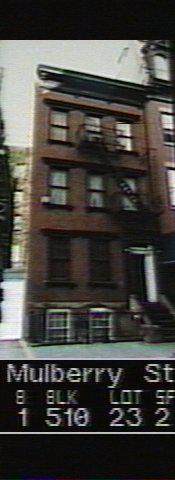
The city photographed every building for its tax records around 1940 and again in the 1980s. NYC Municipal Archives.
Written with AI from the source each entry cites, then fact-checked.
- 1827
A Federal-style brick house goes up at 261 Mulberry Street, home first to a printer
The two-and-a-half-story house was finished around 1827 with Flemish bond brickwork and dormers in a peaked roof, and printer James Evans lived there in 1829. Heirs of James Hart later raised the attic to a full floor and added an Italianate cornice, and an 1897 renovation of what was by then a tenement probably added the heavy stone frame around the doorway. The house was converted to one apartment per floor in 1960.
Source: Daytonian in Manhattan
- 1843
James Hart, sexton of Old St. Patrick's, lives across the street from the cathedral at 261 Mulberry
By 1843 James Hart and his family occupied the house, whose location opposite the cathedral suited his job as the church's sexton. His son William became an undertaker by 1857 and went on to serve as the cathedral's official undertaker for about sixty years. James Hart died in 1869, aged 86, and was buried within the cathedral grounds.
Source: Daytonian in Manhattan
- 1873
A tenant at 261 Mulberry Street spots a thief loading 300 paving stones onto a cart
The city began paving the Mulberry Street block in spring 1873. On April 1 the tenant Hugh Moore, a cemetery superintendent and cathedral trustee, saw Patrick McHugh load granite Belgian blocks onto his cart at the curb. Moore found an officer and McHugh was arrested; the New York Herald described the theft of 300 stones as a heavy larceny.
Source: Daytonian in Manhattan
- 1889
William T. A. Hart, cathedral sexton raised at 261 Mulberry Street, is arrested over a burial
William T. A. Hart succeeded his father as sexton of St. Patrick's after 1869 and became wealthy and influential, though his career had legal troubles. On May 5, 1889, the New York Times reported his arrest for burying a person who died of a contagious disease in an ordinary coffin at St. Michael's Cemetery. In 1893 a surrogate's referee also criticized his handling of an insolvent man's estate.
Source: Daytonian in Manhattan
Further reading
- The 1827 James Hart House - 261 Mulberry StreetDaytonian in Manhattan
Nearby
- Old St. Patrick's Rectory263 Mulberry Street | 4 entries
- 47 Prince Street3 entries
- Tiffany & Co. Silver Factory (Hawley & Hoops Building)55 Prince Street | 4 entries
- Hawley & Hoops Chocolate Factory (Mulberry Street Library)285 Lafayette Street | 3 entries
- St. Patrick's Old Cathedral256 Mulberry Street | 11 entries
- St. Patrick's Chancery Office (St. Michael's Chapel)266 Mulberry Street | 5 entries