Peter Weimar Saloon Building
275 Bleecker Street | West Village | built 1818
Open on the map6 entries

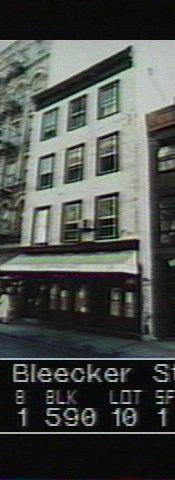
The city photographed every building for its tax records around 1940 and again in the 1980s. NYC Municipal Archives.
Written with AI from the source each entry cites, then fact-checked.
- 1818
A Federal house on Herring Street is first taxed on the lot, owned by Gardiner Jones
A house on Herring Street was first taxed in 1818, on the lot later numbered 263 and then 275 Bleecker Street. It belonged to Gardiner Jones and his wife Sarah Herring, whose family farm had covered much of the surrounding land. They never lived in it. The merchant and later developer Charles Oakley's family lived there in 1819, and Oakley helped petition in 1829 to rename the street Bleecker.
Source: Daytonian in Manhattan
- 1833
Apothecaries' Hall sells patent remedies on the ground floor
By 1833 the ground floor held Apothecaries' Hall, a drugstore run by the British-born Edward L. Cotton. It sold cures such as Gibney's Tetter and Ringworm Destroyer, and in 1842 Cotton advertised Parr's Life Pills and Sharon Springs sulphur water in the New York Herald. The shop was a neighborhood fixture for about twenty years before a hat company replaced it.
Source: Daytonian in Manhattan
- 1863
Peter Weimar buys the house and turns the ground floor into a saloon
Peter Weimar bought the property in 1863, opened a saloon on the ground floor and rented rooms upstairs. His first boarders included a shoemaker, a tailor and a man who ran an eatinghouse on Cedar Street. The ground floor would hold a saloon for most of the next six decades.
Source: Daytonian in Manhattan
- 1870
Weimar advertises a lodge room, and a fraternal order holds a funeral muster here
In April 1870 Weimar ran a notice in the New York Dispatch offering newly furnished rooms at 275 Bleecker Street for $200 a year, enough for two meetings a month. The space found users: in January 1872 the members of Palestine Encampment were summoned to Eureka Lodge Rooms here to attend the funeral of a fellow member, Edward Wright.
Source: Daytonian in Manhattan
- 1876
Weimar hires Thomas J. Drummond to raise the frame house to four stories
In 1876 Peter Weimar hired architect Thomas J. Drummond and carpenter Richard Drummond to lift the three-and-a-half-story frame house with its peaked roof to four full stories. The enlarged building was meant to hold a beer depot and three families. It received a brick or masonry front sometime between 1876 and 1891.
“In 1876, Peter Weimar hired Thomas J. Drummond, architect, and Richard Drummond, carpenter, to raise the 3½-story frame house with peaked roof to four stories…”
- 1897
Frederick Busch takes over the saloon, and his family runs Busch's Hall until Prohibition
Frederick Busch became the saloon's proprietor in 1897 and lived upstairs with his family. A Tribune notice of October 27, 1904 announced a meeting at Busch's Hall, 275 Bleecker Street. In July 1920 Elizabeth Busch bought the building, just as Prohibition closed the hall, and by the Depression years the space was a fruit and vegetable store.
Source: Daytonian in Manhattan
Further reading
- The Peter Weimar Saloon Building- 275 Bleecker StreetDaytonian in Manhattan
Nearby
- 277 Bleecker Street1 entry
- Matt Umanov Guitars273 Bleecker Street | 3 entries
- 271 Bleecker Street1 entry
- 30 Jones Street House30 Jones Street | 8 entries
- Neighborhood Church269 Bleecker Street | 2 entries
- 265 Bleecker Street5 entries