Broadway-Chambers Building
277 Broadway | Tribeca | built 1900
Open on the map7 entries

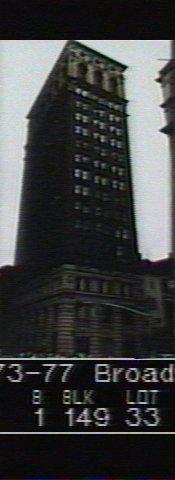
The city photographed every building for its tax records around 1940 and again in the 1980s. NYC Municipal Archives.
Written with AI from the source each entry cites, then fact-checked.
- 1791
Anthony Steenbach builds a row of one-story buildings on the future corner site
Long before the present tower, around 1791, Anthony Steenbach first developed this northwest corner of Broadway and Chambers Street with a row of one-story buildings facing Chambers. Chambers Street itself had been ceded to the city by Trinity Church in 1761. As Broadway north of Chambers turned into a street of shops in the mid-1800s, a five-story masonry building went up on the corner around 1852.
- 1899
Owner Edward Andrews overrules Cass Gilbert and insists on a colorful facade
Edward R. Andrews of a Boston family wanted an office tower on his family's corner, and a Boston lawyer introduced him to architect Cass Gilbert. They signed a contract in March 1899 for a $700,000 building. Gilbert pictured a monochrome Beaux-Arts design, but Andrews pushed for brick and terra cotta in color, writing that he was strongly in favor of it. Andrews won.
Source: Daytonian in Manhattan
- 1899
Cass Gilbert moves to New York amid a Customs House controversy as his first city tower rises
Gilbert shifted his office from St. Paul to New York just before work began here, and entered the contest to design the U.S. Customs House. That competition turned bitter: critics charged favoritism because his former partner, James Knox Taylor, was Supervising Architect of the Treasury and sat on the jury. The press followed it closely, and often made it personal, while the Broadway Chambers rose quickly.
- 1900
A Paris Exposition diploma arrives addressed to "Monsieur Broadway Chambers"
At the 1900 Paris Exposition the building took five awards, including a Grand Prize for its builder, the George A. Fuller Company, which showed two 11-foot models of it. A medal addressed only to "Monsieur Broadway Chambers, Etats-Unis" was reported to be seeking an owner. The Numismatist said two years later that New York's post office somehow found the right recipient, and a letter carrier delivered the box to Gilbert.
Source: Daytonian in Manhattan
- 1900
Tenants move into an office tower with mail chutes, sinks and its own electric plant
Tenants began arriving in April 1900, drawn by amenities that were uncommon then: a mail chute on every floor, running-water sinks in nearly every office, and an independent electric lighting plant. Several insurance firms were among the early occupants, including the People's Security Company in 1901 and Frank F. Eagles, an Aetna agent, in room 1106 in 1907. A candy-makers' buying cooperative opened offices here in December 1916.
Source: Daytonian in Manhattan
- 1900
Gilbert builds a granite base, brick shaft and glazed terra-cotta crown, with lions and Hermes heads
The Landmarks Preservation Commission describes the building as a Beaux-Arts tower organized like a classical column, with each part set off by material and color. Hermes and lion heads at monumental scale and a dramatic arcaded crown add to the ornament. Critic Montgomery Schuyler judged it the culmination of the column-analogy approach to tall buildings. It was Gilbert's first completed design in New York, ahead of the Custom House and the Woolworth Building.
- 1904
Lightning shatters the roof flagpole during a freak storm over lower Manhattan
A violent thunderstorm on August 1, 1904 struck scores of buildings in lower Manhattan and Brooklyn, flooded streets and set off fires. On this building's roof a flagpole about ninety feet tall and nearly a ton in weight took a direct hit. The New York Times reported that the bolt splintered much of the wood and left the rest dangerously damaged.
Source: Daytonian in Manhattan
Further reading
- Broadway–Chambers BuildingWikipedia
Nearby
- Irving House Hotel (surviving section)75 Chambers Street | 3 entries
- Peddie & Morrison Store77 Chambers Street | 3 entries
- 287 Broadway8 entries
- 79 Chambers Street2 entries
- Tower 270270 Broadway | 8 entries
- 83 Chambers Street3 entries