287 Broadway
Tribeca | built 1872
Open on the map8 entries

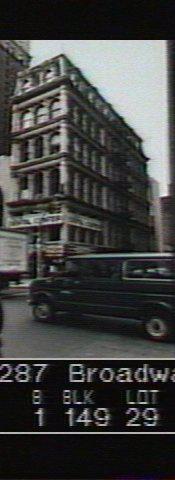
The city photographed every building for its tax records around 1940 and again in the 1980s. NYC Municipal Archives.
Written with AI from the source each entry cites, then fact-checked.
- 1848
Stephen Storm and three neighbors combine their lots to build the Irving House Hotel
Stephen Storm, a grocer and tobacconist who had owned the corner since 1821, merged his property with three adjacent buildings, and the owners built the Irving House Hotel between 1848 and 1849. It had 150 employees and room for 500 guests. Amenities included separate dining rooms for men and women, a barber shop, a wig maker, a smoking room, a bar and bridal suites.
“The hotel had 150 employees and could accommodate 500 guests.”
Source: Wikipedia
- 1850
Jenny Lind and Louis Kossuth stay at the Irving House Hotel
The Irving House, on the west side of Broadway near Chambers Street, welcomed the Swedish singer Jenny Lind in 1850, and the Hungarian patriot Louis Kossuth followed in 1851. It stood on a stretch north of City Hall that was changing from a residential boulevard into the commercial heart of the city, a shift that began with A. T. Stewart's dry goods store at 280 Broadway, completed in 1846.
“Famous guests included SWedish singer Jenny Lind in 1850 and Hungarian patriot Louis Kossuth in 1851.”
- 1872
John B. Snook builds a cast-iron bank and office building with a mansard roof and an Otis elevator
The Storm estate filed plans in March 1871 and construction began two months later. Architect John B. Snook first drew a four-story Italianate building with a flat tin roof, but an amendment added a mansard roof and an Otis passenger elevator, both to raise the building's prestige for bank and office tenants. Jackson, Burnet & Co. made the cast iron, and the Union Pacific Railroad was among the early tenants.
“…an amendment to the application changed the roof to mansard and added an otis elevator…”
- 1885
A ground-floor pharmacist is robbed after a night out by Mary Moran and an accomplice
In 1885 Ernest Washburne's pharmacy occupied the first floor. One January night, after closing, he went to Niblo's Garden with friends and later met Mary Moran, whom the New York Times called a "vulgar, frowsy-looking creature." She asked him to buy her a drink, saw his cash, then embraced him near West 3rd Street and Wooster Street while a male accomplice took $50, a watch and chain and a diamond stud. She was arrested soon after and sentenced to ten years.
Source: Daytonian in Manhattan
- 1914
Henry Bischoff & Co., a forwarding firm on the fourth floor, collapses into receivership
Henry Bischoff & Co., a shipping and forwarding company that also acted as a small private bank, had its offices on the building's fourth floor as World War I approached. Its founder, Henry Bischoff, who came from Germany in 1846, died on March 28, 1913. In January 1914 lawsuits accused the firm of overcharging, and it could not meet its claims.
Source: Daytonian in Manhattan
- 1940
Owners buy 287 Broadway mainly to keep daylight reaching a neighboring office building
In 1940, after nine decades, the Storm family sold the building to the 277 Broadway Corporation, which planned to hold it as a long-term investment and renovate it. The buyers acquired it mainly to protect the daylight reaching the neighboring Broadway-Chambers Building at 277 Broadway. In 1944 Milton Feldman, president of the Broadway Chambers Corporation, bought it and held it as a "light protector" for 277.
Source: Wikipedia
- 1970
Painter Cora Cohen lives in a top-floor loft for 35 years
Sonny Gindi's family bought the building in 1969, and parts of the upper floors were then converted to apartments. The painter Cora Cohen moved into a loft on the top story in the 1970s and stayed for 35 years. By the 1980s the building was used entirely as artists' lofts. After it was evacuated, Cohen sued the owners to force them to fix building-code violations.
“The building's residents included painter Cora Cohen, who lived in a loft on the top story for 35 years starting in the 1970s.”
Source: Wikipedia
- 2007
Excavation for a neighboring condominium tilts the building and the city orders it evacuated
When the buildings around it were razed for a 20-story condominium project by the John Buck Company, deepening excavations quietly began to tilt the landmarked corner building. Cracks opened, and once it leaned a full 8 inches to the south the lean was plain from the sidewalk. In November 2007 the city ordered it evacuated and had heavy shoring installed. The glass-and-steel tower next door was finished four years later.
Source: Daytonian in Manhattan
Further reading
- 287 BroadwayWikipedia
Nearby
- East River Savings Bank Building291 Broadway | 4 entries
- Broadway-Chambers Building277 Broadway | 7 entries
- Irving House Hotel (surviving section)75 Chambers Street | 3 entries
- 79 Chambers Street2 entries
- Peddie & Morrison Store77 Chambers Street | 3 entries
- 58 Reade Street2 entries