279 Church Street
Tribeca | built 1866
Open on the map5 entries

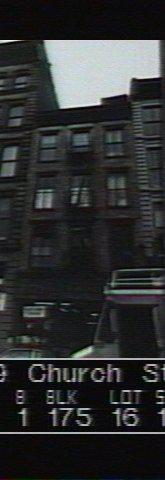
The city photographed every building for its tax records around 1940 and again in the 1980s. NYC Municipal Archives.
Written with AI from the source each entry cites, then fact-checked.
- 1866
Meyer Rosenthal and Betsy Levi build 279 Church Street as one of a matching pair of four-story stores
Built in 1866 for Meyer Rosenthal and Betsy Levi, this building matched its twin at 273 Church Street and replaced a frame dwelling with two frame outbuildings. It is about 25 feet wide and 75 feet deep, faced in brick with molded brownstone lintels and sills that hint at the Italianate style, and a bracketed metal cornice. It was soon let to wholesale dry goods firms, among them William Whiteside, an importer of Irish linen, who had offices here by 1869.
“It was constructed in 1866 for Meyer Rosenthal and Betsy Levi. The building was identical to the building at 273 Church Street…”
- 1888
A forger who cheated a tenant at 279 Church Street escapes his guards by leaving a stuffed dummy in bed
In 1887 George Haywood Carpenter, president of the Brookside Knitting Company, forged bills of lading for $40,000 worth of goods that were never shipped to Foster Black & Company, the underwear makers here, and vanished. He was arrested in Jacksonville, Florida, in January 1888, but guards found only a stuffed figure in his bed the next morning. He was arrested again at his father's home in Chillicothe, Ohio, and returned to New York in June.
Source: Daytonian in Manhattan
- 1905
Patrick Murphy, whose publishing house issued almost only Irish history, buys 279 Church Street
Around 1905 the building was bought by Patrick Murphy, owner of P. Murphy & Son, a publisher whose books dealt almost entirely with Irish history. Its list included Canon John O'Hanlon's Irish-American History of the United States, in two volumes, in 1907, the Atlas of Ireland in 1913 and John O'Hart's Irish Pedigrees in 1915. In 1917 Murphy leased the whole building to the dry goods exporters Standard Mills.
Source: Daytonian in Manhattan
- 1998
A court orders the Harmony Theatre, an adult club on the ground floor of 279 Church, shut after a vice inspection
The Harmony Theatre had occupied the street level since a 1991 conversion, and its storefront was bricked in. After city inspectors who visited in summer 1998 reported nude lap dancing, Justice Stephen G. Crane of State Supreme Court let the city close it, and it was shut on the night of August 3. The next day the club's lawyer told the court the dancers had started wearing tops and bottoms.
Source: Daytonian in Manhattan
- 2004
Collective: Unconscious stages Karen Finley's satire George & Martha at 279 Church Street
After the Harmony Theatre closed, the building became a performance space. Collective: Unconscious, which held at most 74 people, announced Karen Finley's political satire George & Martha for September 17, 2004. Upstairs was an auditorium for bands and plays, and downstairs was the Tank, a non-profit presenting film, comedy, music, dance and theater. The venue left in 2011, about when Slavik Gofman bought the building.
Source: Daytonian in Manhattan
Further reading
- Dry Goods, Irish History, and Lap Dances - 279 Church StreetDaytonian in Manhattan
Nearby
- 281 Church Street5 entries
- 277 Church Street3 entries
- Dream House275 Church Street | 6 entries
- Thomas Barron House39 White Street | 5 entries
- 273 Church Street2 entries
- 41 White Street6 entries