41 White Street
Tribeca | built 1869
Open on the map6 entries

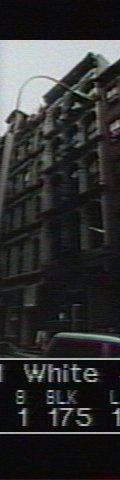
The city photographed every building for its tax records around 1940 and again in the 1980s. NYC Municipal Archives.
Written with AI from the source each entry cites, then fact-checked.
- 1859
Detectives raid a panel-house in the old house at 41 White Street
Before the loft building, a three-story house stood here, home in the 1830s to merchant Joshua Naas. By 1859 Frederick Baumann ran it as furnished lodgings, but the New-York Daily Tribune described it as a panel-house: a brothel where hidden doorways let an accomplice slip in and rob a distracted guest. Detectives raided it early on March 9 and took four people into custody, among them a 17-year-old, Eliza Sinclair. This was an earlier building on the site.
Source: Daytonian in Manhattan
- 1869
Banker Samuel D. Babcock sells his new cast-iron loft building to Andrew T. Hall
Babcock, a banker who turned to real estate development after the Civil War, began a five-story loft building at 41 White Street in 1868. Its architect's name is lost; he faced it in cast iron, blending Italianate and French Second Empire styles, with Corinthian columns at the storefront and between the upper windows. Babcock sold the finished building to Andrew T. Hall on May 15, 1869.
Source: Daytonian in Manhattan
- 1870
Importer Paul Mares, an early tenant at 41 White Street, is arrested for smuggling
Paul Mares, an importing and commission merchant, was among the first tenants of the new building. On March 25, 1870, Detective Applegate arrested him as a participant in a scheme accused of smuggling $500,000 worth of goods into the port over 18 months. He and Isidore Wolff were indicted in May for issuing false invoices, and The Sun reported that after their trial they were freed on bail and escaped to Europe.
Source: Daytonian in Manhattan
- 1986
The Collective for Living Cinema moves into 41 White Street and starts its fall season
In 1986 the Collective for Living Cinema took space here, a sign that the Tribeca renaissance had reached White Street. Its fall season offered a Friday series of in-person appearances by filmmakers, Sunday shows called Expanding Cinema, and a historical series, In Retrospect. It screened work outside the mainstream; on December 16, 1988, for example, it showed Aleksei German's Soviet film My Friend Ivan Lapshin.
Source: Daytonian in Manhattan
- 1991
The Collective for Living Cinema closes at 41 White Street, its last home
The avant-garde film venue began in 1973 at 52 White Street. In the late 1980s legal and financial problems over the building's certificate of occupancy and city codes for movie theaters forced it across the street, to this address. With rising costs, Tribeca's gentrification and cuts in arts funding, it closed in 1991 and passed much of its material to Anthology Film Archives.
“…the Collective closed its doors in 1991, transferring much of its material to Anthology Film Archives. The last home of the Collective, at 41 White Street…”
Source: Wikipedia
- 1996
The Flea Theater is founded and makes 41 White Street its first home
Jim Simpson, Sigourney Weaver, Mac Wellman and Kyle Chepulis founded The Flea Theater in 1996, and its original space was in this building. The company went on to earn early acclaim for The Guys, Anne Nelson's play about the aftermath of September 11, starring Weaver and Bill Murray. It later moved to a larger home on Thomas Street.
“The Flea Theater's original space at 41 White Street in Tribeca. Founded in 1996…”
Source: Wikipedia
Further reading
- From Dry Goods to the Arts - 41 White StreetDaytonian in Manhattan
Nearby
- Thomas Barron House39 White Street | 5 entries
- E. R. Mudge, Sawyer & Co. Building45 White Street | 5 entries
- 279 Church Street5 entries
- 277 Church Street3 entries
- 281 Church Street5 entries
- Dream House275 Church Street | 6 entries