Joseph J. Little Building
28 East 14th Street | Greenwich Village | built 1930
Open on the map6 entries

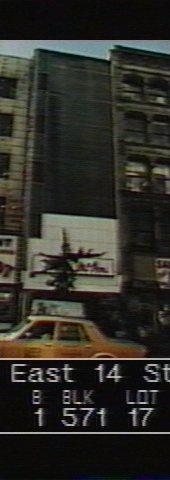
The city photographed every building for its tax records around 1940 and again in the 1980s. NYC Municipal Archives.
Written with AI from the source each entry cites, then fact-checked.
- 1881
Joseph J. Little demolishes Dr. Clarence Cameron's former mansion to build a commercial block
An earlier building on the site was the Union Square mansion of Dr. Clarence Cameron, converted to business use by 1878. In 1881 Joseph J. Little tore it down; he was a partner in a printing firm of about 500 workers, a Civil War first lieutenant, and later president of the Board of Education and a congressman. In January 1881 his architect W. W. Smith filed plans for the five-story replacement.
Source: Daytonian in Manhattan
- 1881
W. W. Smith designs a 25-foot cast-iron front with angled windows that form bays within the building line
William Wheeler Smith, who had recently designed the cast-iron building at 40-42 West 14th Street, gave Little's 25-foot-wide building angled windows that reach the building line yet still read as polygonal bays. Ornamented pilasters frame the second-through-fourth-floor openings, and the top story switches to two bays. The large north-facing windows over Union Square drew artists and manufacturers as tenants.
Source: Village Preservation
- 1881
Little bristles as McCreery's building next door seeks projecting bay windows
As Little's building rose, James McCreery began construction next door at Nos. 22 to 26, and his architects D. & J. Jardine asked the Board of Aldermen to allow projecting bays. The Mayor wrote to the Board on May 28, 1881, rejecting its resolution approving the request, since the owners of Nos. 28 and 30 objected that bays would hurt their plain-fronted stores. Little pointed out that it was McCreery who objected to Little's bays projecting over the property lines.
Source: Daytonian in Manhattan
- 1886
Still-life painter William Harnett lives and works in a studio here until 1889
The Irish-American painter William Michael Harnett, whose trompe-l'oeil still lifes were detailed enough to look nearly photographic, lived and worked in the building from 1886 through 1889. Daytonian in Manhattan credits his Violin and Music, now at the Metropolitan Museum of Art, to the studio here. Other artists in the building included William J. Johnston and John W. Blake, partners in an art dealership.
Source: Daytonian in Manhattan
- 1895
A janitor nearly puts out an arson fire in a third-floor room before the firemen arrive
At 5:15 a.m. on June 14, 1895, janitor Lee Blair saw smoke over the transom of a third-floor room and found old clothes burning in a corner. He pulled the alarm and had nearly put the fire out with pails of water when the firemen arrived. A hole had been chopped in the wall and burnt matches lay on the floor, showing the arsonist had first tried to light the wall itself. The Evening World headlined it an attempt to burn out the artists.
Source: Daytonian in Manhattan
- 1936
The Revolutionary Workers League publishes the Fighting Worker from a building that housed the Communist Party
In 1936 the Revolutionary Workers League was based here and printed its newspaper, the Fighting Worker, on site. Hugo Oehler formed the radical left group, which was active from about 1935 to 1947. Earlier the New York Workers School, set up in October 1923 for what it called true proletarian education, had moved into the building, where Communist Party headquarters already sat.
Source: Village Preservation
Further reading
- W. W. Smith's No. 28 East 14th StreetDaytonian in Manhattan
Nearby
- Baumann Brothers Furniture and Carpets Store22 East 14th Street | 12 entries
- Erskine Press Building17 East 13th Street | 4 entries
- 15 East 13th Street5 entries
- Lincoln Building1 Union Square West | 3 entries
- Spingler Building5 Union Square | 3 entries
- The Jennings Building10 East 14th Street | 7 entries