Erskine Press Building
17 East 13th Street | Greenwich Village | built 1910
Open on the map4 entries

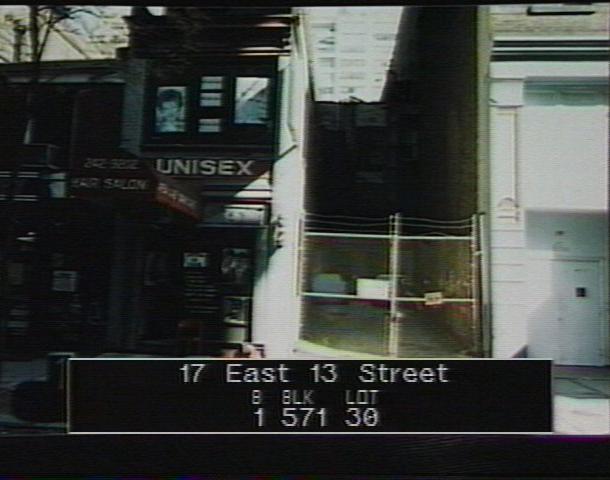
The city photographed every building for its tax records around 1940 and again in the 1980s. NYC Municipal Archives.
Written with AI from the source each entry cites, then fact-checked.
- 1911
The Henschel estate builds a two-story printing shop for Erskine Press
In May 1911 the Henschel estate agrees to put up a new building for Erskine Press at No. 17, replacing the converted dwelling that Butterick Publishing had leased. Architect George Turland Goosey files plans for a two-story structure costing $3,500. His design uses an outdated Italianate style with a bracketed cornice and a facade of storefront windows and red brick. A service alley on the east side lets in extra light.
Source: Daytonian in Manhattan
- 1911
Erskine Press moves into the new building at No. 17
Archibald Erskine, a carpenter who arrived from Scotland around 1867, added a job-printing business, Erskine Press, to his building firm in 1895, at No. 22 across the street. By the time the press moves into the new building he is 81 and retired. His sons Archibald Jr. and George Chambers, involved since about 1897, run it, and the press is listed at the address until 1933.
Source: Daytonian in Manhattan
- 1933
The Villager newspaper moves into the building
In 1933 Walter and Isabel Bryan found The Villager, a weekly newspaper, and move the fledgling operation into No. 17. Its masthead describes a paper that reflects the best traditions of Washington Square and Greenwich Village. By 1944 the paper has moved to roomier quarters.
Source: Daytonian in Manhattan
- 1944
Anais Nin runs her Gemor Press from the building
Writer Anaïs Nin and her partner Gonzalo More, who bought a $75 treadle platen press in 1941, move their Gemor Press into the building in 1944. It has a larger press there and publishes Nin's This Hunger in 1945 along with work by other authors such as Max Ernst. Nin writes that the press collapsed under a mountain of debts, and it leaves East 13th Street in 1946.
Source: Daytonian in Manhattan
Further reading
- The 1911 Erskine Press Building - 17 East 13th StreetDaytonian in Manhattan
- The most charming building on East 13th StreetEphemeral New York
Nearby
- 15 East 13th Street5 entries
- Baumann Brothers Furniture and Carpets Store22 East 14th Street | 12 entries
- Jonathan L. Hyde House22 East 13th Street | 6 entries
- The Jennings Building10 East 14th Street | 7 entries
- G. Gennert Building24 East 13th Street | 6 entries
- Joseph J. Little Building28 East 14th Street | 6 entries