Church Missions House
281 Park Avenue South | also 100 East 22nd Street | Gramercy | built 1894
Open on the map10 entries

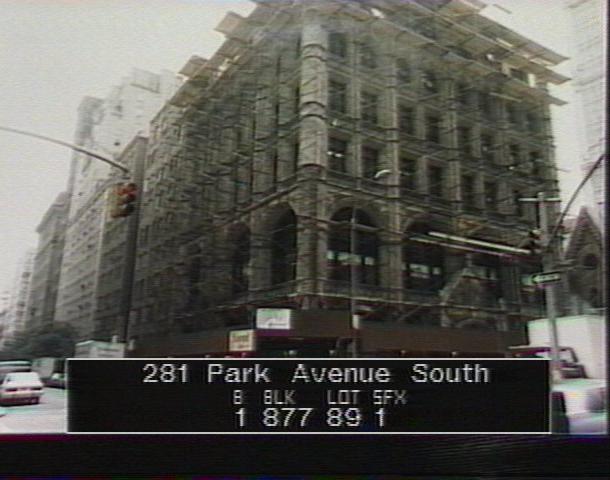
The city photographed every building for its tax records around 1940 and again in the 1980s. NYC Municipal Archives.
Written with AI from the source each entry cites, then fact-checked.
- 1892
J. Pierpont Morgan buys the ASPCA's corner lot and gives it to the Missions Society
Reports in spring 1892 said that J. Pierpont Morgan had bought the neighboring corner parcel of the American Society for the Prevention of Cruelty to Animals, at Fourth Avenue (now Park Avenue South) and 22nd Street, and given it to the Episcopal missionary society. The extra ground let architects Edward J. N. Stent and Robert W. Gibson replace the narrower 1889 scheme, which had sat unbuilt, with a larger design with an 80-foot front on the avenue.
- 1892
The mission house goes up with a steel cage, terra-cotta fireproofing and an elevator
Although it rises only six stories, the Church Missions House combined a steel cage, curtain walls, terra-cotta fireproofing and an elevator, the technology of the new skyscraper style. The Landmarks Commission notes that this came two years before Bruce Price used steel for his 20-story American Surety Building in 1894. Its pale stone skin also anticipated the "pale Gothic wrap" later seen on towers such as the Woolworth Building.
- 1892
Bishop Williams lays the cornerstone of the Church Missions House
On October 3, 1892, Bishop Williams of Connecticut, presiding bishop of the Episcopal Church, laid the cornerstone of the Church Missions House at Fourth Avenue and 22nd Street. Edward J. N. Stent and Robert W. Gibson collaborated on the final design, a steel-framed building in the Flemish style. Cornelius Vanderbilt gave $50,000 toward the cost, and the Morgan family supplied the site, while the total cost grew to about $500,000 against an early estimate of $200,000.
Source: Daytonian in Manhattan
- 1894
Crowds gather to see marble sculptures unveiled above the mission house entrances
On January 17, 1894, hundreds of people gathered at Fourth Avenue and 22nd Street to watch marble sculptures being unveiled above the building's entrances, the last touch on the facade. One group shows St. Augustine preaching to sixth-century Britons and the other shows Samuel Seabury, the first bishop of the American Episcopal Church. They were made from designs by architect Edward J. N. Stent, and the New-York Tribune called the building the city's most striking example of Flemish architecture.
Source: Daytonian in Manhattan
- 1894
The Domestic and Foreign Missionary Society moves into its new headquarters
The Episcopal Church's Domestic and Foreign Missionary Society, founded in Philadelphia in 1821 and based in New York since 1835, moved into the Church Missions House on January 1, 1894. It waited to dedicate the building until its debts were settled, holding the dedication on January 25. The society stayed until moving to new offices in February 1963.
Source: Wikipedia
- 1902
A conference on sweatshop labor meets at the Church Missions House
In 1902 the mission house hosted a sweatshop conference under the Sweatshop Committee of the Church Association for the Advancement of the Interests of Labor. Its stated purpose was to discuss the factory laws in force and the further legislation then contemplated. The Rev. Mr. Morgan reported finding one woman who earned nine cents a dozen finishing boys' knee trousers, and another who earned twelve cents a dozen for the same work.
Source: Daytonian in Manhattan
- 1979
The Landmarks Commission designates the mission house over its owner's objection
The Landmarks Preservation Commission designated the Church Missions House a city landmark on September 11, 1979, after public hearings on May 8 and July 12 of that year. The community board supported designation, while the building's owner spoke against it. The commission praised it as a reminder of the Park Avenue South neighborhood of the 1890s and an early example of steel-frame building.
“The Community Board gave their support in favor of designation. The building's owner spoke in opposition to designation.”
- 1991
A major restoration brings back the mission house's mosaic floors and ornamented ceilings
In 1991 the Federation of Protestant Welfare Agencies, which then occupied the building, began a restoration that cost about $5.5 million. Architects Kappell & Kostow uncovered mosaic marble floors that had been covered in vinyl tile and took out dropped ceilings to reveal the plaster ornament. The work also covered the copper and terra-cotta roof, the leaded stained-glass windows, and the wooden wainscoting and doors.
Source: Daytonian in Manhattan
- 2015
Anna Sorokin, the fake heiress, bids to lease the mission house for her own foundation
When the building was marketed for lease in 2015, one contender was Anna Sorokin, who wanted to lease it to house her planned Anna Delvey Foundation, an art foundation and private members' club. She was indicted for fraud in 2018 after pretending to be a wealthy heiress. The building's popularity rose in the early 2020s when Netflix released the miniseries Inventing Anna about her.
Source: Wikipedia
- 2019
Fotografiska photography museum opens in the old Church Missions House
The Swedish photography museum Fotografiska opened its New York branch in the Church Missions House in December 2019, along with a restaurant run by Stephen Starr. The coronavirus pandemic paused the restaurant a few months after opening. In May 2024 Fotografiska announced it would leave the building, and the museum closed on September 29, 2024.
Source: Wikipedia
Further reading
- Church Missions HouseWikipedia
Nearby
- Calvary Church277 Park Avenue South | 9 entries
- United Charities Building287 Park Avenue South | 3 entries
- Mills & Gibb Building300 Park Avenue South | 4 entries
- James Harper House4 Gramercy Park West | 3 entries
- Madison Square Park Tower45 East 22nd Street | 9 entries
- Gramercy Park Hotel2 Lexington Avenue | 10 entries