Mills & Gibb Building
300 Park Avenue South | also 47 East 22nd Street, 286 Park Avenue South | Flatiron | built 1911
Open on the map4 entries

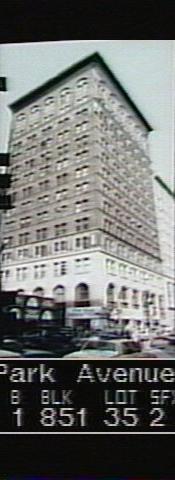
The city photographed every building for its tax records around 1940 and again in the 1980s. NYC Municipal Archives.
Written with AI from the source each entry cites, then fact-checked.
- 1910
Mills & Gibb builds new headquarters on the site of a former church
Dry-goods importers Philo Mills and John Gibb, whose firm had specialized in lace and linen since 1865, erected this 14-story building in 1910 for their own use, on the former site of the Fourth Avenue Presbyterian Church. Architects Starrett & Van Vleck designed it in the Renaissance Revival style with a three-story rusticated limestone base and a double-height arcaded entrance.
Source: Daytonian in Manhattan
- 1913
Publisher Funk & Wagnalls moves into the Mills & Gibb Building
Reference-book publisher Funk & Wagnalls Company took offices in the Mills & Gibb Building starting in 1913, joined over the following decades by publisher E. P. Dutton & Co., the Association for Improving the Condition of the Poor, and the American Red Cross's North Atlantic headquarters during World War II.
Source: Daytonian in Manhattan
- 1959
Fourth Avenue is renamed Park Avenue South
In 1959 the city renamed the stretch of Fourth Avenue running past the building's East 22nd Street corner as Park Avenue South, giving the Mills & Gibb Building its present address. The building continued to house labor, civil-rights and social-service tenants, including the United Federation of Teachers and Planned Parenthood, through the 1960s and 1970s.
Source: Daytonian in Manhattan
- 2010
Rockrose renovates the building into a hub for creative tenants
Rockrose Development Corporation purchased and renovated the century-old Mills & Gibb Building in 2010, preserving Starrett & Van Vleck's original design while updating it for a new generation of office tenants. Within two years the building housed the Smithsonian Institution, the Whitney Museum, modeling agency Wilhelmina, and advertising firm Leo Burnett.
Source: Daytonian in Manhattan
Further reading
- 300 Park Avenue SouthWikipedia
- The 1910 Mills & Gibb Buildilng - 300 Park Avenue SouthDaytonian in Manhattan
Nearby
- Madison Square Park Tower45 East 22nd Street | 9 entries
- United Charities Building287 Park Avenue South | 3 entries
- Church Missions House281 Park Avenue South | 10 entries
- Metropolitan Life Insurance Company Tower1 Madison Avenue | 8 entries
- One Madison23 East 22nd Street | 10 entries
- Calvary Church277 Park Avenue South | 9 entries