282 Bleecker Street
West Village | built 1830
Open on the map5 entries

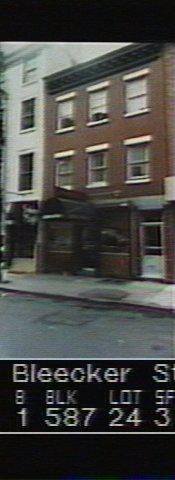
The city photographed every building for its tax records around 1940 and again in the 1980s. NYC Municipal Archives.
Written with AI from the source each entry cites, then fact-checked.
- 1830
Charles Oakley builds a wooden row house with a shop, one of the few frame survivors in the area
Charles Oakley built this house around 1830 as part of his development of Bleecker Street. It was a frame building, and a masonry front was in place by 1891, after architect William Graul supervised alterations in 1886. A new storefront by James Jao & Associates followed in 1992. The Landmarks Preservation Commission counts it among the few frame buildings still standing in the neighborhood.
“No. 282 Bleecker Street is one of the few surviving frame structures in the area.”
- 1894
An explosion and fire hit Henry Carque's candy store, and he is charged with arson
Early on January 16, 1894, a watchman and a policeman saw confectioner Henry Carque enter his shop shortly before a basement explosion and fire. A tenant said he saw Carque flee over a back fence. A sick four-year-old in the building, Joseph Burke, was carried out and died the next day. Carque was arrested on January 22 and charged with arson, after the fire marshal noted that little stock was in the shop but a $3,000 insurance policy was about to expire. He was acquitted after a five-day trial in June.
Source: Daytonian in Manhattan
- 1900
A police sergeant catches a would-be burglar peeping through his keyhole
Police Sergeant James F. Thompson, a tenant, came home for lunch on April 30, 1900 and found a man crouched at his parlor door keyhole. The man claimed he was canvassing for a photography studio, but Thompson found an 18-inch jimmy in his pockets and arrested him. He gave the name John Kelly but was identified as a man who had been sentenced to Sing Sing in 1895 for attempted burglary.
Source: Daytonian in Manhattan
- 1936
Trio French Bakery opens and is praised in the Times for its breads
The Trio French Bakery occupied the store from 1936. In August 1943 Jane Holt wrote in The New York Times that it sold only breads and rolls, with the large ovens behind the shop turning out French, Italian and Viennese loaves, pretzel-salted crescent rolls and poppy seed rolls. Mario Martini and Charles Lazzaro, owners of the bakery's successor, Giovanni Bakery Corp., lived upstairs after 1953.
Source: Daytonian in Manhattan
- 1972
Painter Harold Weston dies in his apartment here
The painter Harold Weston and his wife Faith lived upstairs by the late 1960s. Weston had been president of the Federation of Modern Painters and Sculptors and painted the lobby mural of the Federal Procurement Building in Washington between 1936 and 1938. He died in his apartment on April 11, 1972.
Source: Daytonian in Manhattan
Further reading
- Dry Goods, Candy and Sushi - 282 Bleecker StreetDaytonian in Manhattan
Nearby
- Caliente Cab Restaurant 7 Ave S61 7th Avenue South | 3 entries
- Charles Tousley House280 Bleecker Street | 5 entries
- 57 7th Avenue South2 entries
- 5 Morton Street2 entries
- John's of Bleecker Street272 Bleecker Street | 10 entries
- 7 Morton Street2 entries