291 West 4th Street
West Village | built 1828
Open on the map5 entries

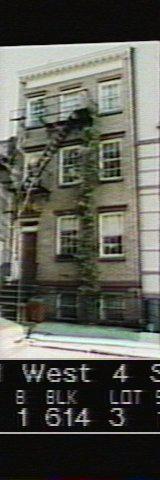
The city photographed every building for its tax records around 1940 and again in the 1980s. NYC Municipal Archives.
Written with AI from the source each entry cites, then fact-checked.
- 1827
Yellow fever refugees spark a building boom that brings a tailor to West 4th Street
After yellow fever swept the city in 1822, anyone who could afford it fled north to Greenwich Village, and speculative rows of houses followed. In 1827 the Bank of New York sold Samuel Z. Smith, a fabric merchant and tailor, the plots on the east side of West 4th Street from the Bank Street corner to No. 291. He put up five 18-foot-wide houses, finished the following year, and No. 291 is the one that remains.
Source: Daytonian in Manhattan
- 1828
No. 291 survives as the last of a row of five Federal houses built for a tailor
The Landmarks Preservation Commission describes this three-story Flemish-bond house as one of five dwellings put up in 1827-28 for Samuel Z. Smith, a tailor and draper. The row once stretched to the Bank Street corner. No. 291 keeps its Federal entry, with columns on either side of the door, and wrought-iron stoop railings; the third story, the sheet-metal window lintels and the cornice were added later.
“…erected in 1827-28 for Samuel Z. Smith as one of a row of five dwellings, which once extended to the Bank Street corner.”
- 1866
Samuel Dodge dies at 84 in the house, one of several family funerals held in its parlor
Samuel Dodge, from an old New England family, lived here in the years before the Civil War. His widowed sister Helen Morris seems to have joined him: her two-year-old daughter Sarah's funeral took place in his parlor in May 1861. Dodge himself died in the house on January 30, 1866, and his funeral was held there too. Five months later Helen's other daughter, Mary Jane Cocks, was also mourned in the same room.
Source: Daytonian in Manhattan
- 1907
Henry Thole's estate auction sells No. 291 to developer John Paul Hoffman
Henry Thole owned numerous Greenwich Village properties, and he most probably raised No. 291 to a full third floor. After his death, 17 of his Village properties were auctioned on June 11, 1907, and John Paul Hoffman bought this one. Hoffman had already replaced the neighboring Nos. 287 and 289 with an apartment building. He kept the little house and sold it in 1920 to Liberale and Theresa Bergano.
Source: Daytonian in Manhattan
- 1922
A cab driver who lodges here is held up by a fare with a toy glass pistol
Frank McDermitt, a cab driver renting a room in the house in 1922, picked up William Buckworth, a 25-year-old Liverpool-born clerk on the HMS Fort Victorian, a ship anchored off 95th Street. When the taxi broke down near 22nd Street and Seventh Avenue, Buckworth ordered him to put his hands up with a pistol made of glass. McDermitt saw through the ruse, and Buckworth spent the night in the 13th Street station house.
Source: Daytonian in Manhattan
Further reading
- The Samuel Dodge House - No. 291 West 4th StreetDaytonian in Manhattan
- Then & Now photos: 291 West 4th StreetVillage Preservation: Greenwich Village Then & Now
Nearby
- 48 Bank Street1 entry
- 46 Bank Street1 entry
- 251 West 11th Street6 entries
- 42 Bank Street2 entries
- 56 Bank Street2 entries
- 58 Bank Street1 entry