Stephen Wise Free Synagogue
30 West 68th Street | Lincoln Square | built 1922
Open on the map8 entries

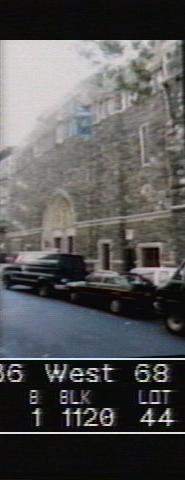
The city photographed every building for its tax records around 1940 and again in the 1980s. NYC Municipal Archives.
Written with AI from the source each entry cites, then fact-checked.
- 1911
The Free Synagogue buys three brownstones on West 68th Street for a permanent home
By 1911 the Free Synagogue, which had started out in the Hudson Theater, had grown to 500 members. That year it bought three brownstones on West 68th Street. The houses served the congregation's school and administration, and from 1913 a mental hygiene clinic. The synagogue went on to acquire several other old houses along the block.
Source: landmarkwest.org
- 1922
Eisendrath & Horowitz design a stone synagogue that looks like a medieval fortress
In March 1922 Stone magazine reported that the Free Synagogue was planning a $250,000 synagogue on West 68th Street. The trustees hired the firm of Eisendrath & Horowitz, which clad the building entirely in undressed stone and added Gothic touches in the arched entrance and in a statuary niche on the upper floor. It was finished before the year ended, and the historian Tom Miller describes it as resembling a medieval fortress.
Source: landmarkwest.org
- 1949
The congregation votes to add Stephen Wise's name a month after his death
Rabbi Stephen Wise had led the congregation since founding it in 1907, and he died on April 19, 1949. He had chosen Rabbi Edward E. Klein to follow him. When the congregation met that May, members voted unanimously to put Wise's name into the formal title, turning the Free Synagogue into the Stephen Wise Free Synagogue.
“At a meeting of the congregation in May 1949, members voted unanimously to incorporate Rabbi Wise's name into the formal name of the congregation.”
Source: Wikipedia
- 1971
One hundred Catholic and Protestant children join 400 Jewish children at a model seder
The synagogue began an annual interfaith Passover seder for children in 1957. The New York Times reported on April 5, 1971, that 100 black and white Roman Catholic and Protestant children had sat at tables with 400 Jewish children the morning before. Rabbi Edward E. Klein explained that Passover is a festival of freedom that, more broadly, stands for religious freedom for people of every faith.
Source: landmarkwest.org
- 1972
The synagogue hires Sally Priesand, the first female rabbi in America, as assistant rabbi
In August 1972 the congregation made history by hiring Sally J. Priesand as assistant to Rabbi Edward E. Klein, the first woman in America to hold the title of rabbi. The New York Times reported that her duties would include preaching, teaching, and officiating at weddings and funerals.
Source: landmarkwest.org
- 1978
Rabbi Klein returns to the pulpit in a wheelchair after a stroke
Rabbi Edward Klein suffered a stroke in 1978. Associate Rabbi Sally Priesand guided the congregation through his return to the pulpit in a wheelchair on September 30, 1978. Priesand left the following year, and Rabbi Balfour Brickner soon arrived from Washington, DC.
“When Rabbi Klein had a stroke in 1978, she led this house through his return to the pulpit in his wheelchair on September 30, 1978.”
Source: Wikipedia
- 1983
The synagogue opens the first on-site homeless shelter in a New York City synagogue
In 1983 Stephen Wise Free Synagogue became the first synagogue in New York City to open a homeless shelter on its own premises. A few months earlier, Mayor Ed Koch had given a speech in the building urging religious communities to take up the problem of homelessness.
Source: swfs.org
- 2009
Rabbi Capers Funnye leads a Martin Luther King Day service as African-American Jews fill a quarter of the room
On Martin Luther King Day in 2009 the pulpit went to Rabbi Capers Funnye, chief rabbi of Chicago's Beth Shalom B'nai Zaken Ethiopian Hebrew Congregation. The New York Times reported about 700 people attended, roughly a quarter of them African-American Jews from Brooklyn, the Bronx and Queens, many in a mostly white synagogue for the first time. The Funnyes passed up an invitation to the presidential inauguration to attend, and Joshua Nelson's Kosher Gospel Band provided the music.
Source: landmarkwest.org
Further reading
- Stephen Wise Free SynagogueWikipedia
Nearby
- York Preparatory School40 West 68th Street | 4 entries
- 67th Street Studios27 West 67th Street | 4 entries
- Hotel des Artistes11 West 67th Street | 7 entries
- The Brentmore88 Central Park West | 9 entries
- Congregation Shearith Israel2 West 70th Street | 7 entries
- First Battery Armory56 West 66th Street | 13 entries