301 West 4th Street
also 41 Bank Street | West Village | built 1910
Open on the map6 entries

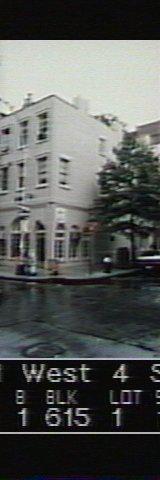
The city photographed every building for its tax records around 1940 and again in the 1980s. NYC Municipal Archives.
Written with AI from the source each entry cites, then fact-checked.
- 1836
Hay carter Alfred Carhart has the corner house built, and later becomes a State Assemblyman
No. 301 was the corner house of a block of houses built in 1836, put up for Alfred Carhart, a hay carter who lived at No. 28 Fourth Street. Carhart later served as an Inspector for the U.S. Customs and as a member of the State Assembly. The brickwork and chimneys still show the outline of the gable-ended house it was before its top floor was raised.
- 1891
John S. Mortimer buys the corner house and turns its store into a saloon
In April 1890 James W. Ketcham paid $24,000 for the house-and-store here, together with a stable at the rear, and raised its peaked attic to a full third floor. A year later, on April 4, 1891, he sold it to John S. Mortimer. Mortimer converted the store into a saloon, tore down the stable and built a one-story extension at 41 Bank Street to serve as the residential entrance to the upper floors.
Source: Daytonian in Manhattan
- 1895
A stable owner is found unconscious at the saloon's side door and dies, wallet missing
In August 1895 Patrick McIntyre, the well-off proprietor of the Tally-Ho Stables, which stood on West 15th Street, was found unconscious on a Sunday morning at the side entrance of John Mortimer's saloon at 41 Bank Street. He died shortly afterward. His son said he had left home with considerable money, and his wallet was missing, but according to the New York Times the police found no evidence of foul play.
Source: Daytonian in Manhattan
- 1905
A fire at 41 Bank Street sends fire engines racing and leaves two men in a runabout with broken bones
Fire broke out at 41 Bank Street on December 6, 1905, and the damage there was minimal. The response was another matter: according to the Evening Post, Engine No. 72's tender smashed into a runabout at 12th Street and Fifth Avenue, injuring Henry Cherry and James McGuire, who were riding in it and suffered broken bones and contusions. The battalion chief's wagon also knocked down and bruised an elderly woman at Bleecker and Bank Streets.
Source: Daytonian in Manhattan
- 1928
Stuyvesant Wainwright remodels the corner and its neighbors as a group called Rosebank
In 1922 the Mortimer family sold the corner house, along with 41 Bank Street, to Stuyvesant Wainwright, who around then also purchased 39 Bank Street and 303 and 305 West 4th Street. In 1928 the New York Times reported that he had remodeled the properties in an artistic manner and given the group the name Rosebank.
Source: Daytonian in Manhattan
- 1928
The 41 Bank Street entrance gets a Federal doorway like those at 327 and 329 West 4th
The little extension at 41 Bank Street has a distinctive Federal doorway that was most likely installed around 1928, when the Rosebank remodeling took place. It is nearly identical to the entrances at 327 and 329 West 4th Street, built in 1829, and was probably taken from another house in the neighborhood. The original eight-paneled door sits between fluted Ionic columns and half-columns, with narrow sidelights and egg-and-dart carving below the cornice.
Source: Daytonian in Manhattan
Further reading
- The Puzzling Anomaly at 41 Bank Street Daytonian in Manhattan
- Then & Now photos: 301 West 4th StreetVillage Preservation: Greenwich Village Then & Now
Nearby
- 37 Bank Street1 entry
- 51 Bank Street1 entry
- 33 Bank Street1 entry
- 48 Bank Street1 entry
- 55 Bank Street1 entry
- 313 West 4th Street5 entries