Third County Courthouse
302 Center Street | also 395 Center Street | Lighthouse Hill | built 1837
Open on the map4 entries

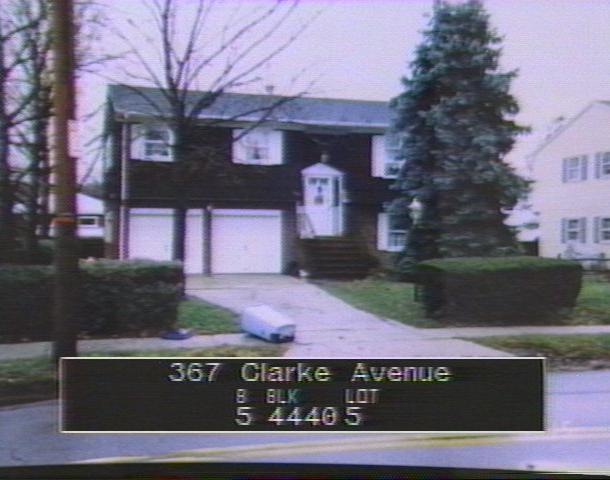
The city photographed every building for its tax records around 1940 and again in the 1980s. NYC Municipal Archives.
Written with AI from the source each entry cites, then fact-checked.
- 1837
Developer Henry I. Seaman gives the county a Center Street lot for a new courthouse
In 1836 New York merchant Henry I. Seaman bought ninety acres of farmland east of Richmondtown's center and laid out Center Street and Court Place. In April 1837 he gave the county a large lot on Center Street facing Court Place, on condition that a new courthouse be built there promptly. The gift anchored his development and kept the county government in the village for years to come.
“In April 1837, Seaman donated a large plot on Center Street opposite Court Place to the county on condition that a new courthouse…”
- 1837
The Greek Revival Third County Courthouse rises on newly opened Center Street
The Third County Courthouse, completed in 1837, is a Greek Revival building with a pedimented portico of giant Doric columns and a square tower decorated with pilasters. That August the Richmond County Mirror reported that seven small houses had been built along the newly opened Center Street and said that they and the new court house made the village look more businesslike.
“…the new (Third) County Courthouse (1837) was a Greek Revival building, distinguished by its pedimented portico with giant Doric columns and square tower…”
- 1844
Polly Bodine stands trial here in a sensational double-murder case
In 1844 the courthouse held the crowded trial of Polly Bodine, charged with killing her husband's sister and a niece and torching their house. Edgar Allan Poe and P. T. Barnum were among those who commented on the case. The trial ended in a hung jury, and in an early change of venue the case moved to Manhattan, where a conviction was later overturned, and then to Newburgh, where Bodine was acquitted.
“The building was the site of the sensational 1844 trial of Polly Bodine, who was accused of murdering her husband's sister and niece…”
Source: Wikipedia
- 1919
County offices move to St. George, leaving the old courthouse empty
By 1919 the last county offices in Richmondtown had been moved to St. George and the village's old county buildings, the courthouse among them, were abandoned. In the early 1930s the city agreed at the urging of the Staten Island Historical Society (founded 1856) to pay for rehabilitating the empty County Court House and County Clerk's Office as the society's library and museum.
“…the last county offices located in Richmondtown were transferred to St. George, and the old county buildings were abandoned.”
Further reading
Nearby
- Britton Cottage1001 Richmond Hill Road | 6 entries
- Guyon-Lake-Tysen House3737 Richmond Road | 5 entries
- Boehm House43 Arthur Kill Road | 2 entries
- Voorlezer's House59 Arthur Kill Road | 7 entries
- St. Patrick's Church256 Center Street | 3 entries
- Stephens-Prier House3672 Richmond Road | 5 entries