Voorlezer's House
59 Arthur Kill Road | also 3961 Arthur Kill Road | Lighthouse Hill | built 1931
Open on the map7 entries

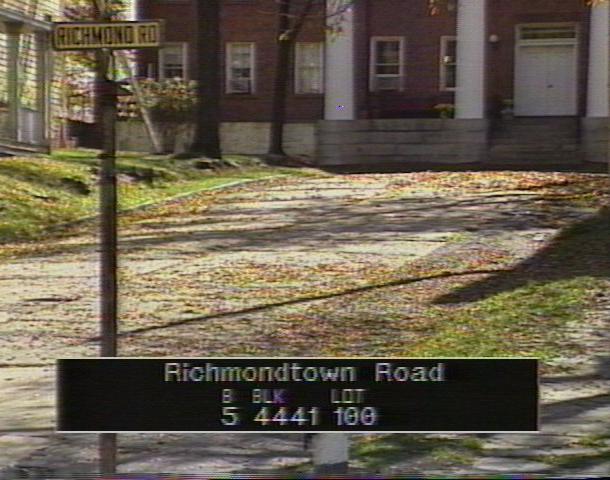
The city photographed every building for its tax records around 1940 and again in the 1980s. NYC Municipal Archives.
Written with AI from the source each entry cites, then fact-checked.
- 1696
Voorlezer Hendrick Kroesen occupies the site in an earlier building
Hendrick Kroesen, a voorlezer, lived on this site from 1696 to 1701. In New Netherland a voorlezer was a lay official who might assist a pastor, lead services and read scripture, or run a school. The building Kroesen lived in was probably lost early in the 1700s; the house standing now came later.
“Voorlezer Hendrick Kroesen only occupied the site from 1696 until 1701. The structure inhabited by Kroesen during this period was likely lost…”
Source: Wikipedia
- 1760
Jacob Rezeau probably builds the present house in the 1760s
Although long dated to before 1696, the present house was more likely put up in the mid-1700s, most likely the work of Jacob Rezeau during the 1760s; the Rezeau family had owned the land since 1705. It is a Dutch-influenced vernacular house with two-foot-thick foundation walls of rough fieldstone, oak and whitewood timbers hewn with a broadaxe, and a front wall two feet taller than the back, which gives the roof its uneven pitch.
Source: Wikipedia
- 1883
Solomon Rosenberg opens a store here, later running it as the Arlington Hotel
The Rezeau family farmed here until 1793 and the Van Pelt family until 1871. In 1883 Solomon Rosenberg and his family moved in, living in the house and keeping a store in it. From 1893 to 1924 the Rosenbergs ran the building as a hotel and saloon called the Arlington Hotel.
Source: Wikipedia
- 1925
Restaurateur Nicholas George runs the Acorn Inn in the old house
From 1925 to 1938 restaurateur and tavern keeper Nicholas George lived in the house and ran it as the Acorn Inn. He was the last occupant on record before the building was given to the Staten Island Historical Society in 1939.
“1925-1938: Nicholas George; restaurateur, tavern keeper (Acorn Inn), residence…”
Source: Wikipedia
- 1939
Mrs. T. Livingston Kennedy gives the threatened house to the Staten Island Historical Society
By 1936 the long-maintained house had decayed and was in danger of demolition. In 1939 Mrs. T. Livingston Kennedy donated it to the Staten Island Historical Society, which restored it to how it was thought to have looked around 1700. The society still owns and operates the house.
“1939: Structure donated to Staten Island Historical Society by Mrs. T. Livingston Kennedy…”
Source: Wikipedia
- 1942
The restored Voorlezer's House opens to visitors as an early schoolhouse
The restored house welcomed its first visitors on April 14, 1942. For a long time it was considered the country's oldest surviving schoolhouse, though it is unclear whether the present building ever held a school. Its large second-floor room, framed with an extra set of floor beams to hold many people, is thought to be where the school met.
“It was first opened to the public on April 14, 1942…”
Source: Wikipedia
- 1981
The house closes for a major restoration, reopening in 1985
In 1981 the Voorlezer's House closed for major work to stabilize the structure while keeping as much original material as it could. Workers restored the kitchen and installed leaded casement windows to better match a building of about 1696. The house reopened to the public on June 27, 1985.
“In 1981, the building was closed for major renovation to stabilize the structure while retaining as much of its historic fabric as possible.”
Source: Wikipedia
Further reading
- Voorlezer's HouseWikipedia
Nearby
- Boehm House43 Arthur Kill Road | 2 entries
- Britton Cottage1001 Richmond Hill Road | 6 entries
- Third County Courthouse302 Center Street | 4 entries
- Church of St. Andrew5 Arthur Kill Road | 7 entries
- Guyon-Lake-Tysen House3737 Richmond Road | 5 entries
- Stephens-Prier House3672 Richmond Road | 5 entries