Mutual Reserve Building
305 Broadway | also 91 Duane Street | Tribeca | built 1894
Open on the map9 entries

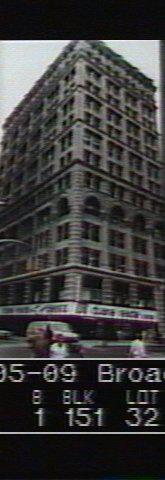
The city photographed every building for its tax records around 1940 and again in the 1980s. NYC Municipal Archives.
Written with AI from the source each entry cites, then fact-checked.
- 1888
The Weld estate buys the Broadway and Duane Street corner for $350,000
William Fletcher Weld, a Boston shipping magnate and shipbuilder who died in 1881, left an estate of about $21 million that passed largely to four grandchildren. In May 1888 the estate bought the lot at the northwest corner of Broadway and Duane Street for $350,000 and added a tiny adjoining interior lot in 1890. It commissioned a speculative office building there in 1892, and the Weld family kept the property until 1920.
- 1893
The Arkwright Club and a cluster of paper and publishing firms take offices in the tower
While the building was still under construction, the Arkwright Club, a club for dry goods merchants, leased one of the top stories in 1893 for $90,000, with the lease running to 1899. The location near the newspaper and publishing district also drew paper and publishing firms, among them Hubbell Publishing and the West Virginia Pulp & Paper Co. Another tenant from about 1905 to 1914 was Hapgoods, described as the "National Organization of Brain Brokers."
- 1894
The steel-cage Mutual Reserve Building is dedicated after strikes slow construction
Architect William H. Hume filed plans for the 13-story building in June 1892, and work began at the end of that month. The builder, Richard Deeves, said he lost at least eight months to a strike at the Carnegie steelworks, and a granite strike also slowed the job. Frederick H. Kindl of Carnegie Steel was the consulting engineer for the steel-cage frame. The building was dedicated on June 14, 1894, and officially finished that September.
- 1896
Reports of falling business and drained reserves dog the Mutual Reserve Association
The Mutual Reserve Fund Life Association had $225 million of insurance in force in 1892 and $300 million by 1895, the year its founder and president Edward B. Harper died. By 1896 reports said business was dropping, reserves were shrinking and executive salaries were too high. The company was reincorporated in 1902, but complaints continued, and its president and vice-president were later indicted. By 1911 it was gone.
- 1904
A burlap dealer falls nine floors down an elevator shaft in the Mutual Reserve Building
On July 21, 1904, William B. Cunningham, a 50-year-old burlap dealer, opened an elevator gate while the car was above him, lost his balance and fell nine floors to his death. A second fall followed on August 11, 1908, when August Does, a 45-year-old delicatessen owner, jumped for the gate as the car passed his floor and fell nine stories. The elevator operator was arrested. Both men fell in a building that had opened in 1894.
Source: Daytonian in Manhattan
- 1908
Former Mutual Reserve president Frederick A. Burnham is found dead in his bed from gas
Frederick A. Burnham, who had led the Mutual Reserve, was under indictment for grand larceny and forgery when he died. On December 23, 1908, he was found dead in his bed, overcome by gas, and the first reports called it a probable suicide. The Mutual Reserve, the building's main tenant, was already in receivership and collapsing under scandal.
Source: Daytonian in Manhattan
- 1920
Lawyers crowd into 305 Broadway, which earns the nickname "Den of Forty Thieves"
In 1920 the Broadway-John Street Corp. bought the building for about $2 million, planning to remodel it as offices for lawyers pushed out of the financial district by high rents. Lawyers already renting there formed an Office Tenants League to protest. Two authors later wrote that the building had a poor name in the legal world, one calling it a law office slum and the "Den of Forty Thieves," the other placing it among the centers of the faked personal injury trade in the 1920s.
“…the structure was regarded as a law office slum. The other called the building one of the centers in the 1920s of the faked American "personal injury underworld.”
- 1922
Earle Liederman's Progressive Exerciser Co. runs a mail-order fitness business here
From 1922 to 1930 the building was home to Earle E. Liederman and his Progressive Exerciser Co., which the landmark report describes as an early physical culture mail-order business. Other tenants of the period included the Wall Street Synagogue in 1929, and by 1950 the building had begun to house state government agencies.
- 1967
The Landmarks Preservation Commission makes the building its first long-term headquarters
The city agency that designates landmarks rented space at 305 Broadway from 1967 to 1980, which made the building its first long-term home. The commission later designated the Mutual Reserve Building and its lot as a landmark, in a report dated December 20, 2011.
Further reading
- Mutual Reserve BuildingWikipedia
Nearby
- 311 Broadway Building311 Broadway | 12 entries
- 315 Broadway Building315 Broadway | 8 entries
- David S. Brown Store8 Thomas Street | 4 entries
- 319 Broadway (one of the Thomas Twins)319 Broadway | 7 entries
- Engine Company 7 / Hook & Ladder Company 1 Firehouse104 Duane Street | 5 entries
- Mason Brothers Building108 Duane Street | 5 entries